WWU turns away homeless encampment removed from Laurel Park by city of Bellingham
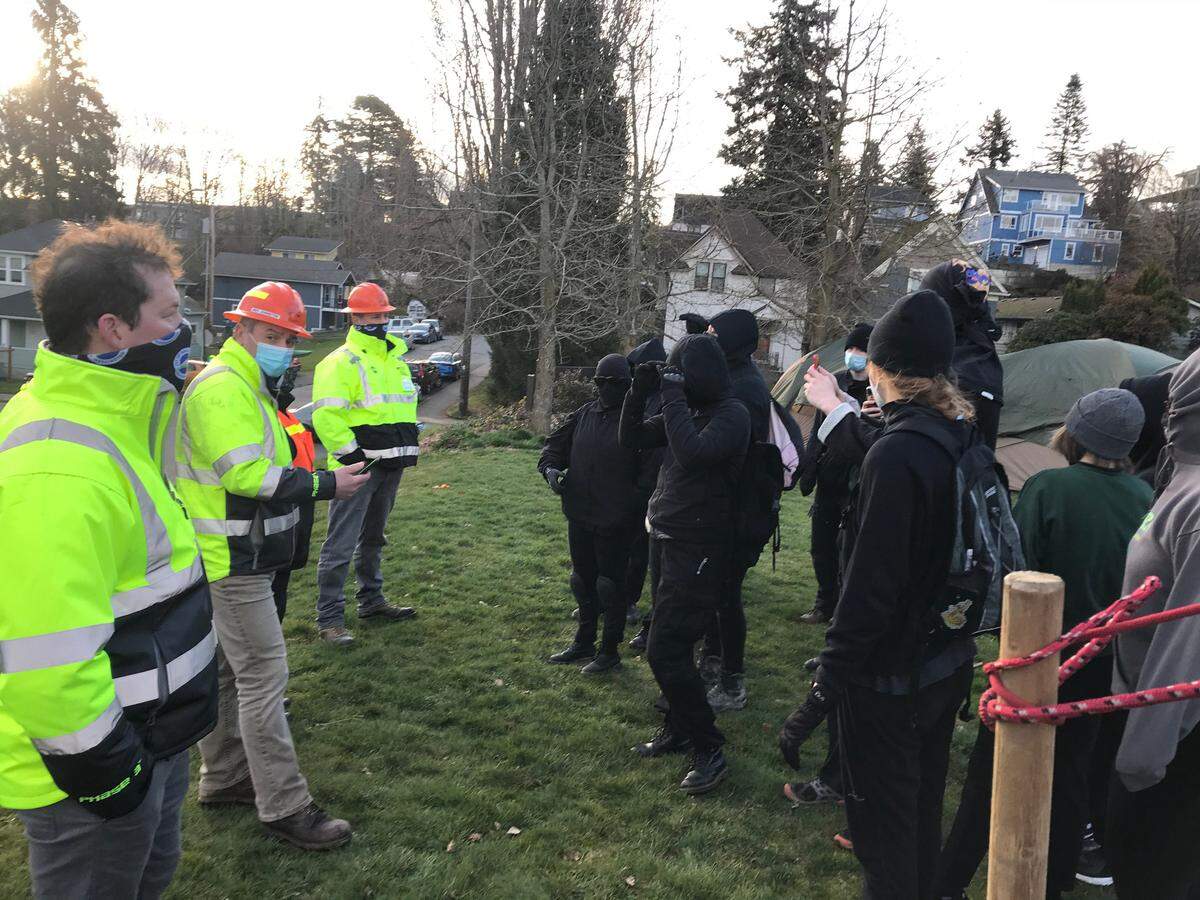
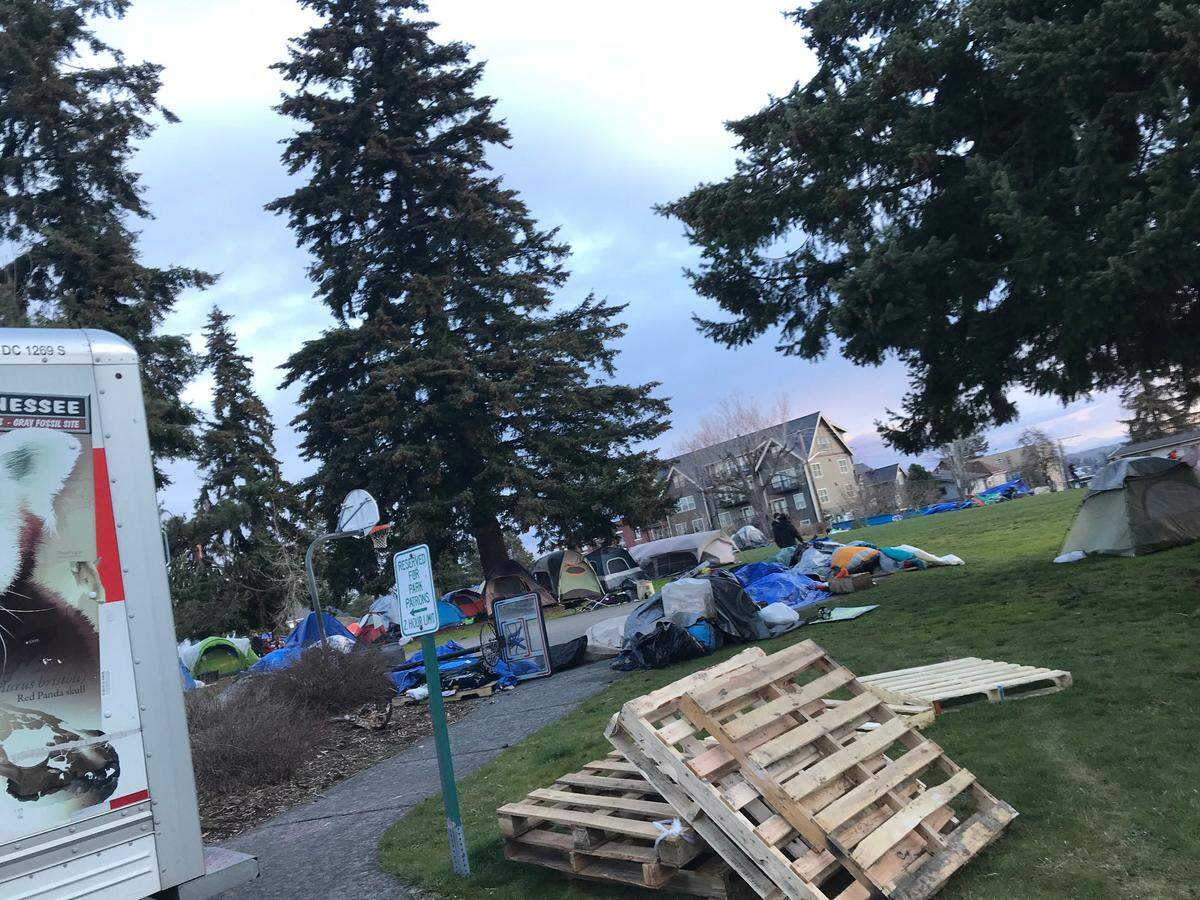
Volunteers helped homeless residents remove a tent encampment at Laurel Park in the Sehome Hill neighborhood Friday morning, March 19, as workers from Bellingham Public Works and Parks and Recreation stood by.
At noon Saturday, March 20, about a dozen tents were seen at Laurel Park.
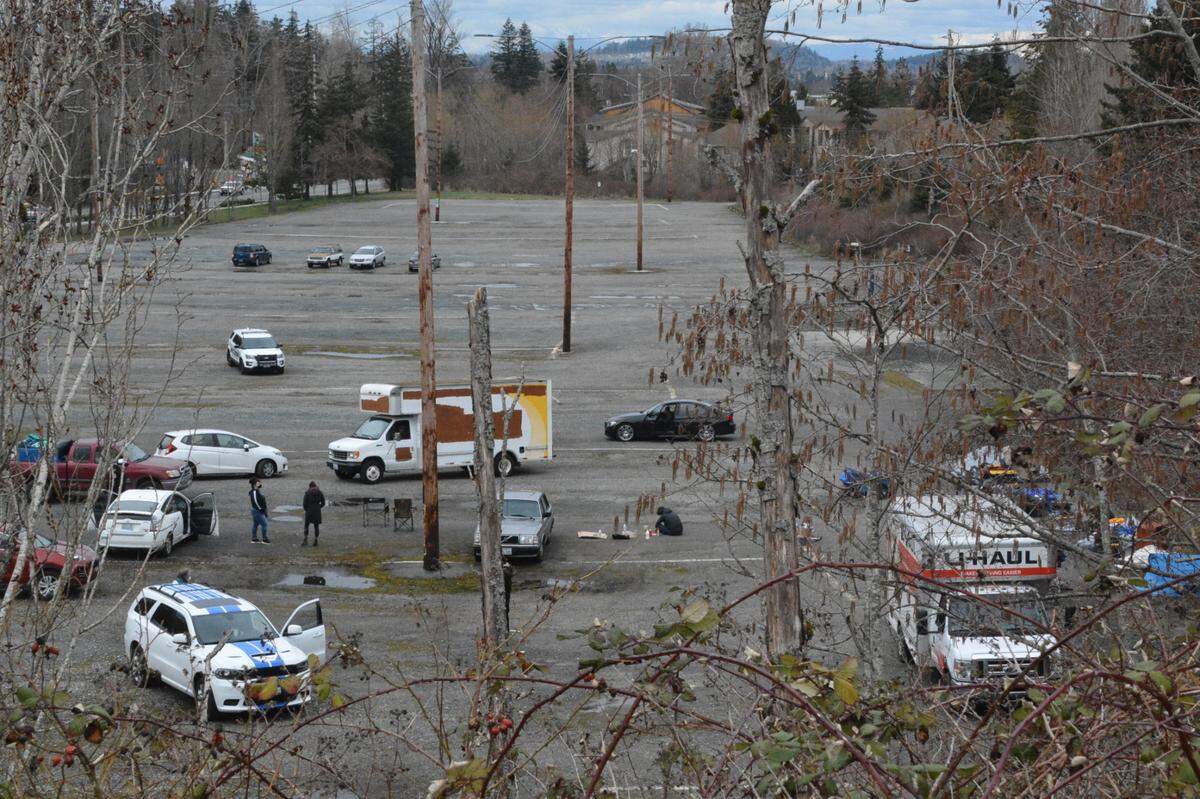
Friday afternoon, protesters attempted to move the camp to Western Washington University’s Lincoln Creek Park & Ride.
“We are asking the potential campers to move and not set up a camp at the park and ride. The parking lot is not appropriate for camping and in fact is prohibited,” Paul Cocke, director of the WWU Office of University Communications told The Bellingham Herald in an email.
Several police cars were in the parking lot where protesters hung signs on the fence.
By 6 p.m., the people had left the parking lot, according to the university.
Earlier, about a dozen or so black-clad protesters showed up, shouting vulgarities at workers about the lack of shelters for homeless people. They again attempted to stop The Herald from documenting the scene, even as the protesters live-streamed on Instagram, showing the faces of reporters and city officials.
They yelled homophobic and misogynistic language toward city officials and news media at the scene.
The protesters asked for more time for the camp to move.
Director of Parks & Recreation Nicole Oliver and Public Works Director Eric Johnston spoke with the protesters. Johnston reiterated that “it is illegal to camp in a city park.
“Today is the day that this group needs to leave Laurel Park,” Johnston said.
During the standoff with protesters and city officials, volunteers and homeless people continued to pack belongings. Parks staff and several Bellingham Police officers waited around the park’s perimeter. After an hour, protesters began to help other volunteers with the move.
.jpg "DSC_4368 (1).jpg")
Oliver said city works would wait until campers moved their belongings.
“As long as they are moving, we are standing by,” Oliver told The Herald. “We don’t want a confrontation with police, the mayor’s been pretty clear about that.”
One person from the Laurel Park encampment sought shelter Thursday at Base Camp, an overnight emergency shelter run by Lighthouse Mission Ministries, Oliver said.
“There continues to be room at Base Camp, and we’re happy to store people’s belongings,” she said.
Base Camp received two people from Laurel Park Friday, according to Hans Erchinger-Davis, executive director of Lighthouse Mission Ministries.
Base Camp’s 142 people overnight Thursday was nine more than Wednesday night. But the shelter still had room for 48 more people, Erchinger-Davis said.
Homeless advocate Markis Stidham arrived with a box truck donated to Serenity Outreach Services to help campers move.
Stidham, who is on the Serenity Outreach Services board and an appointed member of the Whatcom County Homeless Strategies Workgroup, said he can’t speak for the collective operating and assisting the encampment.
“It was a waste of time, money and energy to justify a sweep during a pandemic,” Stidham told The Herald.
.jpg "DSC_4441 (2).jpg")
He described a “foursquare plan” for an encampment of 100 tiny homes or “pallet shelters” such as those already in use at Unity Village and Swift Haven, arranged around a central building with a kitchen, showers and toilets, and offices for service providers.
“We are seeking space on private property because the city has been a bad-faith partner,” Stidham said. “There’s no credibility with them from the campers’ perspective.”
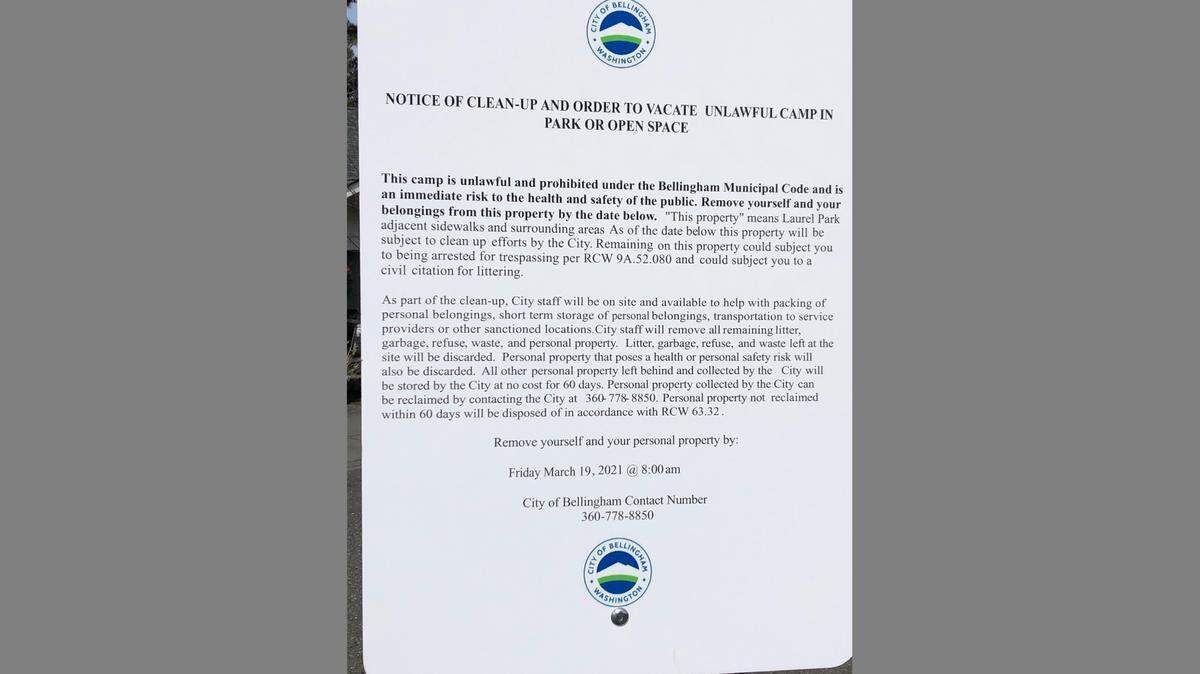
On Tuesday afternoon, March 16, the city posted a legal notice saying the camp at Laurel Park is “unlawful and prohibited” under the city’s code and is “an immediate risk to the health and safety of the public.” The notice stated people had until 8 a.m. on Friday, March 19, to remove themselves and their belongings from the area.
If people don’t leave, they could be arrested for trespassing and receive a civil citation for littering, the notice states.
Campers moved to Laurel Park last weekend as the city planned to dismantle a homeless tent encampment in the lower parking lot of Frank Geri Softball Fields Tuesday morning. City officials cleared about two dozen people from that Puget neighborhood encampment.
By Wednesday morning, March 17, roughly 30 tents had been set up at Laurel Park. Signs were put up by campers stating “Administrative accountability now,” “City Council stop criminalizing homelessness” and “Pandemic emergency — where do displaced citizens go.”
Since the campers moved to Laurel Park, police had received at least 49 complaints by Wednesday evening, Bellingham Police Lt. Claudia Murphy said for another Herald story.
“Many of the reports are about concerns for safety of the neighborhood residents, health hazards, fire hazards, increase in thefts (beer stolen from one citizen as they were unloading their groceries), open-air urinating and defecating, an increase in garbage in the neighborhood, and the inability for the neighborhood kids to use the playground/park,” Murphy said.
Volunteers were told by police officers at Laurel Park Friday morning to take the camp residents to the Lincoln Creek Park & Ride as a potential place for the tent encampment to set up, according to Bill Schenken, who is a homeless advocate working with the residents of the encampment.
Brian Heinrich, deputy administrator for the city, told The Herald police did not tell people to go to the Lincoln Street transportation center. “The only suggestion we make is the campers utilize the services that are available to them,” he said.
The tent encampment had attempted to move to Maritime Heritage Park but was immediately asked by Bellingham police to leave, Schenken said. The residents of the tent encampment want to stay together, but they didn’t know where they could go, Schenken said.
“The community of the camp gives them the best chance to survive, but we have no place to go now,” Schenken said. “If our unsheltered neighbors don’t have support, they’re slowly being murdered.”
Schenken said the people who are falling “through the net” are at risk of dying from malnutrition, disease and exposure.
“Our unsheltered neighbors are not the easiest, but they’re still human beings and have a right to be alive on this planet and in our community — and what the city is doing is denying them that basic human right,” Schenken said.
Mayor Seth Fleetwood disputed Schenken’s claims in an email to The Herald Saturday, March 20.
“Our actions are publicly known and well documented. We made a good faith offer to the Collective (of which Schenken was an active member) that included a Port of Bellingham location, 25 tiny homes purchased by the county, low barrier status, and reasonable conditions by the city with funding for credentialed professionals,” Fleetwood said.
“This was rejected by the Collective. Had they accepted this offer, it would have been operational two months ago. Work to prepare this proposal was in addition to the city fast-tracking a new tiny home village, Swift Haven, operated by Homes Now, and in addition to our work with Low Income Housing Institute and Road2Home on another tiny home village planned this spring.
“This was in addition to our support for Base Camp. This was in addition to tolerating two large unauthorized encampments while exploring potential new options. And of course, this was in addition to the approximately $10 million the city and Whatcom County invest annually to provide permanent housing solutions, respond to the need for emergency shelter, and address the root causes of homelessness.”
City staff was aware the residents of the encampment may try to establish another camp in other parks, Heinrich said in a statement sent Friday to The Herald.
.jpg "DSC_4390 (1).jpg")
“We monitored the situation and discouraged that activity,” Heinrich said.
While it is not required under the city’s municipal code to give residents of a homeless tent encampment notice, city officials usually provide 72 hours advance notice to leave, he said.
“The notice requirements to leave begin when camping has been established,” Heinrich said.
There are reasonable alternatives for shelter that are immediately available at Base Camp and other shelters and the city is encouraging people staying at Laurel Park to use those services, according to Heinrich.
“Others may return to dispersed small encampments located throughout our community, prior to organizers efforts to consolidate campers in public places there were over 100 encampments throughout the city which we did not enforce against,” Heinrich said in an emailed statement Thursday, March 18, to The Herald.
Heinrich said illegal encampments won’t be allowed and the city will continue to enforce its code against camping in public parks.
Following guidance
Advocates for the homeless people at the encampment and several organizations condemning the repeated removal of the camps have said the city’s actions don’t follow the U.S. Centers for Disease Control and Prevention interim guidance for service providers and local officials regarding homeless encampments during the COVID-19 pandemic.
The guidance says partners and providers should be involved in helping homeless people stay safe during the pandemic, and that people who are living unsheltered or in encampments should be allowed to remain where they are.
But the city says that the volunteers didn’t follow CDC guidelines when they encouraged the congregation of unsheltered community members into the large camps that have moved from downtown Bellingham to the Puget neighborhood and now to the Sehome neighborhood, Heinrich said.
“Their actions have increased the risk of transmission by consolidating many small encampments into a single location,” he said.
The city also said its actions don’t violate a 9th U.S. Circuit Court of Appeals ruling that states cities can’t prosecute people for sleeping outside if they have no other reasonable place to be. Heinrich said there is available shelter space, but whether people staying at the encampments choose to use it is their own discretion.
“Although Bellingham chooses to support a diverse network of shelters serving many populations, it is not required by this decision to provide unsheltered community members their preferred choice of shelter,” Heinrich said. “The city prefers that efforts be directed towards finding additional housing solutions. While Bellingham is a very tolerant and accepting community, the use of misinformation, violence, vandalism and intimidation undermines the ideals promoted by advocates.”
Homeless solutions
The city and county health department spend roughly $5 million each per year on contracts with providers who offer services to help and prevent homelessness, Heinrich said. The city and county are working together to provide permanent housing solutions, respond to emergency shelter needs and address root causes of homelessness, he said.
“Affordable housing and homelessness are top concerns in our community and safe, stable housing is the foundation upon which people build their lives,” Mayor Seth Fleetwood said in a prepared statement sent Thursday to The Herald. “These topics are complex and dynamic, and Bellingham is not alone in experiencing these challenges in our efforts to address them. I encourage people to look beyond the misinformation, rhetoric and social media commentary if they wish to truly understand these issues.”
Five guests moved to Base Camp in downtown Bellingham from the ball fields encampment in the three days leading up to the city’s removal actions, according to Erchinger-Davis.
A homeless tent encampment, known as Camp 210, started in November on the lawns of Bellingham City Hall and the Bellingham Public Library as an occupied protest over the lack of shelter available in the area for homeless people.
The city spent nearly $75,000 on the Jan. 28 removal of the downtown tent encampment, which was cleared a day before the city’s deadline for the homeless encampment to leave. Protesters used wooden pallets to block officials from clearing the encampment, while volunteers helped the encampment move to the lower parking lot near the ball fields.
This story was originally published March 19, 2021 at 8:04 AM.