Bellingham tells new homeless tent encampment to move hours after city cleared Geri Fields
People who were removed from a homeless tent encampment near the Civic Athletic Complex Tuesday by the city of Bellingham were told hours later to remove themselves and their belongings from their new location in Laurel Park by Friday morning.
City officials cleared about two dozen people from a homeless tent encampment in the lower parking lot of Frank Geri Softball Fields on Tuesday, March 16.
Many of the residents who were staying at the encampment moved to Laurel Park in the Sehome Hill neighborhood. Campers were seen loading belongings into moving trucks last weekend, and several community volunteers helped move people’s belongings to the park as the city cleared the Puget neighborhood encampment.
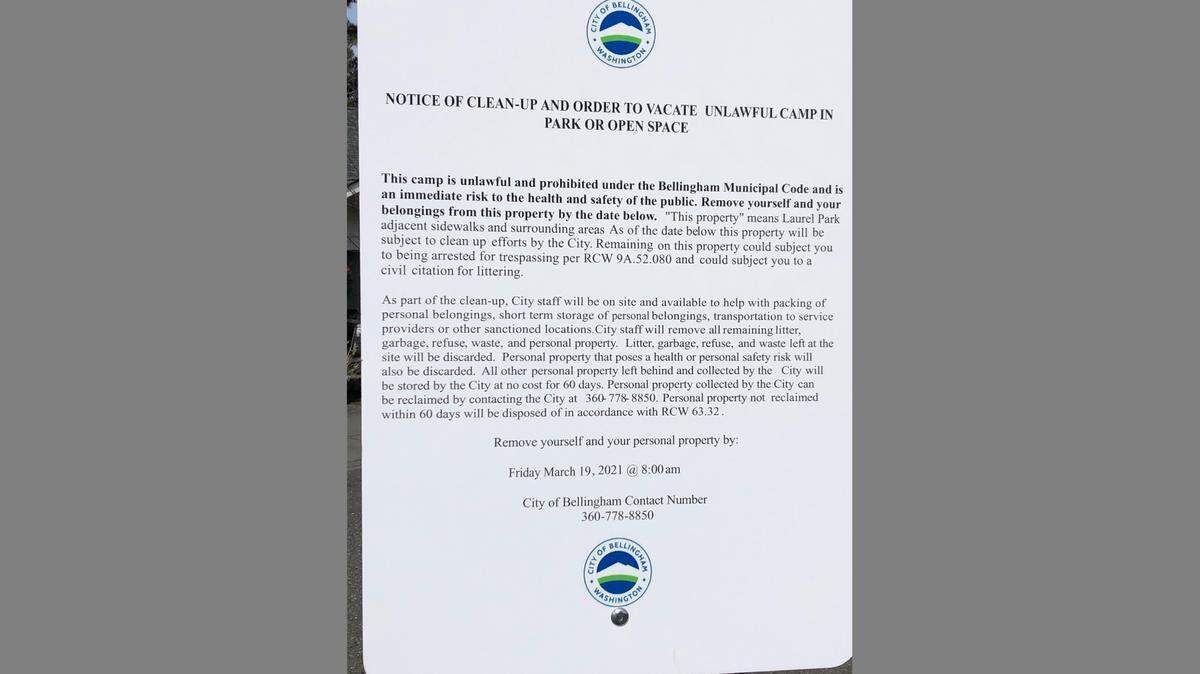
On Tuesday afternoon, the city posted a legal notice saying the camp at Laurel Park is “unlawful and prohibited” under the city’s code and is “an immediate risk to the health and safety of the public,” according to Eric Johnston, Bellingham public works director and the public notice. The notice states that people have until 8 a.m. on Friday, March 19, to remove themselves and their belongings from the area.
If they don’t, they could be arrested for trespassing and receive a civil citation for littering, the notice states.
As of Wednesday morning, March 17, roughly 30 tents had been set up at the park near Western Washington University. A fire had been started in a 55-gallon drum and several patio-style propane heaters were set up.
Signs have been erected by campers stating “Administrative accountability now,” “City Council stop criminalizing homelessness” and “Pandemic emergency — where do displaced citizens go.”
.jpg "IMG_5885 (1).jpg")
There are reasonable alternatives for shelter that are immediately available at Base Camp, an overnight emergency shelter operated by Lighthouse Mission Ministries and others, and the city is encouraging people staying at Laurel Park to use those services, according to Brian Heinrich, deputy administrator for the city.
“Others may return to dispersed small encampments located throughout our community, prior to organizers efforts to consolidate campers in public places there were over 100 encampments throughout the city which we did not enforce against,” Heinrich said in an emailed statement Thursday, March 18, to The Herald.
Heinrich said illegal encampments won’t be allowed and the city will continue to enforce its code against camping in public parks.
Homeless advocate Markis Stidham compared the city’s actions to the game Whac-A-Mole. Stidham said many campers have been contacted by police as soon as they try to relocate to a new location.
“It’s going to turn into a game of cat and mouse right now in this town, with no one being sheltered,” Stidham, who is an appointed member of the Whatcom County Homeless Strategies Workgroup, told The Bellingham Herald.
Advocates for the homeless people at the encampment and several organizations condemning the repeated removal of the camps have said the city’s actions don’t follow the U.S. Centers for Disease Control and Prevention interim guidance for service providers and local officials regarding homeless encampments during the COVID-19 pandemic.
The guidance says partners and providers should be involved in helping homeless people stay safe during the pandemic, and that people who are living unsheltered or in encampments should be allowed to remain where they are.
But the city says that the volunteers didn’t follow CDC guidelines when they encouraged the congregation of unsheltered community members into the large camps that have moved from downtown Bellingham to the Puget neighborhood and now the Sehome neighborhood, Heinrich said.
“Their actions have increased the risk of transmission by consolidating many small encampments into a single location,” he said.
The city also said its actions don’t violate a 9th U.S. Circuit Court of Appeals ruling that states cities can’t prosecute people for sleeping outside if they have no other reasonable place to be. Heinrich said there is available shelter space, but whether people staying at the encampments choose to use it is their own discretion.
“Although Bellingham chooses to support a diverse network of shelters serving many populations, it is not required by this decision to provide unsheltered community members their preferred choice of shelter,” Heinrich said. “The city prefers that efforts be directed towards finding additional housing solutions. While Bellingham is a very tolerant and accepting community, the use of misinformation, violence, vandalism and intimidation undermines the ideals promoted by advocates.”
Mayor Seth Fleetwood told the City Council in an online meeting Monday that social workers and others have been working to find shelter and services for people who had been staying at the Geri Fields encampment.
The city and county health department spend roughly $5 million each per year on contracts with providers who offer services to help and prevent homelessness, Heinrich said. The city and county are working together to provide permanent housing solutions, respond to emergency shelter needs and address root causes of homelessness, he said.
“Affordable housing and homelessness are top concerns in our community and safe, stable housing is the foundation upon which people build their lives,” Fleetwood said in a prepared statement sent Thursday to The Herald. “These topics are complex and dynamic, and Bellingham is not alone in experiencing these challenges in our efforts to address them. I encourage people to look beyond the misinformation, rhetoric and social media commentary if they wish to truly understand these issues.”
Five guests had come to Base Camp from the ball fields encampment in the three days leading up to the city’s removal actions, Lighthouse Mission Ministries spokesman Dave Brumbaugh told The Herald Wednesday.
Monday night’s count at Base Camp showed 138 people staying overnight and room for 52 more, Brumbaugh said.
Outreach teams talked with many of the residents on three days last week and a few found housing, Fleetwood told the Council.
But Stidham said the outreach was done through a chain-link fence roughly 1,000 feet away from the encampment. He said people are staying in the encampment because they need support. Many people at the encampment want services, but the city and others aren’t providing them or making them accessible, he said.
“That’s why they’re here. This camp is a hub of support,” Stidham said. “Come meet people where they live, where they are, meet them at where the need is. We want providers to provide. They want services.”
“The goal is to get these people sheltered,” Stidham said.
The Opportunity Council’s Homeless Outreach Team had previously been in contact with volunteers and advocates working to connect people staying at the ball fields encampment with community resources, according to Teri Bryant, director of the Whatcom Homeless Service Center with Opportunity Council.
“Safety concerns have limited their ability to enter these particular camps, but HOT is willing and able to meet with individuals needing housing assessments or other resources off-site. HOT enters camps throughout the city limits for this purpose,” Bryant said in an emailed response to The Herald in February.
A homeless tent encampment, known as Camp 210, started in November on the lawns of Bellingham City Hall and the Bellingham Public Library as an occupied protest over the lack of shelter available in the area for homeless people.
The city spent nearly $75,000 on the Jan. 28 removal of the downtown tent encampment, which was cleared a day before the city’s deadline for the homeless encampment to leave. Protesters used wooden pallets to block officials from clearing the encampment, while volunteers helped the encampment move to the lower parking lot near the ball fields.
This story was originally published March 17, 2021 at 1:41 PM.