First ‘murder hornet’ nest destroyed in Washington, using foam, cellophane and a vacuum
Wearing thick suits to protect themselves against painful stings, Washington State Department of Agriculture scientists vacuumed 85 Asian giant hornets from a small nest inside a tree southeast of Blaine over the weekend, the agency said on Monday, Oct. 26.
Another 13 of the invasive hornets were caught, alive, in nets at the site on Friday. Together, a total of 98 hornets were removed from the site — the first such nest found in Washington state and the U.S. All were workers.
The nest was found on private property on Thursday, Oct. 22, near an area cleared for a residence, on the edge of wooded land. It was in the Burk Road area, where there have been recent sightings of the unwanted hornets, after scientists were able to capture live hornets, tie a radio tracker on them and follow one back to the nest.
They were concerned when they saw that the nest was less than 30 feet from a children’s playset, said Sven Spichiger, managing entomologist for the state agency, during a virtual media briefing on Monday, Oct. 26.
Spichiger noted the success in removing the nest but said their work wasn’t done.
“We found one and we took it out. We’re all pretty happy here,” Spichiger said. “The eradication went very smoothly, even though our original plan had to be adapted due to the fact that the nest was in a tree, rather than the ground.”
The hornets usually nest in the ground.
“While this is certainly a morale boost, this is only the start of our work to hopefully prevent the Asian giant hornet from gaining a foothold in the Pacific Northwest. We suspect there may be more nests in Whatcom County,” Spichiger said in a news release on Monday, Oct. 26.
Threat to pollinators
Up to 2 inches long, the Asian giant hornet, or Vespa mandarinia, is the world’s largest hornet species. They are identifiable by their large yellow/orange heads and are popularly referred to as “murder hornets” because of a New York Times Article.
The hornets are known for their painful stings. They will attack people and pets when threatened. People should be extremely cautious near them, agriculture officials said, and those who have allergic reactions to bee or wasp stings should never approach an Asian giant hornet.
One sting isn’t going to kill you, unless you have an allergy.
The thick foam suits worn by scientists as they removed the nest on Saturday was meant to protect them against the hornets’ stinger, which is 6 millimeters long, or nearly 1/4-inch.
The suits included face coverings to protect against the venom that the hornets can spray.
The hornets’ native range is Asia. They also are known as the Japanese hornet, yak-killer hornet and the giant sparrow bee.
In Japan, where there are a lot more of them, the hornets kill 20 to 50 people a year, according to Spichiger.
By comparison, about 60 people in the U.S. die each year from hornet, bee and wasp stings, according to the Centers for Disease Control and Prevention.
Asian giant hornets are feared for the threat they pose to honeybees and, by extension, the valuable crops in Washington state that the bees pollinate, including blueberry and other cane crops in the region that includes Whatcom County, Spichiger said.
He said agriculture officials don’t want migratory beekepers who travel the country and rent out their hives to pollinate crops to think it’s unsafe to bring their bees here.
The hornets also are a threat to local pollinators such as wasps, posing a threat to the local ecosystem.
When Asian giant hornets are in their slaughter phase, which they’re entering now, they mark a honeybee hive, attack it, use their powerful jaws to decapitate the bees, and take the bees’ young to feed their own. A few hornets can kill 30,000 honeybees and take out a hive within hours, and managed honeybees here have no defense against them, Spichiger said in a previous Bellingham Herald article.
Combined with the most recent captures, a total of 120 Asian giant hornets have been discovered in Whatcom County since winter 2019. They represent the first findings of the hornets in Washington state and the U.S.
The state is racing to trap them and find their nests to prevent the hornets from spreading outside of Whatcom County to the rest of Washington and the U.S. They also have been found just over the Whatcom County border, in British Columbia, Canada, including in Langley in spring.
Although it’s not believed that the hornets can thrive in Eastern Washington in the farm belt away from the mountains, Spichiger said, the hornets are capable of surviving east of the Mississippi River — not just along the coast in the Pacific Northwest.
“It’s a battle that’s worth fighting,” he said of eradication efforts that have so far occurred in Washington state and in Whatcom County.
Taking them out
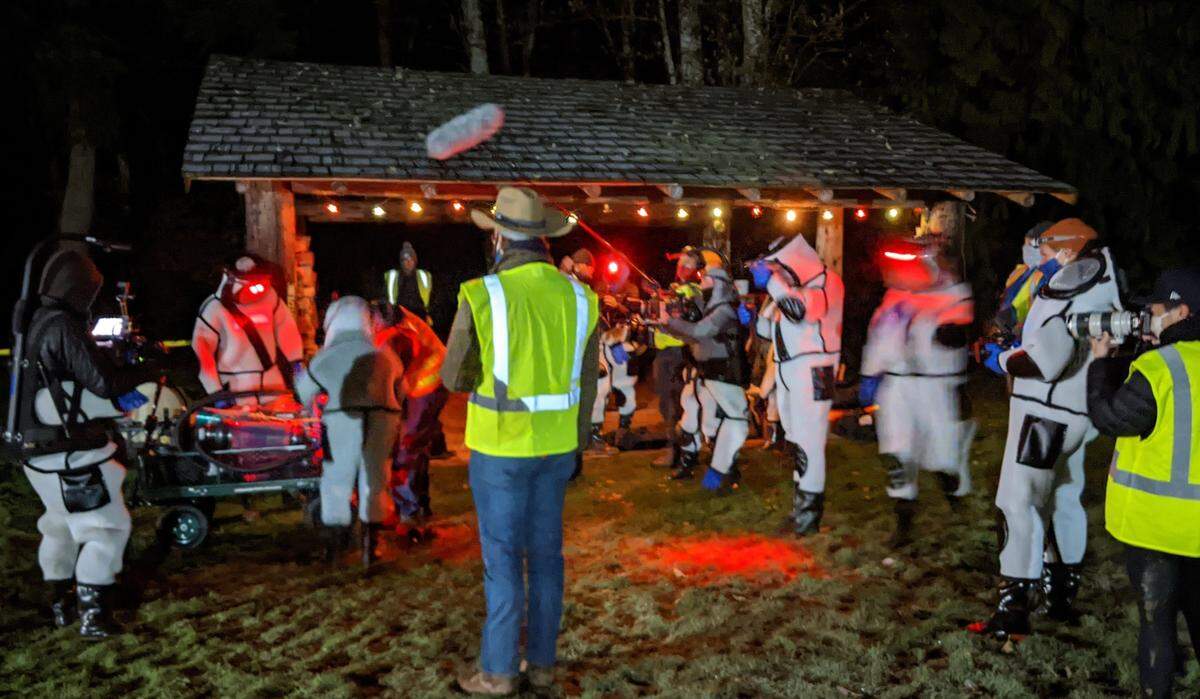
In their protective suits, the team of scientists who removed the nest on Saturday, Oct. 24, looked like they were in a sci-fi movie.
They started about 5:30 a.m. when temperatures were in the 30s. They were done by 9 a.m.
Here’s what they did:
▪ They put on their suits, which had red lights so the scientists could see but the hornets couldn’t. “It gives you an advantage,” Spichiger said. They set up scaffolding around the tree to reach the nest, which was in an opening about 10 feet up.
▪ They stuffed foam padding into a crevice above and below the entrance. They wrapped the tree in cellophane, leaving one opening for a vacuum hose.
▪ It was slow going at first because few hornets emerged, officials said. So they hit the tree, believed to be a dead alder, with a wooden board to agitate the hornets to get more to leave the nest that was in the tree’s cavity. That worked.
▪ When the hornets stopped coming out of the nest, they pumped carbon dioxide into the tree to kill or anesthetize any hornets still in there.
▪ They sprayed foam into the tree to seal it and wrapped it in cellophane again.
▪ They put up more traps in the area to catch hornets that may have survived or were away while the nest was being destroyed.
Spichiger said scientists don’t know how well the protective suits work because the hornets didn’t attack them. He attributed their docility, in part, to the frigid temperature.
The hornets that were vacuumed out of the tree looked dead at first but sprang back once they were taken elsewhere and warmed up, he said. They will be used for research.
During the week, the state agency’s Pest Program plans to cut down the tree and open it to see the nest’s size. Spichiger said the queen for that nest is still believed to be inside.
The entomologists also want to find out whether the nest had begun to produce new queens, which are the ones that can create more nests.
Agriculture officials said they will continue to set traps through November at least. They hope to catch more Asian giant hornets in Whatcom County and find more nests.
Spichiger believed there could be three more nests in Whatcom County, in the Blaine area, Birch Bay and possibly Custer.
Nests usually last a year and the hornets that remain in them, other than the ones that leave to establish new nests, generally die, he said of their life cycle.
The state agency has been using a network of traps placed by its staff, hundreds of citizen scientists and what it calls cooperators — including Whatcom beekeepers and parks departments — locally and in other parts of the state to find the hornets and their nests.
State agriculture officials said it’s still important for Whatcom County residents to continue reporting ssightings of suspect of Asian giant hornets.
“This fight is not over. We still need residents to report every single hornet every time they see one,” said Karla Salp, spokesperson for the state agency.
Report hornets
State agriculture officials say each report leads them closer to finding a nest as it did with the nest destroyed over the weekend southeast of Blaine.
Make reports at agr.wa.gov/hornets, which is preferred, and hornets@agr.wa.gov, or by calling 800-443-6684. Officials said it’s more important at this time of year to track the hornets or capture them while they’re alive instead of killing them.
When reporting, note the direction the hornet’s fly, which helps in tracking efforts.
An emergency line also has been set up for Washington state beekeepers to immediately call when they see their hives being attacked by Asian giant hornets. That phone number is 360-902-1880.
This story was originally published October 26, 2020 at 11:37 AM.