How’s your neighborhood’s ‘tree equity score’? New state DNR tool has the answer
AI-generated summary reviewed by our newsroom.
- American Forests launched a tree equity map scoring neighborhoods statewide.
- Bellingham scored 85 overall, with downtown and city center showing lower canopy.
- City aims for 45% tree cover by 2050; planting 9,000 trees per year is required.
A new “tree equity” map is giving Washington residents another way to see how their neighborhood’s tree canopy stacks up to others across the state.
“Tree equity” refers to the concept that all communities should have equal access to the benefits that trees provide, such as improved air quality, reduced urban heat effects and increased recreational space.
The map, created by the conservation nonprofit American Forests in partnership with the Washington Department of Natural Resources, spans communities across Washington and assigns them a “Tree Equity Score.”
That score is designed to measure how well the critical benefits of urban tree canopy are reaching those who need them most, according to American Forests.
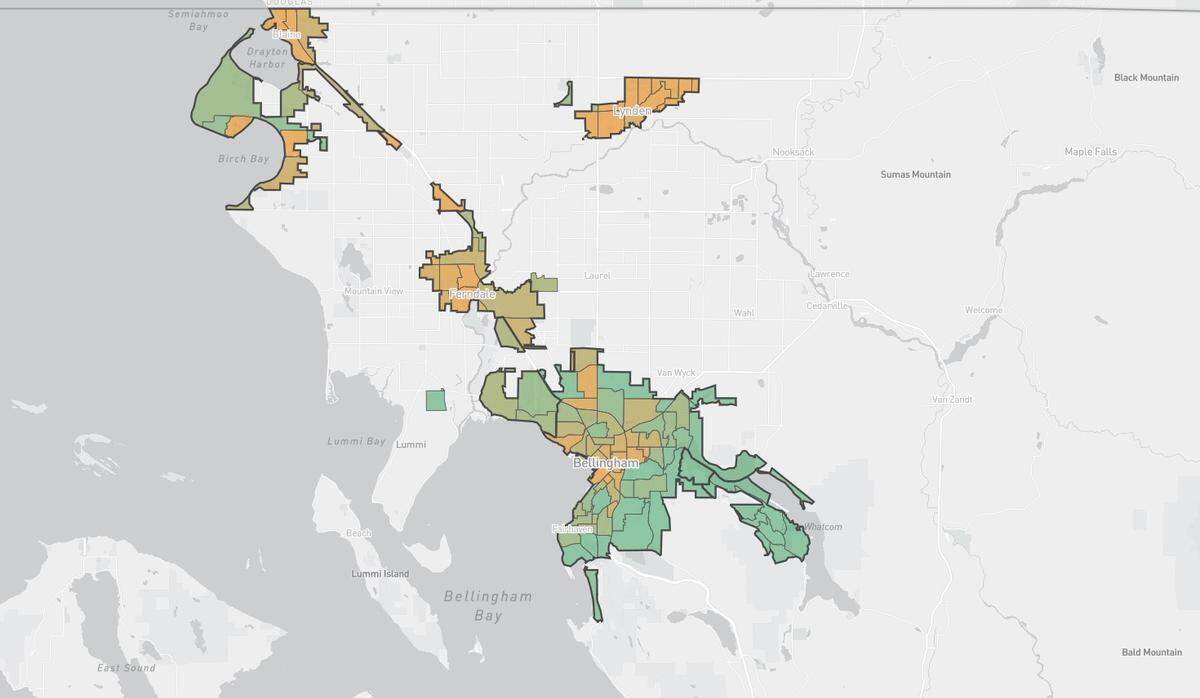
Each area analyzed on the map receives a composite score out of 100. The metric is meant to help cities “assess how well they are delivering equitable tree canopy cover to all residents.” It factors tree canopy cover, climate, demographic and socioeconomic data. The lower the score, the greater the priority for tree planting. A score of 100 means the neighborhood has met tree planting goals, according to the nonprofit.
Bellingham as a whole received a score of 85 — higher than Birch Bay (81), Blaine (61), Ferndale (74) and Lynden (58).
A more nuanced view of various regions within Bellingham shows that the city’s neighborhoods vary widely in their scores. The map doesn’t define Bellingham’s neighborhoods with exactly the same boundaries that the city uses, although they are similar. However, the Sudden Valley area, for example, earned a score of 100, while the downtown core earned a score of 68.
The map indicates that some areas of Bellingham can feel up to 14 degrees Fahrenheit warmer than others. Many of the hottest areas also see some of the highest disparities in health and socioeconomic factors, indicating “greater potential for residents to be disproportionately affected by extreme heat, pollution and other environmental hazards which could be reduced with the benefit of trees,” according to the analysis.
Access to nature is an environmental justice issue, with people of color and low-income communities more likely to live in a “nature-deprived” area, according to a 2020 report by the nonpartisan policy institute Center for American Progress.
Regions including the Sunnyland, Lettered Streets, Columbia, Roosevelt, Birchwood, Meridian and Cordata neighborhoods all earned lower “tree equity” scores. Meanwhile regions including the Silver Beach, Geneva, Whatcom Falls, Puget, Samish, Happy Valley, South Hill, Western Washington University, Edgemoor and South neighborhoods scored higher.
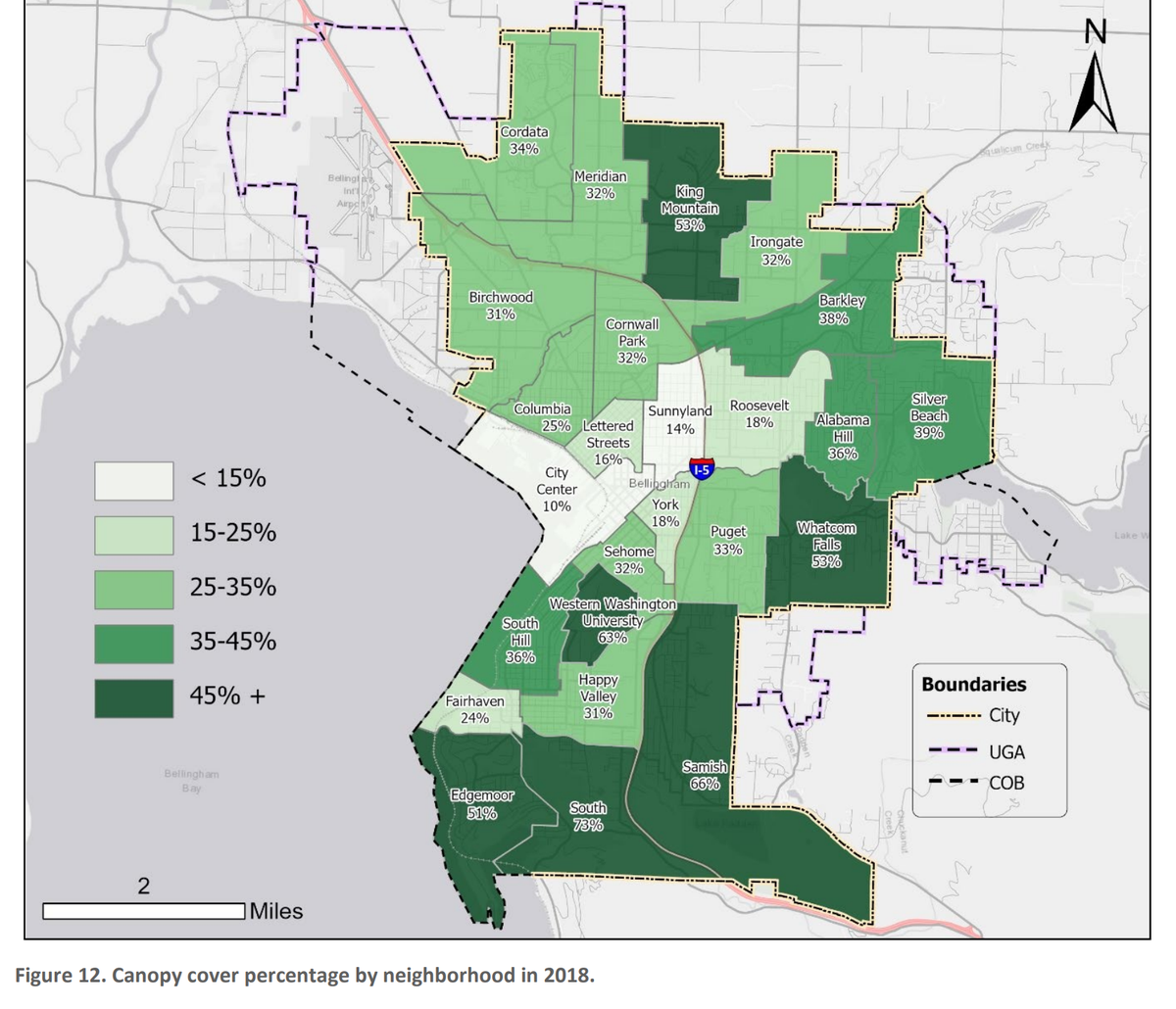
Previous city reports echo similar findings. In highly developed areas, such as downtown and in the commercial areas north of the city center, tree canopy cover dips below 15%. The neighborhood with the lowest canopy cover is the City Center at 10%, followed by Sunnyland at 14% and Lettered Streets at 16%. In other places — such as in neighborhoods south of downtown, parklands and along riparian corridors — tree canopy cover exceeded 45%, according to city reports.
The city of Bellingham is a Tree City USA community, recognized nationally for its citizen-based effort to sustain its urban forest, and has been working to protect and maintain its urban forests through various efforts, including the creation of an Urban Forestry Management Plan.
“We understand trees not only beautify an area but also provide shade, reduce levels of noise and dust, increase property values, reduce stormwater runoff, produce oxygen, absorb carbon dioxide, improve well being and provide habitat for wildlife,” according to the city’s website.
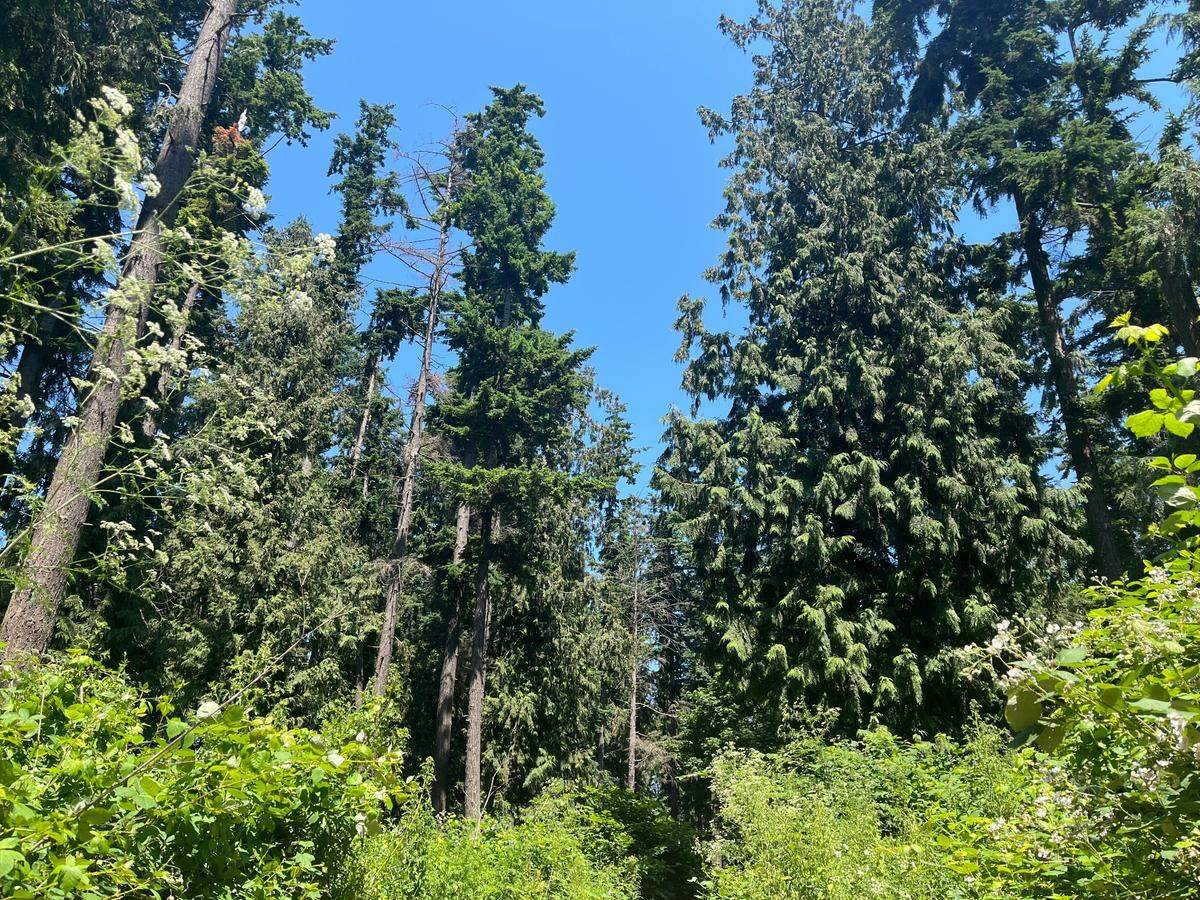
That plan is meant to identify strategies to help maintain a “healthy and desirable urban forest through well-coordinated, consistent, efficient and sustainable long-term urban forest management,” according the the city’s website.
The draft plan, which was released in April of 2024, recommends a goal of reaching 45% tree canopy coverage in Bellingham by 2050. Offsetting for expected canopy loss, the plan says reaching that goal would require 9,000 trees to be planted in the city every year.
As of 2018, Bellingham had an average canopy coverage of about 40% — a figure that has remained relatively stable since 2006.
Work on the Urban Forest Plan is currently on pause due to limited staff capacity. In the meantime, city staff implemented an emergency Landmark Tree Protection ordinance designed to protect the largest, most significant trees in Bellingham by establishing a landmark tree inventory and a permitting process for removal. The ordinance also establishes a larger fine for illegal removal.
City staff also launched multiple Community Tree Programs that focus on increasing trees planted on private property.
This story was originally published August 27, 2025 at 5:00 AM.