Which Bellingham neighborhoods have the most trees? A new report gives answers and why it matters
Bellingham just completed a crucial step in its efforts to protect and maintain its urban forests.
In the final days of August, the city published a wealth of information regarding Bellingham’s tree canopy cover, wildlife corridors and forest maturity and health. This marks the end of the first phase of the city’s effort to develop an Urban Forestry Management Plan, which will guide future policies regarding Bellingham’s trees.
“We had a lot of information about aquatic habitats but not as much information about forests, particularly dry forests,” said Analiese Burns, the city’s habitat and restoration manager, in an Aug. 30 presentation to Bellingham’s Public Works and Natural Resources Committee.
Urban tree canopy refers to the expanse of leaves, branches and stems that extend from trees when they are viewed from above, according to the U.S. Department of Agriculture Forest Service.
The recently released reports found that Bellingham’s 2018 tree canopy covered 40% of the area within city limits, a figure that has remained relatively stable since 2006. That puts the city at a good starting point compared to cities such as Tacoma and Vancouver, Wash., which Burns told city councilmembers hover around 20% tree canopy cover.
“We are in the upper range of Puget Sound canopy cover,” she said.
An Urban Forestry Management Plan must be developed carefully and comprehensively in order to avoid unrealistic or unsustainable actions, conflicts between community values and city policies and programs, inefficient spending of funds and inequity, Burns told the Herald in an email.
Differences between neighborhoods
Trees improve public health in urban environments, according to The Nature Conservancy, reducing pollutants, alleviating high summer temperatures and decreasing community members’ stress levels. Tree canopy is also beneficial to urban wildlife, providing habitat and keeping nearby streams cool by providing shade, according to the Environmental Protection Agency.
Bellingham’s relatively large canopy cover is not distributed equally throughout the city’s neighborhoods, though.
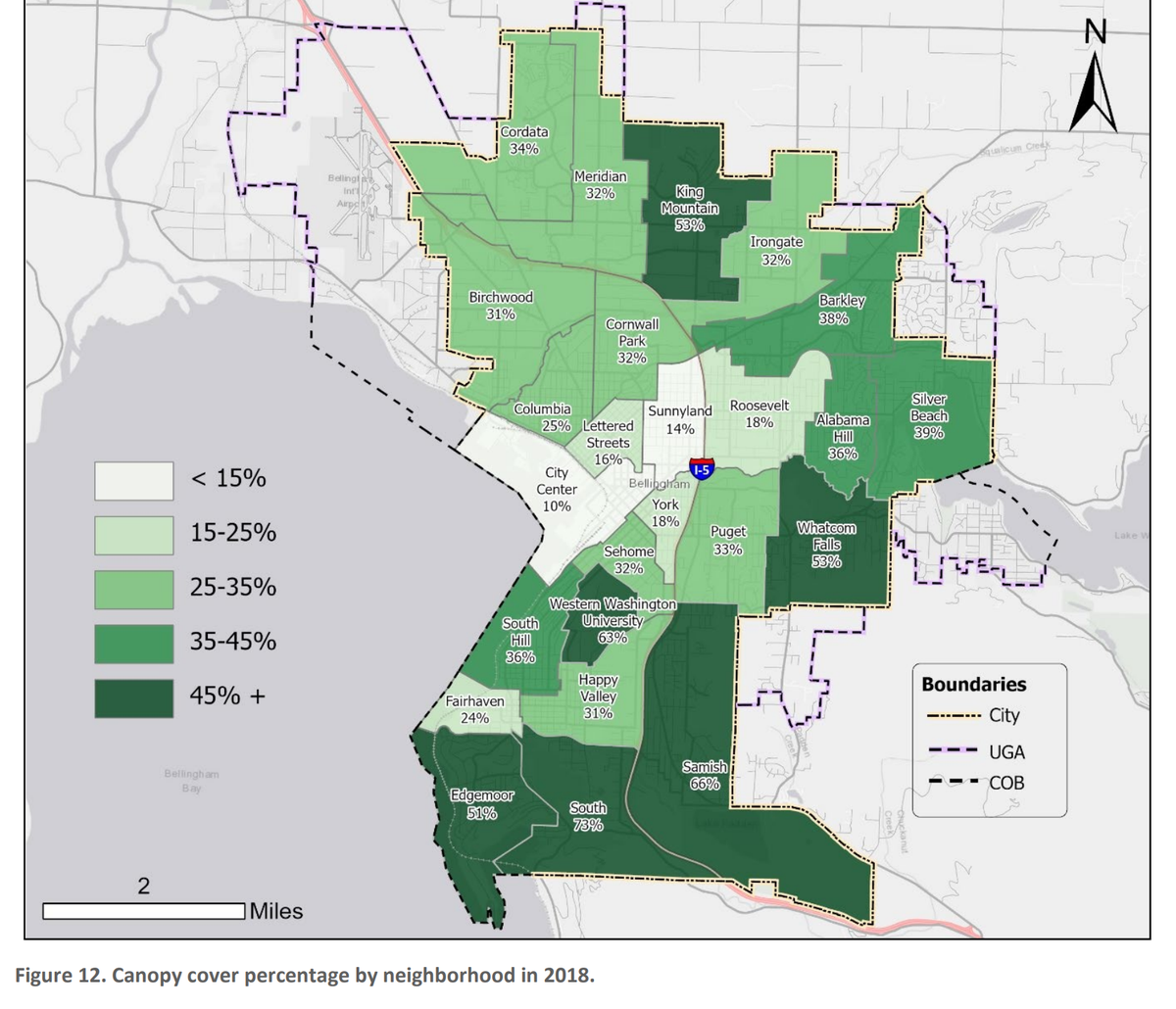
In highly developed areas, such as downtown and in the commercial areas north of city center, tree canopy cover dips below 15%. The neighborhood with the lowest canopy cover is the City Center at 10%, followed by Sunnyland at 14% and Lettered Streets at 16%.
In other places, such as in neighborhoods south of downtown, parklands and along riparian corridors, tree canopy cover exceeded 45%.
Riparian corridors consist of the vegetation surrounding natural bodies of water, such as streams and lakes. Increasing canopy cover in these areas is a key strategy in the city’s efforts to meet the state’s water quality standards for temperatures in local streams, Burns said.
“That’s what we spend a lot of our restoration efforts doing — trying to increase that canopy cover,” she told city council members.
The neighborhood with the highest tree canopy cover is South at 73%, followed by Samish at 66% and Western Washington University at 63%.
The only two neighborhoods where there was a net loss in tree canopy cover between 2006 and 2018 were the Whatcom Falls and King Mountain neighborhoods, Burns told the Public Works and Natural Resources Committee. The report attributes King Mountain’s loss to residential development in forests and on rural lands and Whatcom Falls’ loss to residential development and forest harvesting.
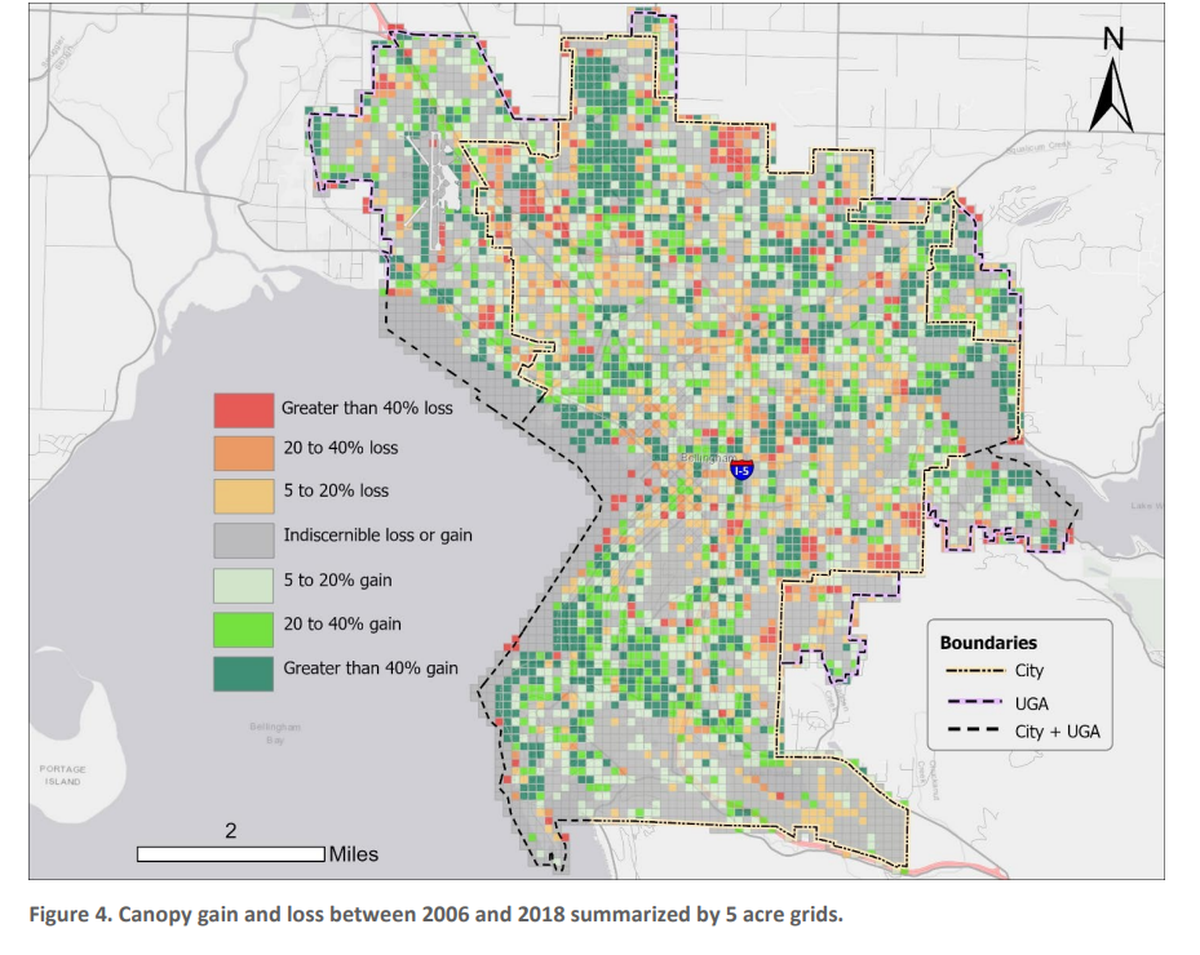
These neighborhoods, however, still have some of the highest tree canopy cover in the city, both at 53%.
The northern areas of Bellingham are dominated by younger forests, while southern areas are inhabited by older, taller forests, the report found — unsurprisingly, since the southern neighborhoods border the Chuckanut Mountains.
The separate wildlife corridor analysis found that the major movement barriers for the city’s critters are concentrated along Interstate 5.
Phase two begins
In the second phase of developing the Urban Forestry Management Plan, city staff will analyze the data compiled in August’s reports from several different perspectives, including equity, looking how tree canopy correlates with neighborhood demographics.
Access to nature is an environmental justice issue, with people of color and low-income communities more likely to live in a “nature-deprived” area, according to a 2020 report by the nonpartisan policy institute Center for American Progress.
Bellingham Council Member Michael Lilliquist also requested in the Aug. 30 meeting that staff break the data down by land use or zoning type as well.
“If we have goals at all, they will be different for a public park than for a business park than for a single-family neighborhood, than they will be for downtown where we have to rely on street tree coverage and that’s it,” he said.
Council Member Lisa Anderson expressed hopes that the plan would result in harsher punishments for people who cut down large trees in city rights-of-way without appropriate permits. She described current fines as “a slight tap on the wrist.”
Anderson said she has held off pushing for policy changes regarding this issue because she assumed it could be addressed more holistically in the Urban Forestry Management Plan.
In 2022, the city will work to engage the community in plan development, identifying residents’ priorities. In the following, final phase, the plan itself will be drafted and tangible actions will be prioritized.
“We as a city have long valued forests,” Burns said. “But we have lacked that overarching strategic plan.”
This story was originally published September 14, 2021 at 5:00 AM.