Whatcom homeless resource providers recount a year burdened by extreme weather
Melissa Gragg Wisener was scared when she logged onto Facebook on Nov. 16, in the wake of record rainfall and flooding in Whatcom County.
But the executive director of Bellingham’s Serenity Outreach Services wasn’t worried about herself. She was worried about unsheltered community members experiencing homelessness. Many of them live alongside creeks in wooded areas — while that might be a good place to avoid law enforcement officials clearing out encampments, it’s not safe during a flood.
“Most of the encampments are gone. I don’t know if everybody is OK yet,” Gragg Wisener said in the social media video, choking up. “And I won’t for a while because they don’t get counted properly, and there’s no way to track them properly.”
In 2021, Whatcom County endured scalding heat waves, suffocating wildfire smoke and intense rainfall that led to destructive floods. In a frigid finale to the year, snow dumped on the county and arctic winds brought wind-chill factors of -14 degrees.
Extreme weather takes a toll on the unsheltered homeless community and the organizations that serve them, Whatcom resource providers told The Bellingham Herald. Providers recount a year in which the unforgiving conditions piled an extra burden onto what they describe as their sometimes understaffed, underfunded teams. As these workers look to the future, some grapple with how to keep pace with climate change, which will bring more hot, smoky summer days and heavy rainfall in the winter.
“Our funders are asking so much of people doing this work. They are always asking for people to step up above and beyond,” said Teri Bryant, director of the Opportunity Council’s Whatcom Homeless Service Center. “That’s difficult to do when you are already at 110%.”
Bryant should be leading a 14-person staff, but two employees are currently on leave and there are three vacancies. She worries about filling those positions — it’s increasingly difficult to find and retain staff during the pandemic without the ability to offer a higher salary.
Whatcom’s homelessness hit its highest level in more than a decade last year, according to the annual Point In Time Count, taken on Jan. 28, 2021. The 859 people counted is likely an underestimate, said Markis Dee Stidham, director of civic engagement at Serenity Outreach Services. He puts the figure closer to 1,500.
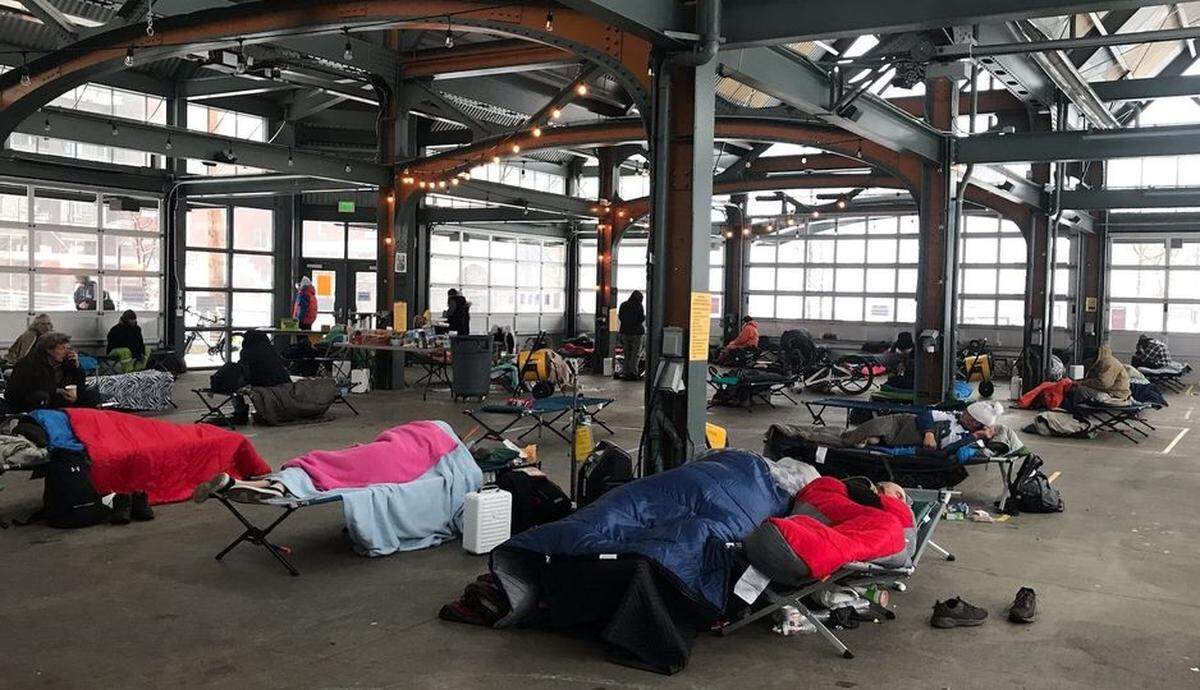
Whatcom County typically responds to extreme weather events as they come, urgently reaching out to local churches and sometimes putting together severe weather shelters in a matter of hours, said Ann Beck, human services supervisor for the county’s Health Department Housing Program. But during the pandemic, the county has discovered it can no longer rely on volunteers and churches to fill that need, she said.
That’s why the county is planning to collaborate with Bellingham to establish winter warming shelters at Bellingham Public Library and Depot Market Square through the end of this winter. These mostly volunteer-run shelters would operate during exceptionally cold weather.
Governments at all levels are still stuck reacting to extreme weather, rather than anticipating it and establishing preventative measures, said Sean Kidd, chief of the psychology division at Ontario’s Centre for Addiction and Mental Health in Canada. He has researched global health work involving climate change and homelessness.
“Running around handing out water bottles is not enough,” Kidd said. “We need to get more serious about this and consider that this is a problem that is going to grow.”
Destabilizing community
When November’s flooding began in areas of Bellingham, the volunteers at Serenity Outreach Services sprung into action to check on the homeless community.
It quickly became clear that the conditions were dangerous, but the unpaid community members still scattered across the city to check on residents living outside.
“Outreach workers risk their lives to figure it out,” Stidham said. “They go into the woods, down to the stream beds.”
Most of us get extreme weather alerts online, but if someone on the streets doesn’t have a phone, is struggling with mental health issues or isn’t plugged into the right network, they might not be aware of dangerous conditions until it’s too late, he said.
About 80% of the homeless community served by Serenity Outreach Services was immediately displaced by the November flooding, Stidham estimated.
That takes a toll on the relationships that service providers have built with individuals formerly living in an established outdoor location. The flood was a “very destabilizing event,” said Bryant with the Whatcom Homeless Service Center.
“Folks don’t hold still for very long out there, especially when they are in need,” Stidham said. “Someone without shoes, you tell them to stay still for 10 minutes so you can get them some, but they leave because their feet got cold.”
The health impacts of extreme weather — lung and heart problems triggered by inhaling smoke, heat stroke, frostbite — can be particularly debilitating for people living on the streets. This community typically exhibits health issues seen in populations about 10 years older than them, said Bridget Reeves, associate executive director at Lighthouse Mission Ministries. Even when people are experiencing a medical crisis, however, they might refuse the offer to call an ambulance, out of fear that their possessions will be stolen while they are gone, Stidham said.
As resource providers struggle to meet the needs of people already experiencing homelessness, some worry that extreme weather could grow that population. The November floods destroyed many houses, and as time wears on, Whatcom may see an uptick in homelessness, Bryant said.
“People have used all the last resorts they had and exhausted them,” she said. “That’s when people impacted by flood will become homeless. We won’t see it just yet.”
Shelter or housing?
The projected increase in heat waves, wildfire smoke and intense rainfall has some local resource providers wondering if it’s time to invest in more summer cooling centers and flood planning in addition to winter warming shelters.
This need presents a dilemma for advocates who work with the homeless community: Do we invest precious, finite funding into affordable housing or emergency shelters?
“Even before these conditions, there has always been a tension between shelter and housing,” Bryant said.
It’s on leaders’ minds: In October, Bellingham Mayor Seth Fleetwood proposed spending $5 million on electric cooling and ventilation systems in municipal buildings, which could then serve as locations where community members can escape wildfire smoke and high temperatures.
There are several shelters available for the homeless community throughout Whatcom and in Bellingham, including Lighthouse Mission Ministries’ Base Camp and Overflow, which combined have 240 beds. There’s also the Young Adult Winter Shelter, operated by Northwest Youth Services, and the Ferndale Severe Weather Shelter. The YWCA and some motels are available for folks with an Opportunity Council referral.
When the June heat wave hit, Bellingham High School served as an air-conditioned space with water for community members for three days, said Bellingham Communications Director Janice Keller. Extra winter warming centers were provided in February and December 2021. There was no extra emergency shelter opened in Bellingham during the November floods (although there were efforts to provide shelter to families displaced in Sumas, Everson and other areas).
But these resources are not perfect, particularly in a pandemic, providers acknowledged. People experiencing homelessness can be wary of congregate shelter — they might have a conflict with or feel threatened by someone else staying at Base Camp, Bryant said. Perhaps they are concerned about catching COVID-19, a very real worry illustrated by an outbreak at Base Camp in January.
Stidham says the answer is to create more tiny home villages in Bellingham. They allow for distancing during the pandemic, foster community and are relatively cheap to run, he said — it costs roughly $1,600 a month to operate 20 tiny homes at Unity Village. There are two other tiny home villages in Bellingham: Swift Haven near the Civic Athletic Complex and Gardenview Village at Lakeway Drive and Woburn Street.
Stidham wants to set up 100 additional tiny homes in Bellingham.
Until Serenity Outreach Services achieves its goal of ending homelessness — first here, then across the country — Stidham continues to drive around Bellingham offering services to people living on the streets.
On the night of Nov. 14, he and his wife did just that, he said in a Nov. 15 Facebook live video. They came across a woman standing on Holly Street, soaking wet and clearly in pain and distress, Stidham said. It was difficult for the woman to communicate, and Stidham guessed they were the first people to speak to her in days.
The woman asked him to help her take her gloves off.
“Oh my god, you guys,” Stidham said in the video. “Her hands looked like a cadaver you find on the beach.”
In the morning, Stidham drove by the same spot, his jacket still damp from the night before. They had ended up calling the woman an EMT.
“There is no sign of her ever existing there,” he said.