Whatcom County sees 40 new confirmed COVID-19 cases on Wednesday, state reports
Whatcom County recorded 40 new confirmed COVID-19 cases and eight new probable cases, according to the Washington State Department of Health Wednesday, Dec. 16. No additional deaths were reported for Whatcom County
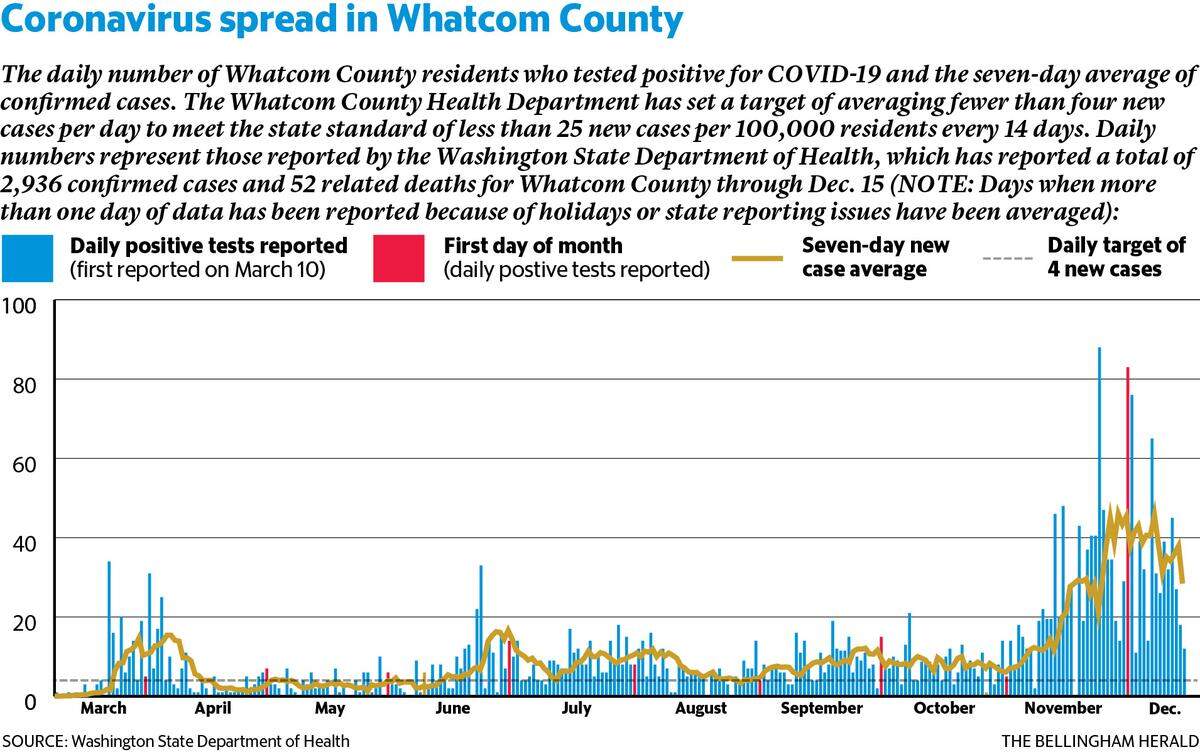
Whatcom County now has seen 2,976 confirmed cases, eight probable cases and 52 related deaths during the pandemic, according to state data as of 11:59 p.m. Tuesday, Dec. 15. That means that 1.7% of the Whatcom residents who have tested positive for COVID during the pandemic have died.
On Wednesday, the state added probable cases reported since June 2020 to all case, hospitalization, and death counts. “Probable cases are those where individuals had a positive antigen test result for COVID-19, but no positive molecular test result,” according to the state Health Department website.
The state Department of Health data Wednesday also showed Whatcom County has had 166 hospitalizations (one more from Tuesday’s report).
The state also reported that a total of 99,119 tests have been administered in Whatcom County during the pandemic — an increase of 93 tests from Tuesday’s report. The state continues to caution that “test data from Nov. 21 through today are incomplete and should be interpreted with caution.”
Antigen testing data change
Beginning Wednesday, the Washington State Department of Health will include positive antigen test results among the COVID-19 cases it reports on its COVID-19 Data Dashboard and the COVID-19 Risk Assessment Dashboard, according to a news release.
Before Wednesday, antigen-positive test data was posted on a separate weekly report, while the state further studied how reliable those results were.
“With this inclusion, reporting antigen-positive test results will provide a more accurate picture of community transmission and help guide efforts to respond to COVID-19,” the release states.
The addition of antigen-positive results will change statewide case numbers, the release states, but it will not change test data. The dashboard will be updated to reflect all positive antigen results since June, when the first antigen tests were reported. Testing data on the dashboards, though, will only reflect results from molecular tests.
“While the test results tabs on the DOH and Risk Assessment dashboards are useful tools for understanding how communities are being impacted by the virus, it’s also important to track the epidemiological curve graphs to understand disease activity across the state,” the release states.
Currently, only about 5% of all COVID-19 cases come from positive antigen tests, according to the release, with the remaining 95% coming from molecular tests. But the Department of Health expects that antigen test use to increase in the coming months.
Whatcom County numbers
St. Joseph hospital in Bellingham, which is licensed and staffed for 241 beds, reported to The Bellingham Herald on Wednesday that it was treating 12 patients for COVID-19 — an increase of three from Tuesday.
Western Washington University’s most recent on-campus student COVID testing data show Wednesday that, since Sept. 15, WWU has tested 13,749 students, 38 of whom had positive tests.
Lummi Nation again extended its shelter-in-place order, this time until Jan. 12, 2021. In a Facebook post Wednesday, the nation noted it has recorded 128 cases during the pandemic through Dec. 11.
The order says no indoor gatherings are permitted and only outdoor gathers of less than five people outside of the household are permitted
Race and ethnicity data
The percentage of Whatcom County COVID-19 cases impacting people identifying as Hispanic increased for the second straight week, while every other race or ethnicity category saw its percentage either decrease slightly or remain unchanged.
The increase in case percentage among Whatcom’s Hispanic community the past two weeks comes after eight straight weeks in decreases that dropped the percentage of cases from 30.3% on Sept. 28 to 26.6% Dec. 1. Since then, the percentage has increased 0.7 percentage points to 27.3%, as of Tuesday.
The county health department breaks down the percentage of cases each for eight race or ethnicity categories represented in Whatcom’s total count and released its latest data Tuesday evening. The Bellingham Herald used those percentages and the county’s total number of cases to estimate the number of cases each race or ethnicity has seen during the pandemic.
Here is what the latest data, which is through Dec. 15, shows:
▪ White, non-Hispanic: 58.9% of cases, down from 59.2% on Dec. 8 (people identifying as white represent 78.7% of Whatcom’s total population). Using that percentage, The Herald estimates 1,383 cases in people who identify as white — a 6.7% increase over the Dec. 8 estimate of 1,296 cases.
▪ Hispanic: 27.3% of cases, up from 27.0% on Dec. 8 (people identifying as Hispanic represent 9.5% of Whatcom’s total population). Using that percentage, The Herald estimates 641 cases are in people who identify as Hispanic — an 8.5% increase over the Dec. 8 estimate of 591 cases.
▪ American Indian/Alaska Native, non-Hispanic: 5.2% of cases, unchanged from Dec. 8 (people identifying as American Indian or Alaska native represent 2.5% of Whatcom’s total population). Using that percentage, The Herald estimates 122 cases are in people who identify as American Indian or Alaska Native— a 7.3% increase over the Dec. 8 estimate of 114 cases.
▪ Multiracial, non-Hispanic: 2.8% of cases, unchanged from Dec. 8 (people identifying as multiracial represent 3.6% of Whatcom’s total population). Using that percentage, The Herald estimates 66 cases are in people who identify as multiracial — a 7.3% increase over the Dec. 8 estimate of 61 cases.
▪ Asian, non-Hispanic: 2.4% of cases, down from 2.5% on Dec. 8 (people identifying as Asian represent 4.3% of Whatcom’s total population). Using that percentage, The Herald estimates 56 cases are in people who identify as Asian — a 3.0% increase over the Dec. 8 estimate of 55 cases.
▪ Black, non-Hispanic: 1.1% of cases, unchanged from Dec. 8 (people identifying as Black represent 1.0% of Whatcom’s total population). Using that percentage, The Herald estimates 26 cases are in people who identify as Black — a 7.3% increase from the Dec. 8 estimate.
▪ Native Hawaiian or other Pacific Islander, non-Hispanic: 0.6% of cases, down from 0.7% on Dec. 8 (people identifying as Native Hawaiian or other Pacific Islander represent 0.3% of Whatcom’s total population). Using that percentage, The Herald estimates 14 cases are in people who identify as Native Hawaiian or other Pacific Islander — unchanged from the Dec. 8 estimate.
▪ Other race, non-Hispanic: 1.6% of cases, unchanged from Dec. 8 (people identifying as some other race or ethnicity represent 0.0% of Whatcom’s total population). Using that percentage, The Herald estimates 38 cases are in people who identify as a race or ethnicity other than the seven listed above — a 7.3% increase over the Dec. 8 estimate of 35 cases.
Approximately 20% of all cases (an estimated 587 cases) do not have a known race or ethnicity.
Overall, the number of cases reported in the county increased by 7.3% (199 cases) between Dec. 8 and 15, according to the state Department of Health.
Whatcom’s risk assessment
The state’s Risk Assessment Dashboard was last updated Wednesday for data as of 11:59 p.m. Tuesday. It showed that Whatcom County is missing the marks on two key metrics goals.
▪ Whatcom is missing the target rate of fewer than 25 new cases per 100,000 residents every 14 days with a rate of 221.0.
▪ Whatcom had an average COVID-19 testing rate per 100,000 people over a week of 42.9. No goal was stated for this metric, however, the overall statewide number was 300.5. The state Department of Health has said that testing data since Nov. 21 is incomplete and that is likely impacting this metric.
▪ Whatcom is missing the target of less than 2.0% of individuals testing positive for COVID-19 during the past week with a rate of 39.4%. The state Department of Health has said that testing data since Nov. 21 is incomplete, and that likely impacting this metric.
The latest Healthcare System Readiness risk assessment dashboard, which was last updated Wednesday for data through Tuesday, shows for the North region, which combines Whatcom, Skagit, Snohomish, San Juan and Island counties:
▪ Occupied beds: 1,030 of the region’s 1,241 adult hospital beds (83.0%) were occupied, missing the state’s goal of 80% or less.
▪ COVID occupied beds: 127 of the region’s 1,2419 adult hospital beds (10.2%) were occupied by COVID patients, missing the state’s goal of 10% or less.
▪ Occupied ICU beds: 92 of the region’s 140 adult ICU beds (65.7%) were occupied. The state does not have a goal for this metric, but the number is nine more than in Tuesday’s report.
▪ COVID occupied ICU beds: 36 of the region’s 140 adult ICU beds (25.7%) were occupied by COVID patients. The state does not have a goal for this metric, but it was one less from Tuesday’s report.
Vaccine reminder
Though more than 20,475 doses of the Pfizer vaccine arrived in Washington State as of Tuesday, Dec. 15, and distribution has begun, the Washington State Department of Health reminds residents about the importance of taking measures to prevent the spread of COVID-19.
“Even though it may not be convenient, we need to prepare to wear masks for many more months,” State Health Officer Kathy Lofy said in a news release.“ COVID-19 is mostly spread by droplets, and masks help us keep those droplets to ourselves and help us avoid breathing in others’ droplets. Wearing masks can decrease the spread of COVID-19, and when we combine that with the effect of the vaccine, we could see a drastic drop in the spread of the virus.”
Lofy went on to say that there remain a lot of unknowns about the vaccine and COVID-19, making continuing COVID safety measures even more important.
“We don’t know how many people will be vaccinated statewide or when vaccine will be widely available,” she said. “We also don’t know how long the vaccine’s protection will last. Until we have more data around those crucial components, masks, distancing and hand washing will continue to be crucial pieces of our disease prevention strategy.”
WA Notify gets plug
Pearl Jam guitarist Stone Gossard recently recorded a public service announcement encouraging Washington residents to sign up to use WA Notify.
Since it was launched three weeks ago, nearly 1.5 million Washingtonians have enabled the free tool that notifies users when they may have come in contact with somebody who tested positive for COVID-19, provided they also had the tool enabled.
WA Notify reportedly uses privacy-preserving technology developed by Google and Apple, doesn’t track who you are or where you go and doesn’t collect any location or personal data.
Stone also reminded residents of the importance of wearing masks and social distancing in the advertisement.
Numbers elsewhere
COVID-19 cases and deaths according to Johns Hopkins University Wednesday afternoon:
▪ The U.S. has more than 16.9 million reported cases, the most of any nation, and 307,064 deaths.
▪ Worldwide, there are more than 77 million reported cases and 1.64 million deaths.
Washington state reported these numbers from the Department of Health Wednesday evening:
▪ 206,594 confirmed cases, an increase of 1,525 from reported cases on Tuesday. Up to 1,100 duplicate cases may be included in statewide totals, according to the state.
▪ New Wednesday, the state is now also reporting 7,671 new probable cases for a cases total of 214,265.
▪ 13,074 coronavirus-related hospitalizations, an increase of 301 from data Tuesday.
▪ 3,432,892 total tests, an increase of 21,216 from Tuesday.
▪ 3,042 deaths related to COVID-19, 89 more than were reported Tuesday, meaning that 1.4% of the state residents who have tested positive for COVID during the pandemic have died.
Washington state actions
Gov. Inslee announced rules Nov. 15 that eliminate indoor service at restaurants and bars, close indoor activity at gyms, and limit occupancy at retail stores to 25% in an effort to curb the dramatic rise in COVID-19 cases in Washington state.
Those restrictions were originally scheduled to last until Dec. 14, but on Dec. 8, Inslee announced they have been extended another three weeks to Jan. 4.
Inslee issued a travel advisory for Washington state on Nov. 13, recommending Washington state residents self-quarantine for 14 days when they return home after traveling out of the state. The governors of Oregon and California joined Inslee in making similar advisories for their states.
On Oct. 13, Inslee moved all counties in modified Phase 1 to Phase 2, but his July 28 extension of an indefinite pause on counties moving ahead in the Safe Start Washington plan remains in place. That came a week after Inslee loosened some restrictions for activities and businesses.
That means 22 counties — including Whatcom — are in Phase 2 and 17 counties are in Phase 3.