Whatcom sees an additional 26 COVID-19 cases and one death, state reports Wednesday
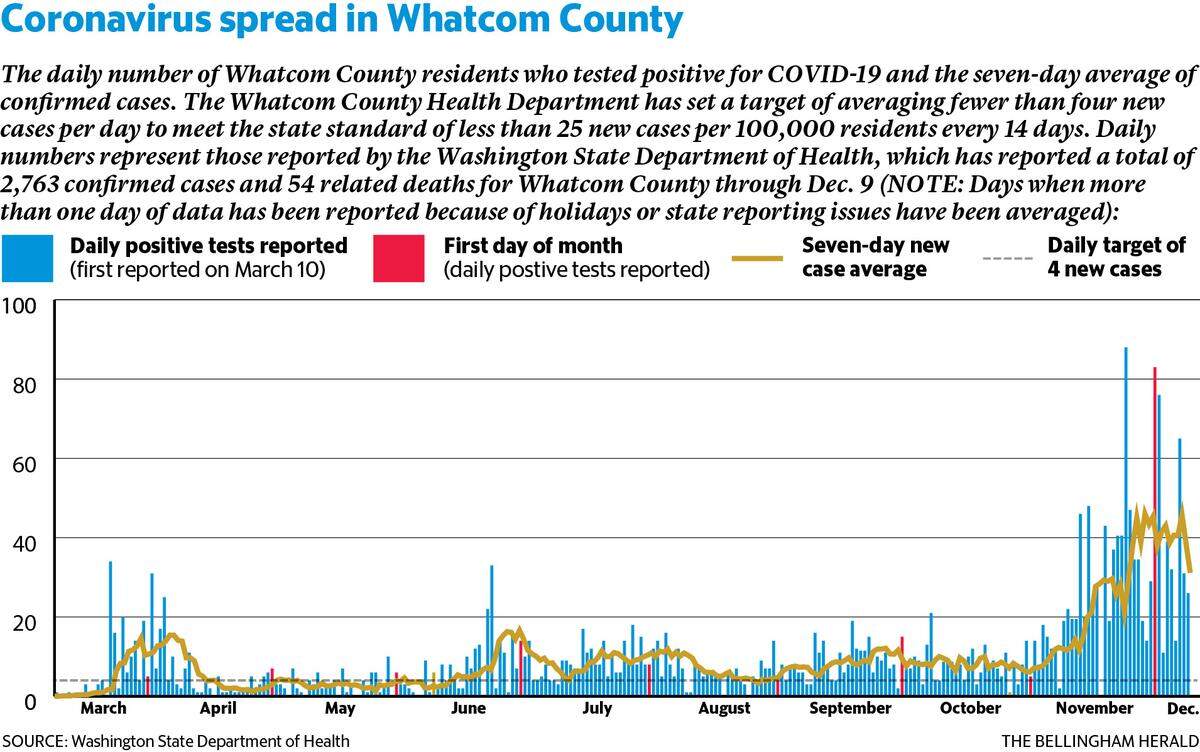
One death and 26 new COVID-19 cases were reported in Whatcom County, according to the Washington State Department of Health Wednesday, Dec. 9.
Whatcom County now has seen 2,763 confirmed cases and 54 related deaths during the pandemic, according to state data as of 11:59 p.m. Tuesday, Dec. 8. That means that 2% of the Whatcom residents who have tested positive for COVID during the pandemic have died.
The state Department of Health data Wednesday also showed Whatcom County has had 159 hospitalizations (no change from Tuesday’s report).
The state also reported that a total of 98,115 tests have been administered in Whatcom County during the pandemic — an increase of 131 tests from Tuesday’s report. The state cautioned, though that “test data from Nov. 21 through today are incomplete and should be interpreted with caution.”
St. Joseph hospital in Bellingham, which is licensed and staffed for 241 beds, reported to The Bellingham Herald on Wednesday that it was treating 15 patients for COVID-19 — unchanged from Tuesday. The hospital hit a record of 21 COVID-19 patients on Tuesday, Dec. 1.
As of Tuesday evening, PeaceHealth was still waiting to hear back from the state Department of Health regarding its application to have the Bellingham hospital be a distribution site for vaccines once they are ready, spokesperson Bev Mayhew told The Bellingham Herald in an email.
Race and ethnicity data
The percentage of Whatcom County COVID-19 cases impacting people identifying as Hispanic, American Indian/Alaska Native and Asian increased last week, according to the latest data released by the Whatcom County Health Department. Every other race or ethnicity category saw its percentage either decrease slightly or remain unchanged.
The county health department breaks down the percentage of cases each for eight race or ethnicity categories represented in Whatcom’s total count and released its latest data Tuesday evening. The Bellingham Herald used those percentages and the county’s total number of cases to estimate the number of cases each race or ethnicity has seen during the pandemic.
Here is what the latest data, which is through Dec. 8, shows:
▪ White, non-Hispanic: 59.2% of cases, down from 59.7% on Dec. 1 (represents 78.7% of Whatcom’s total population). Using that percentage, The Herald estimates 1,296 cases in people who identify as white — a 9.9% increase over the Dec. 1 estimate of 1,179 cases.
▪ Hispanic: 27.0% of cases, up from 26.6% on Dec. 1 (represents 9.5% of Whatcom’s total population). Using that percentage, The Herald estimates 591 cases are in people who identify as Hispanic — a 12.5% increase over the Dec. 1 estimate of 525 cases.
▪ American Indian/Alaska Native, non-Hispanic: 5.2% of cases, up from 5.0% on Dec. 1 (represents 2.5% of Whatcom’s total population). Using that percentage, The Herald estimates 114 cases are in people who identify as American Indian or Alaska Native— a 15.3% increase over the Dec. 1 estimate of 99 cases.
▪ Multiracial, non-Hispanic: 2.8% of cases, unchanged from Dec. 1 (represents 3.6% of Whatcom’s total population). Using that percentage, The Herald estimates 61 cases are in people who identify as multiracial — a 10.9% increase over the Dec. 1 estimate of 55 cases.
▪ Asian, non-Hispanic: 2.5% of cases, up from 2.4% on Dec. 1 (represents 4.3% of Whatcom’s total population). Using that percentage, The Herald estimates 55 cases are in people who identify as Asian — a 15.5% increase over the Dec. 1 estimate of 47 cases.
▪ Black, non-Hispanic: 1.1% of cases, down from 1.2% on Dec. 1 (represents 1.0% of Whatcom’s total population). Using that percentage, The Herald estimates 24 cases are in people who identify as Black — unchanged from the Dec. 1 estimate.
▪ Native Hawaiian or other Pacific Islander, non-Hispanic: 0.7% of cases, unchanged from 0.7% on Dec. 1 (represents 0.3% of Whatcom’s total population). Using that percentage, The Herald estimates 15 cases are in people who identify as Native Hawaiian or other Pacific Islander — a 10.9% increase over the Dec. 1 estimate of 14 cases.
▪ Other race, non-Hispanic: 1.6% of cases, unchanged from Dec. 1 (represents 0.0% of Whatcom’s total population). Using that percentage, The Herald estimates 35 cases are in people who identify as a race or ethnicity other than the seven listed above — a 10.9% increase over the Dec. 1 estimate of 32 cases.
Approximately 20% of all cases (an estimated 547 cases) do not have a known race or ethnicity.
Overall, the number of cases reported in the county increased by 10.9% (268 cases) between Dec. 1 and 8, according to the state Department of Health.
Homeless testing to continue
The Whatcom County Health Department will continue to test those who are homeless and staying at Base Camp as well as the tent encampment at City Hall for COVID-19.
A total of 199 tests have been conducted at both sites since Dec. 1, according to Amy Cloud, spokesperson for Whatcom Unified Command. That includes two rounds of testing at each location.
“We aren’t able to quickly de-duplicate, so that represents total tests, not (the) number of people tested,” Cloud told The Bellingham Herald.
She said people will be tested twice a week.
“At this time, we haven’t set an end date for that twice-weekly testing,” Cloud said.
So far, there have been seven confirmed COVID-19 cases between the two Bellingham sites.
Both sites have become focal points after Lighthouse Mission Ministries, Base Camp’s operator, was notified on Nov. 28 that a homeless man who stayed at the shelter had tested positive. He told Base Camp staff that he had been staying at the City Hall tent encampment as well.
— Kie Relyea, krelyea@bhamherald.com.
Whatcom’s risk assessment
The state’s Risk Assessment Dashboard was last updated Wednesday for data as of 11:59 p.m. Tuesday. It showed that Whatcom County is missing the marks on two key metrics goals.
▪ Whatcom is missing the target rate of fewer than 25 new cases per 100,000 residents every 14 days with a rate of 232.1.
▪ Whatcom had an average COVID-19 testing rate per 100,000 people over a week of 34.8. No goal was stated for this metric, however, the overall statewide number was 185.7. The state Department of Health has said that testing data since Nov. 21 is incomplete, and that likely impacting this metric.
▪ Whatcom is missing the target of less than 2.0% of individuals testing positive for COVID-19 during the past week with a rate of 41.0%. The state Department of Health has said that testing data since Nov. 21 is incomplete, and that likely impacting this metric.
Here is what the latest Healthcare System Readiness risk assessment dashboard, which was last updated Wednesday for data through Tuesday, shows for the North region, which combines Whatcom, Skagit, Snohomish, San Juan and Island counties:
▪ Occupied beds: 1,047 of the region’s 1,222 adult hospital beds (85.7%) were occupied, missing the state’s goal of 80% or less.
▪ COVID occupied beds: 133 of the region’s 1,243 adult hospital beds (10.7%) were occupied by COVID patients, missing the state’s goal of 10% or less.
▪ Occupied ICU beds: 107 of the region’s 139 adult ICU beds (77.0%) were occupied. The state does not have a goal for this metric, but that data is unchanged from Tuesday’s report.
▪ COVID occupied ICU beds: 41 of the region’s 139 adult ICU beds (29.5%) were occupied by COVID patients. The state does not have a goal for this metric, but one more bed was occupied than in Tuesday’s report.
Cancer center cases
The St. Joseph Cancer Center in Bellingham recently had one caregiver and one patient test positive for COVID-19 in unrelated instances, Mayhew told The Herald in an email Tuesday, but no exposure to anyone else was found in either case.
The patient was asymptomatic and went to the hospital as part of readmission testing when their test came back positive, Mayhew reported.
In both cases, Mayhew reported interviews and contact tracing “determined that there were no gaps in PPE (personal protection equipment), therefore no exposure.”
“This is testament to the safety measures we have in place among caregivers and patients — and our very rigorous surveillance protocols,” Mayhew wrote.
Numbers elsewhere
COVID-19 cases and deaths according to Johns Hopkins University Wednesday evening:
▪ The U.S. has more than 15.3 million reported cases, the most of any nation, and 288,889 deaths.
▪ Worldwide, there are more than 68.8 million reported cases and 1.56 million deaths.
Washington state reported these numbers from the Department of Health Wednesday evening:
▪ 189,863 reported cases, an increase of 2,536 from data on Tuesday.
▪ 11,996 coronavirus-related hospitalizations, an increase of 155 from data Tuesday.
▪ 3,225,428 total tests, an increase of 28,378 from Tuesday.
▪ 3,016 deaths related to COVID-19, an increase of 49 from what was reported Tuesday and meaning that 1.6% of the state residents who have tested positive for COVID during the pandemic have died.
Washington state actions
Gov. Inslee announced rules Nov. 15 that eliminate indoor service at restaurants and bars, close indoor activity at gyms, and limit occupancy at retail stores to 25% in an effort to curb the dramatic rise in COVID-19 cases in Washington state.
Those restrictions were originally scheduled to last until Dec. 14, but on Dec. 8, Inslee announced they have been extended another three weeks to Jan. 4.
Inslee issued a travel advisory for Washington state on Nov. 13, recommending Washington state residents self-quarantine for 14 days when they return home after traveling out of the state. The governors of Oregon and California joined Inslee in making similar advisories for their states.
On Oct. 13, Inslee moved all counties in modified Phase 1 to Phase 2, but his July 28 extension of an indefinite pause on counties moving ahead in the Safe Start Washington plan remains in place. That came a week after Inslee loosened some restrictions for activities and businesses.
That means 22 counties — including Whatcom — are in Phase 2 and 17 counties are in Phase 3.
This story was originally published December 9, 2020 at 5:20 PM.