Whatcom sees 31 more COVID-19 cases Tuesday, high transmission rate at Thanksgiving
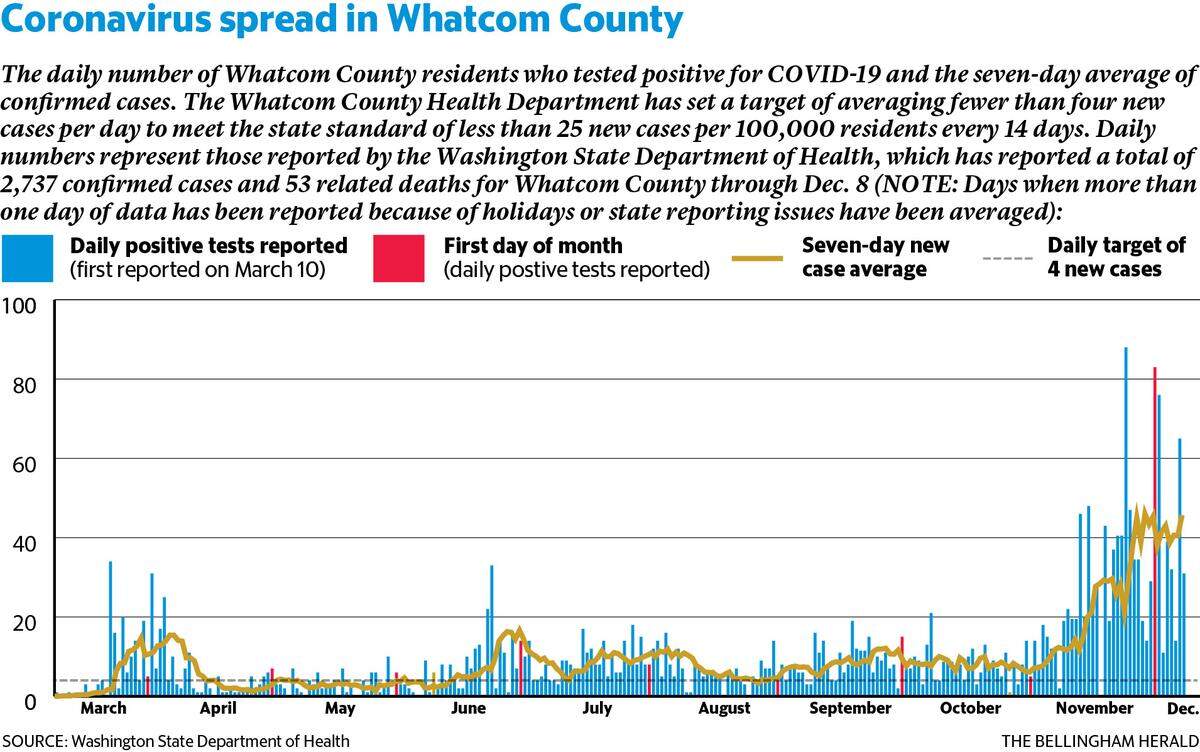
Whatcom County saw its number of COVID-19 cases increase by 31, the Washington State Department of Health reported Tuesday, Dec. 8, but no related deaths were reported.
Whatcom County now has seen 2,737 confirmed cases and 53 related deaths during the pandemic, according to state data as of 11:59 p.m. Monday, Dec. 7. That means that 1.9% of the Whatcom residents who have tested positive for COVID during the pandemic have died.
The state Department of Health data Tuesday also showed Whatcom County has had 159 hospitalizations (an increase of three from Monday’s report).
The state also reported that a total of 97,984 tests have been administered in Whatcom County during the pandemic — an increase of 147 tests from Monday’s report. The state cautioned, though that “test data from Nov. 21 through today are incomplete and should be interpreted with caution.”
On Monday, the state reported three fewer deaths related to COVID-19 in Whatcom County than it had previously reported. During an online media briefing Tuesday, Whatcom County Health Department Director Erika Lautenbach attributed that adjustment to a processing error that occurred Dec. 4 and the removal of some incorrect data.
St. Joseph hospital in Bellingham, which is licensed and staffed for 241 beds, reported to The Bellingham Herald on Tuesday that it was treating 15 patients for COVID-19 — a decrease of one from Monday. The hospital hit a record of 21 COVID-19 patients on Tuesday, Dec. 1.
The Lummi Tribal Health Center reported three new cases late Monday, bringing the total number of cases in the Lummi community during the pandemic to 127, including 63 new cases since Oct. 1. As of Tuesday, the Lummi health department reported it had 12 active cases and no hospitalizations. During the pandemic, four people have been hospitalized, but there have been no related deaths and the health center has conducted 2,893 tests.
Thanksgiving transmission
Lautenbach said the county health department took a “deep dive” into where Whatcom County’s exposures were occurring and found that the highest percentage — approximately 75% — continued to be tied to transmission at home or in small social gatherings.
Of that 75%, the county health department found that between Nov. 27 and Dec. 5, approximately 42% of the infections were tied to Thanksgiving celebrations or travel, Lautenbach reported Tuesday.
“The data certainly tells us that the risk among small social and family gatherings is there for the transmission of COVID-19,” Lautenbach said.
Lautenbach said Whatcom County residents should use those numbers as a guide as they decide how they should celebrate the holidays, now only weeks away, and pointed to the statewide travel advisory, which still remains in effect.
“There is still a significant risk, and it’s not a risk any of us want to take if means infecting our parents or our grandparents,” Lautenbach said.
Even getting screened before holiday travel or gatherings doesn’t necessarily reduce the risk and can put added strain on the testing system.
“Screening is just that — it’s a snapshot of a point in time,” Lautenbach said, adding it doesn’t show the viral load in a person’s system, if they’ve been exposed or the likelihood that a negative test result will become positive in a couple of days. “A negative doesn’t mean you are negative — it only means you’re negative at that point in time. It’s not a free pass to see friends and family a few days later.”
As an example, Launtenbach held up the American Dynasty trawler outbreak that occurred in late May. When the fishing vessel left port in Seattle, all crew members tested negative. Two weeks later, the ship arrived in Bellingham with 86 crew members testing positive.
“We are asking people to stay home with the people they live with during the holidays and find creative, loving ways to celebrate with others outside their household,” Lautenbach said.
Homeless testing update
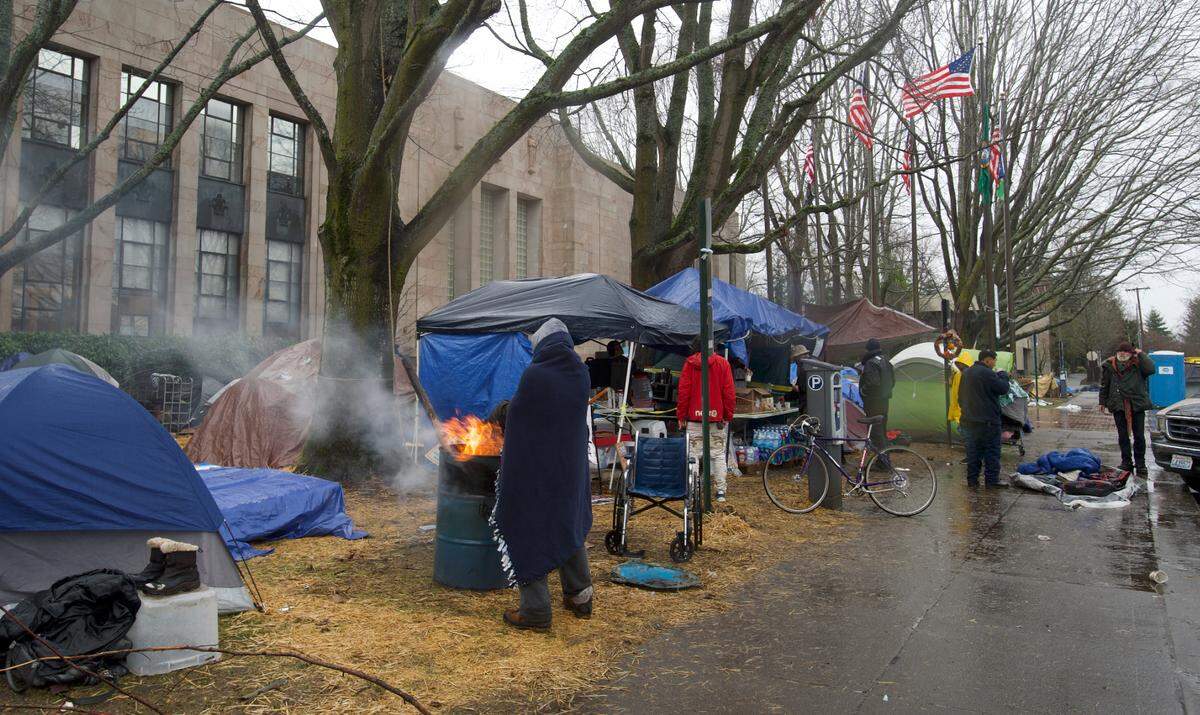
The number of positive COVID-19 cases connected to the Base Camp emergency shelter and a separate tent encampment for the homeless at City Hall has increased by one.
That brings to seven the number of confirmed cases between the two Bellingham sites, according to Lautenbach.
Lautenbach said the health department has conducted two rounds of testing at the tent encampment, which also is known as Camp 210, and plans to do another one later this week.
Those staying at Base Camp also have been tested.
Lautenbach said the health department was still waiting for all of the results for testing conducted at both sites on Sunday, Dec. 6.
Both sites have become focal points after Lighthouse Mission Ministries, Base Camp’s operator, was notified on Nov. 28 that a homeless man who stayed at the shelter had tested positive. He told Base Camp staff that he had been staying at the City Hall tent encampment as well.
The tent camp has been at City Hall for nearly a month, and people there are protesting the lack of shelter for the homeless.
— Kie Relyea, krelyea@bhamherald.com
Whatcom’s risk assessment
The state’s Risk Assessment Dashboard was last updated Tuesday for data as of 11:59 p.m. Monday. It showed that Whatcom County is missing the marks on two key metrics goals.
▪ Whatcom is missing the target rate of fewer than 25 new cases per 100,000 residents every 14 days with a rate of 225.5.
▪ Whatcom had an average COVID-19 testing rate per 100,000 people over a week of 33.8. No goal was stated for this metric, however, the overall statewide number was 188.5. The state Department of Health has said that testing data since Nov. 21 is incomplete, and that likely impacting this metric.
▪ Whatcom is missing the target of less than 2.0% of individuals testing positive for COVID-19 during the past week with a rate of 41.1%. The state Department of Health has said that testing data since Nov. 21 is incomplete, and that likely impacting this metric.
Here is what the latest Healthcare System Readiness risk assessment dashboard, which was last updated Tuesday for data through Monday, shows for the North region, which combines Whatcom, Skagit, Snohomish, San Juan and Island counties:
▪ Occupied beds: 997 of the region’s 1,219 adult hospital beds (81.8%) were occupied, missing the state’s goal of 80% or less.
▪ COVID occupied beds: 129 of the region’s 1,240 adult hospital beds (10.4%) were occupied by COVID patients, missing the state’s goal of 10% or less.
▪ Occupied ICU beds: 107 of the region’s 139 adult ICU beds (77.0%) were occupied. The state does not have a goal for this metric, but that data is unchanged from Monday’s report.
▪ COVID occupied ICU beds: 40 of the region’s 139 adult ICU beds (28.8%) were occupied by COVID patients. The state does not have a goal for this metric, but five fewer beds were occupied than in Monday’s report.
Reporting backlogs and duplicates
The Washington State Department of Health reported Monday night that it is still seeing a backlog of positive lab test results from the weekend and approximately 1,800 duplicate results that have not yet been resolved. The news came in a release shortly after the state reported, 6,972 new COVID cases Monday.
The state reports that it has caught up with most of the backlog of positive test results from last week and has upgraded its servers, and that the high number of cases reported Monday was partially a result of those delays.
But it the dashboard still needs to be updated with nearly 1,800 duplicate cases, according to the result.
The department also resumed reporting negative test results Friday, Dec. 4, after a nearly two-week pause, but the release said not all tests between Nov. 21 and Dec. 7 have been processed yet. For that reason, the dashboards reflect incomplete data.
Numbers elsewhere
COVID-19 cases and deaths according to Johns Hopkins University Tuesday afternoon:
▪ The U.S. has more than 15.1 million reported cases, the most of any nation, and 285,880 deaths.
▪ Worldwide, there are more than 68.1 million reported cases and 1.5 million deaths.
Washington state reported these numbers from the Department of Health Tuesday:
▪ 187,327 reported cases, an increase of 2,923 from data on Monday.
▪ 11,841 coronavirus-related hospitalizations, an increase of 145 from data Monday.
▪ 3,197,050 total tests, an increase of 32,336 from Monday.
▪ 2,967 deaths related to COVID-19, an increase of 26 from what was reported Monday and meaning that 1.6% of the state residents who have tested positive for COVID during the pandemic have died.
Washington state actions
Gov. Inslee announced rules Sunday, Nov. 15, that eliminate indoor service at restaurants and bars, close indoor activity at gyms, and limit occupancy at retail stores to 25% in an effort to curb the dramatic rise in COVID-19 cases in Washington state.
Those restrictions were originally scheduled to last until Dec. 14, but on Tuesday Inslee announced they have been extended another three weeks to Jan. 4.
Inslee issued a travel advisory for Washington state on Friday, Nov. 13, recommending Washington state residents self-quarantine for 14 days when they return home after traveling out of the state. The governors of Oregon and California joined Inslee in making similar advisories for their states.
On Tuesday, Oct. 13, Inslee moved all counties in modified Phase 1 to Phase 2, but his July 28 extension of an indefinite pause on counties moving ahead in the Safe Start Washington plan remains in place. That came a week after Inslee loosened some restrictions for activities and businesses.
That means 22 counties — including Whatcom — are in Phase 2 and 17 counties are in Phase 3.
This story was originally published December 8, 2020 at 4:54 PM.