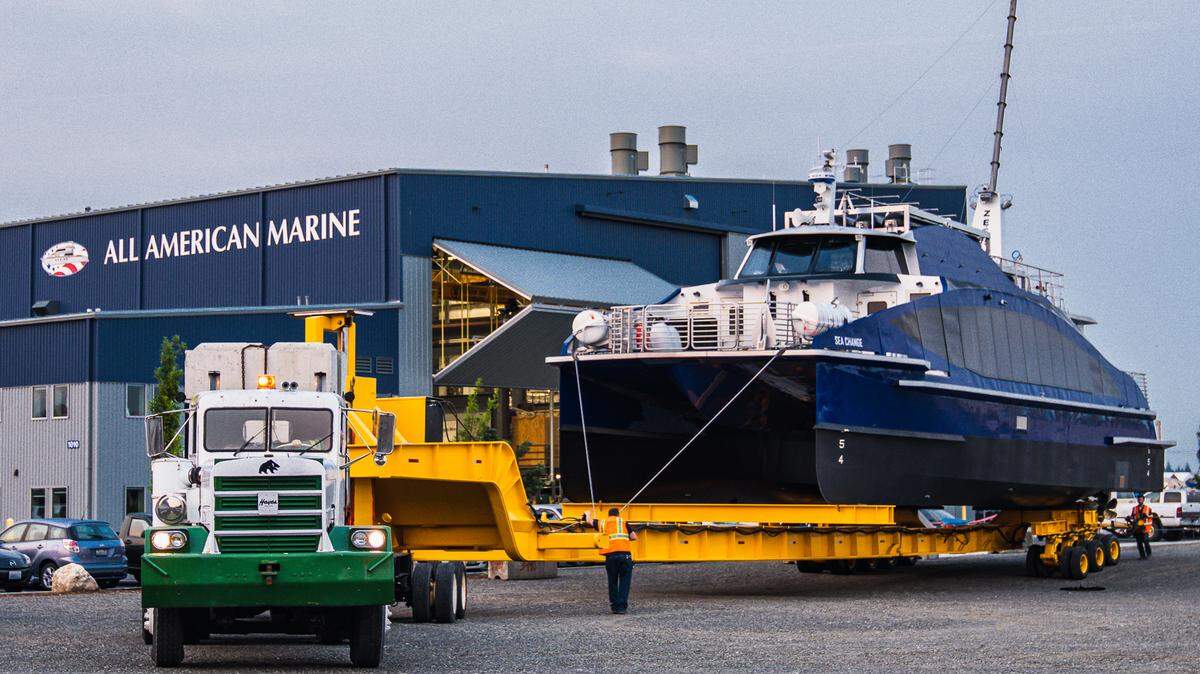
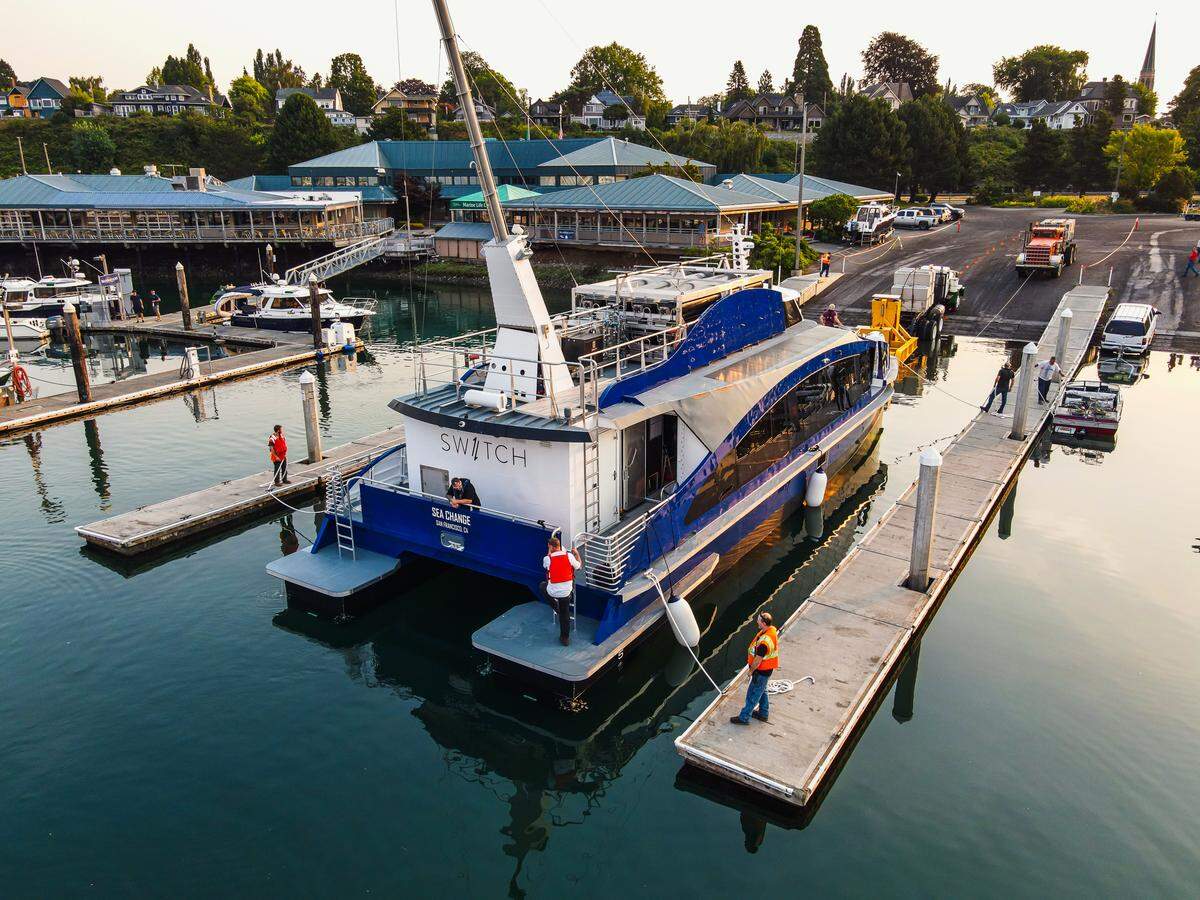
Sea Change, the first hydrogen fuel cell-powered vessel in the U.S., built by Bellingham-based shipbuilder All American Marine and investment company SWITCH Maritime.
Bronson Lamb
Courtesy to The Bellingham Herald
When San Francisco Bay Ferry launched the “Sea Change” on Friday, it became the “world’s first commercial passenger ferry powered 100% by zero-emission hydrogen fuel cells,” according to a news release. But while its impact will mainly be felt around San Francisco Bay, the project has ties to a certain bay two states to the north.
The ferry was built by Bellingham-based boat manufacturers All American Marine in their waterfront workshop on Bellingham Bay. In an email to the Bellingham Herald, AAM Business Development Manager Daniel Zech said that the project fell in line with the company’s goal to be at the forefront of innovation in the shipbuilding industry.
“One of All American Marine’s core values is innovation,” Zech said. “We are constantly striving to push the envelope and incorporate new technologies in our builds.”
Building the first hydrogen-powered ferry
That focus on building unique and innovative boats came with a few challenges while building the “Sea Change,” Zech said.
“As a shipyard, we understand that our customers want reliability and safety because our vessels are the backbone of their operations.,” Zech said. “To that end, our innovation is typically through sustainable, incremental improvements that over the years amount to significant gains in efficiencies, reliability, and passenger experiences.”
For AAM, the toughest part of building a first-of-its kind ferry was that regulatory bodies didn’t have any precedent to base their standards for approval on. The boat initially launched in 2021, but it took years to go through the complete regulatory process and get the ferry in service.
“When it came to the construction of the ‘Sea Change,’ there was no playbook to look to for guidance, so the Coast Guard was writing all of these policies and looking to other regulatory agencies and classification societies for precedent at the same time that All American Marine was looking to them for review and approvals,” Zech said. “The approvals process took so long that by the time we had worked through certain sets of approvals, people within the Coast Guard had been transferred or promoted, and so we had to wait for the replacement to catch up to speed and start the process again.”
Sea Change, a 70-foot-long ferry that can hold 75 passengers, was developed by All American Marine and SWITCH Maritime to test and prove the viability of hydrogen fuel cell technology in the commercial maritime industry. It was launched Thursday, Aug. 12, 2021, at Squalicum Harbor in Bellingham, Wash. All American Marine Courtesy to The Bellingham Herald
Environmental impact of hydrogen-powered ferries
The ferry, which is offering free service between San Francisco’s Downtown Ferry Terminal and the city’s Pier 41, can carry 75 passengers at a time. While it’s owned by Switch Maritime, it will be part of SFDF’s fleet for the next six months to showcase that hydrogen-powered ferries can be a viable option.
“Providing access to this world-first technology for the thousands of future ‘Sea Change’passengers is a key step toward protecting the environment,” Jim Wunderman, Chair of the San Francisco Bay Ferry Board of Directors, stated in a news release.
In the same news release, Washington Governor Jay Inslee stated that the project shows how the two west coast states can partner to develop climate solutions.
“We’re very proud that this state-of-the-art vessel was built in Washington, and we are thrilled that it will be put into operation in the San Francisco Bay Area,” Inslee said. “The ‘Sea Change’ is a great example of Washington and California collaborating toward our shared goal to reduce greenhouse gas emissions and create a more sustainable future.”
2019 data from the Congressional Budget Office says that passenger transportation produces 1.8 billion metric tons of carbon dioxide emissions in the U.S. in a given year. Water transit accounts for 2% of that amount, or 36 million metric tons. However, hydrogen fuel cells could be an option to cut that number drastically.
According to the U.S. Department of Energy, fuel cells work by separating hydrogen molecules into electrons and protons. Like in a battery, the electrons flow to a positively-charged cathode at one end of the cell, and are funneled there through a circuit, which creates an electric current. The hydrogen protons, meanwhile, combine with oxygen to produce water, the fuel cell’s only emission.
Since the ferry’s only emission is water vapor, some of which gets pumped back into a water fountain on board, according to the press release.
This story was originally published July 23, 2024 at 11:08 AM.
Daniel Schrager is the service journalism reporter at the Bellingham Herald. He joined the Herald in February of 2024 after graduating from Rice University in 2023.Support my work with a digital subscription