
Community input sought on next phase of the Whatcom Creek Waterway cleanup project
Cleanup of the Whatcom Creek Waterway is continuing, and the project needs input from the community to determine the next steps.
People can comment and view comments through the Washington Department of Ecology website.
The public comment period lasts until May 23.
Ian Fawley, outreach planner, said the department is seeking constructive feedback on the project, as well as direct community insight and experience. Fawley said people should be specific with their comments by pointing out sections of documents they want to comment on. He also encouraged people to comment if they have specific information or ideas about the waterfront.
“We are dealing with a historical, legacy contamination and the community may know a little more about that legacy contamination as well,” Fawley said.
As part of the public participation required for the project, The Port, the Department of Ecology and a local non-profit RE Sources, hosted a public tour of the waterfront Wednesday.
The cleanup is organized through the Cleanup Action Plan, which will be amended at the end of the public comment period.
One of these amendments includes an early start to the project. The Port received a grant to dredge the contaminated area near the shipping terminal, which will start near the end of the summer. The rest of the Phase II cleanup will begin in 2025, said Lucy McInerney with the Department of Ecology during the waterfront tour.
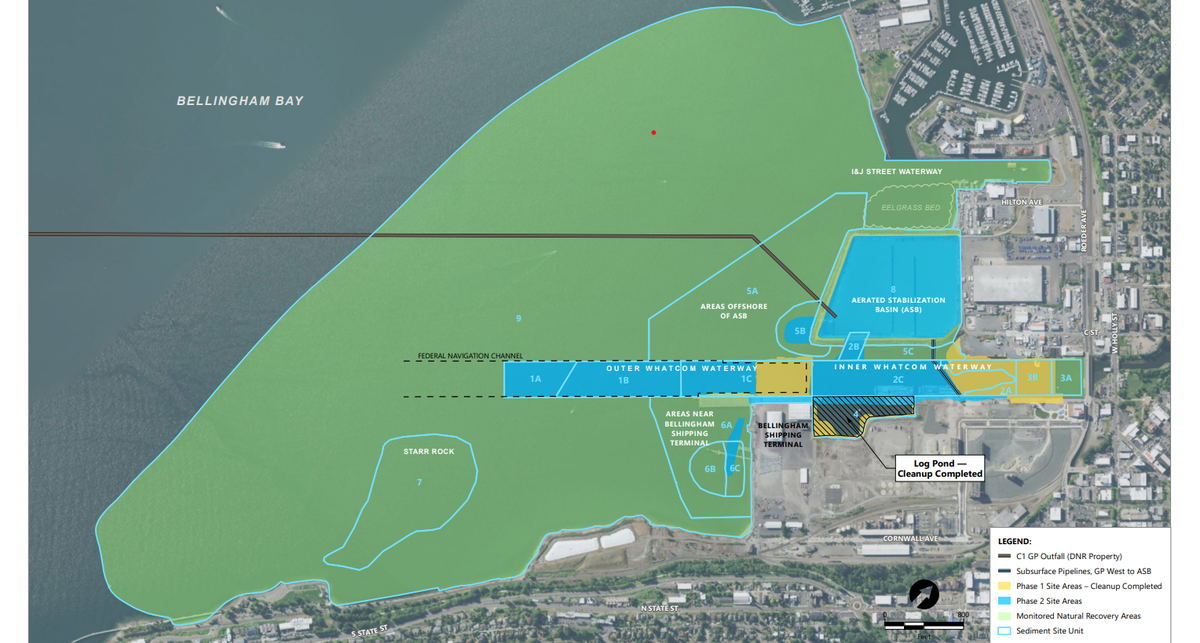
Phase II of the cleanup will include the aerated stabilization basin (ASB). This is a 29-acre wastewater basin, one of the main drivers of the amendment. The Port originally wanted to use this basin as a marina back in 2011, but has changed its goals since that time. Because the use of the area is changing, the cleanup plan needs to change as well.
“That decision was made last year,” Brian Gouran, director of environmental planning services for The Port of Bellingham said during the tour. “This would allow us to change the cleanup approach in the ASB to lead to what is out for public comment right now, which is to build a containment wall down a portion of the ASB, remove all the contaminated sediment from there and put it behind the wall, and take all the rest of the dredged material we take out of the waterway and also put that behind the wall.”
This approach would create about 15 acres of new, aquatic habitat, according to Gouran.
The waterfront was contaminated by the Georgia Pacific chlor-alkali plant, which “used mercury to produce chlorine and sodium hydroxide for use at the pulp and tissue mill. Petroleum was also stored there,” according to the Department of Ecology. The plant shut down its pulp mill operations in 2001, eventually ending its tissue operations in 2007.
The Port of Bellingham bought all 137-acres of the Georgia Pacific property in 2005 for $10, with The Port assuming responsibility for the environmental cleanup.
The first phase of the cleanup started in July 2015 and was completed in 2016. The project removed 111,446 cubic yards of contaminated sediment, 9,962 tons of soil and 265 tons of creosote-treated timber, 5,146 tons of concrete and asphalt rubble (over 98% was reused or recycled), according to the Department of Ecology’s website.
This story was originally published May 5, 2023 at 12:27 PM.
.jpg)