As pandemic eases, Bellingham cracks down on RV encampments
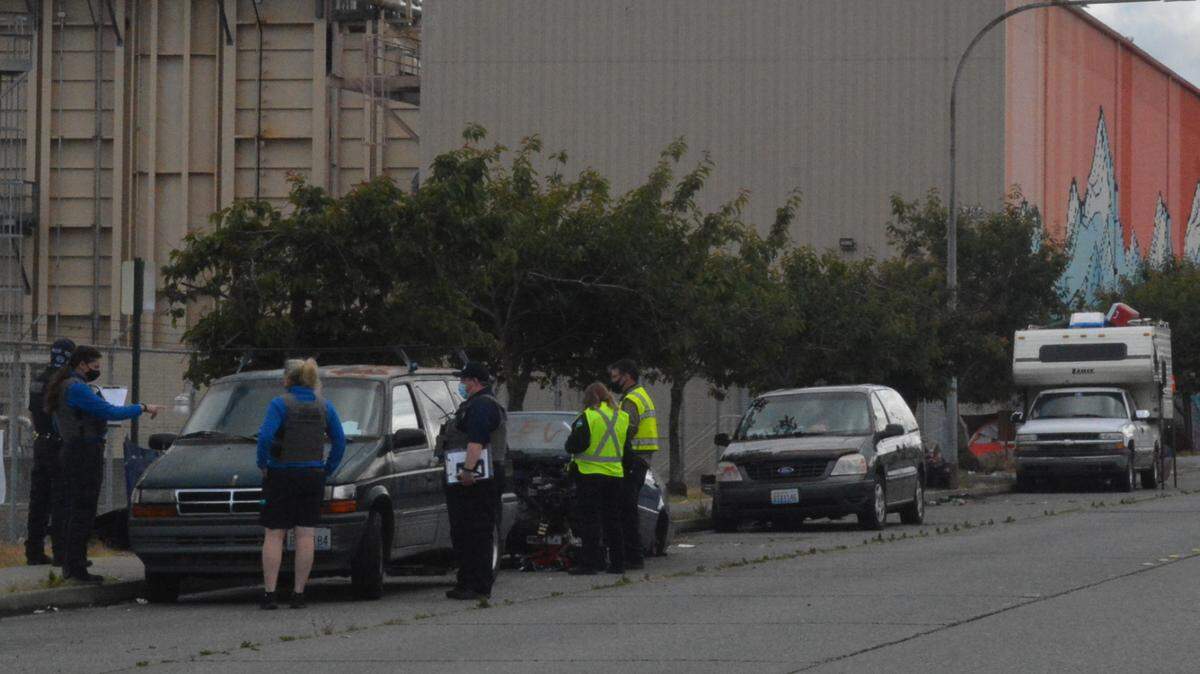
After loosely enforcing the city’s 72-hour parking rules as people sought shelter in cars and RVs during the new coronavirus pandemic, Bellingham officials are now ticketing and towing junked vehicles and forcing others to move every three days.
It’s part of an aggressive new approach by the Police and Public Works departments to clear streets of trash, to remove RV encampments in neighborhoods and to address environmental issues of leaking automotive fluids and sewage from RVs, said Mayor Seth Fleetwood.
Those RV encampments have sparked anger and frustration among residents, business and neighborhood groups on social media, but the city’s recent actions have also drawn criticism from homeless activists whose efforts operate outside local mainstream social service agencies.
“During much of the COVID emergency, we refrained from enforcement of rules that otherwise prohibit parking for longer than 72 hours on our public streets,” Fleetwood told the City’s Council Committee of the Whole on Monday, March 14.
Fleetwood said that the city looked the other way for more than a year during the pandemic for several reasons, including:
▪ Advice from the U.S. Centers for Disease Control and Prevention to allow people to live in cars and RVs, instead of trying to send them to congregate shelters.
▪ Gov. Jay Inslee’s ban on evictions.
▪ A state Supreme Court ruling that affected towing and impounding an RV if it is the owner’s home.
But that changed in late November 2021, even as the highly contagious COVID-19 omicron variant tore through the nation, Fleetwood said.
“The concentrations that we were seeing were just creating some unhealthy situations,” Fleetwood told the City Council.
Fleetwood said the city acted to enforce the parking ordinances after consulting its legal team and agencies such as the Whatcom County Health Department.
Further, the city recently created a Sanitation and Solid Waste Division to address code violations and remove litter.
But homeless activist Markis Stidham criticized the recent action in a conversation over Facebook Messenger.
“With a way understaffed police force, code enforcement is still a priority for them,” said Stidham, a member of Serenity Outreach Services and an appointed member of the now-disbanded Whatcom County Homeless Strategies Workgroup.
“Unless you’ve got a house. Then you’re free to park your car in front of your home for decades,” Stidham told The Bellingham Herald.
Stidham said that evicting people from RVs violates a 2018 ruling by the U.S. Ninth Circuit Court of Appeals in Martin v. Boise, which held that homeless encampments cannot be disbanded if adequate shelter space is not available.
Current CDC guidelines advise caution in the clearing of urban homeless encampments.
“Any modifications to approaches to encampments or people experiencing unsheltered homelessness should be conducted with an awareness of housing availability and homeless service capacity,” the CDC said at its website.
Shelter is not available for many people living outside, according to the most recent Point in Time survey in January 2021, which found 859 homeless people in Whatcom County.
Police Lt. Claudia Murphy said the city is acting within the law as she briefed the City Council about the administration’s concerns, and how the Public Works and Police departments are handling the crackdown.
Murphy described people living in squalor, occupying derelict cars, trailers and RVs full of trash, vermin, rotting food and human waste, and she said it was “inhumane” to allow people to continue living in such situations.
“None of us want to do this, Council. My heart is heavy every time I go out there,” Murphy said.
“I swore to this city 29 years ago that I would do nothing but protect and serve, and there are days when I go home and I feel like I have done neither,” she said.
She told the council that the city adopted a “measured” approach on Nov. 30, 2021, sending officers to place warning notices on cars and RVs and talk to the people living there if possible.
City officials have placed warning notices on some 62 cars and RVs, Murphy said.
It costs the city between $1,500 to $2,500 to have each junked car or RV towed and crushed, she said, but did not say how many cars and RVs have been towed or cite a total cost for the cleanup efforts.
“While some will say that taking that vehicle away from that person is a worse thing, I believe it is not, because we have (services) in place to help that person,” Murphy said.
Murphy said the RVs fall into two categories — ones that can be moved and those that can’t.
Owners of the operational RVs generally are cooperative and leave a neighborhood when they are warned, Murphy said.
But many of the people living in the derelict RVs refuse to leave, and often suffer from mental illness and substance abuse, Murphy said.
“This is not about someone not having a home. It’s about the lack of mental-health services, about the lack of drug addiction and treatment services, and just the lack of services in general,” she said.
This story was originally published March 15, 2022 at 1:53 PM.