This new nonprofit is planting half a million trees in Whatcom. Where will they all go?
It’s been more than two years since Whatcom County Executive Satpal Sidhu ran on a platform that included planting a million trees in the county by 2025.
Now, a version of that ambitious dream might become reality.
The Whatcom Million Trees Project is a new nonprofit taking up the mantle of Sidhu’s call for more trees in the county. Rather than simply planting a million trees, the nonprofit will plant — and protect — a million trees between 2022 and 2026.
“We are planting a lot of trees,” said Michael Feerer, executive director of the Whatcom Million Trees Project who has lived in Bellingham for about three decades. “But half of the million is planting and half of that is protecting.”
Other local nonprofits have been planting and protecting trees in the county for years, including the Nooksack Salmon Enhancement Association and the Whatcom Land Trust. But the Whatcom Million Trees Project will be planting trees at a much greater volume, Feerer said.
Trees have numerous environmental and social benefits for nearby communities — they make for cleaner water and provide shade and habitat. Proximity to trees can even help our mental and physical health, researchers say. And trees are a crucial tool in our fight against worsening climate change, since they suck planet-warming carbon out of the atmosphere.
The trees targeted for protection will be those in existing mature forests, which store more carbon than younger forests. Feerer has recently participated in a local effort to prevent the state from logging a century-old patch of forest south of Lake Whatcom.
The newly planted trees, on the other hand, won’t provide a similar quality of climate and biodiversity benefits until they are at least 20 years old, according to the nonprofit’s website.
Where will the trees go?
Planting half a million trees by 2026 will double the current rate of tree-planting in the county, the nonprofit’s site says.
But where will they all go? About 85% of the projects funded by the new nonprofit will restore critical habitat on public lands, and the remaining ones will be in local parks and in urban environments.
Most of the trees planted will be native conifer species, Feerer said. Some projects in local parks may include species with larger canopies that provide more shade.
The Whatcom Million Trees Project budgets $10 for each new tree, which includes not only the cost of the two-year-old sapling itself but the cost of monitoring the young tree for three years after it is planted.
The nonprofit does not receive any county funding and currently relies on donations and fundraisers.
Diligent monitoring done by the nonprofit’s volunteers will ensure that the trees planted have the best chance of survival. Feerer doesn’t want a repeat of what happened in Turkey in 2020: Up to 90% of 11 million trees planted as part of a similar project were suspected to have died after only a few months.
“We want to avoid these situations,” Feerer said. “It helps that we are here locally.”
The nonprofit is trying to be “climate-smart” as it selects which species of trees it will plant, Feerer said. Climate change projections show that regional temperatures may shift, making Whatcom County hotter on average.
“Studies show there might be good reason to plant conifers more acclimated to, say, an Oregon or southern Washington, up here because of the way temperatures are shifting,” Feerer said.
Collaborating with industry
Although the Whatcom Million Trees Project is trying to protect trees, Feerer isn’t trying to make an enemy out of local logging companies. He’d rather try to work together.
He has met up with members of the logging industry to explore alternative ways for them to make money on their forests. Feerer is particularly interested in the potential of Whatcom forests to generate “carbon credits,” which companies, governments or individuals can purchase to offset greenhouse gas emissions created by their own activity.
“Logging companies are painted as monsters,” Feerer said. “If I can walk into their office and talk carbon credits and dollars with them, then I have their interest.”
Cherry Point, an area known for its fossil fuel activity and heavy industry, also presents an unexpected opportunity for tree-planting, Feerer said. The industry players there own much more land than is currently developed, he said. Feerer is trying to connect with the companies to discuss whether trees can be planted along the borders of their land to tie together different habitat areas.
But whether the companies choose to collaborate remains to be seen.
“Not only does local management have to agree, but world headquarters has to agree,” Feerer said. “It takes a while.”
A very local effort
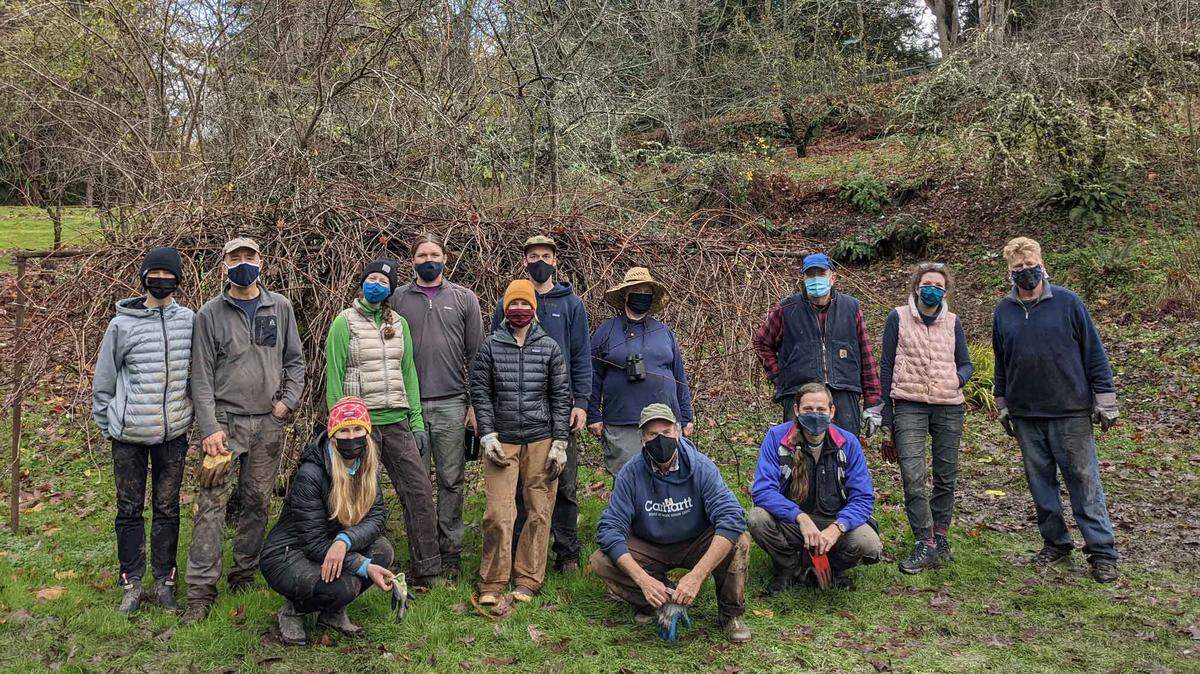
The Whatcom Million Trees Project has already held a volunteer work party at the city of Bellingham’s Woodstock Farm, where it is helping to restore an heirloom orchard and reforest a clearing. The nonprofit has several more projects planned for 2022, including one at Cordata Park in northern Bellingham and another at Hovander Homestead Park in Ferndale.
Feerer encourages residents interested in participating in future work parties to get on the nonprofit’s contact list through its website, whatcommilliontrees.org. The contact list currently has about 25 names, but Feerer is hoping to grow that number to several hundred by the end of 2022.
“People can be involved without having to wait for national policy,” Feerer said. “Planting trees is a very hands-on thing that people naturally resonate with.”
This story was originally published January 11, 2022 at 5:00 AM.