Washington plans to log a century-old Whatcom forest, but opponents aren’t giving up yet
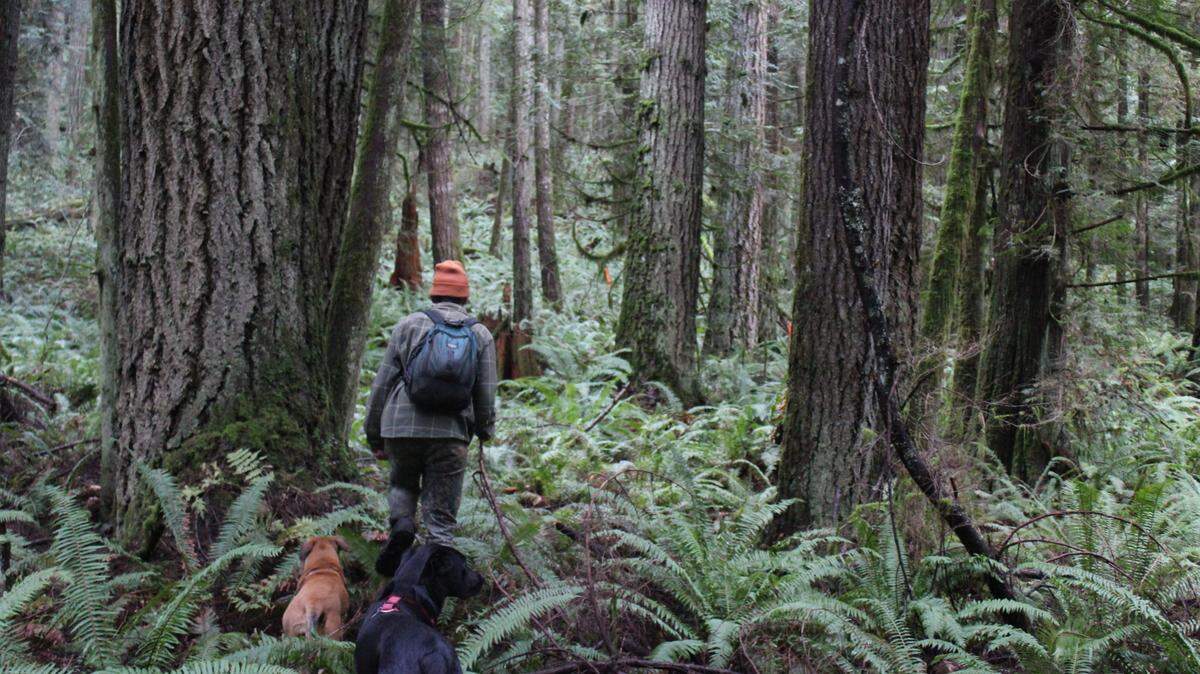
It’s not easy to get where Stephen Kropp was headed on a cool day in mid-November. But it was well worth it to the executive director of the nonprofit Center for Responsible Forestry — by the end of his journey, he stood among trees south of Lake Whatcom that have guarded this land for more than a century.
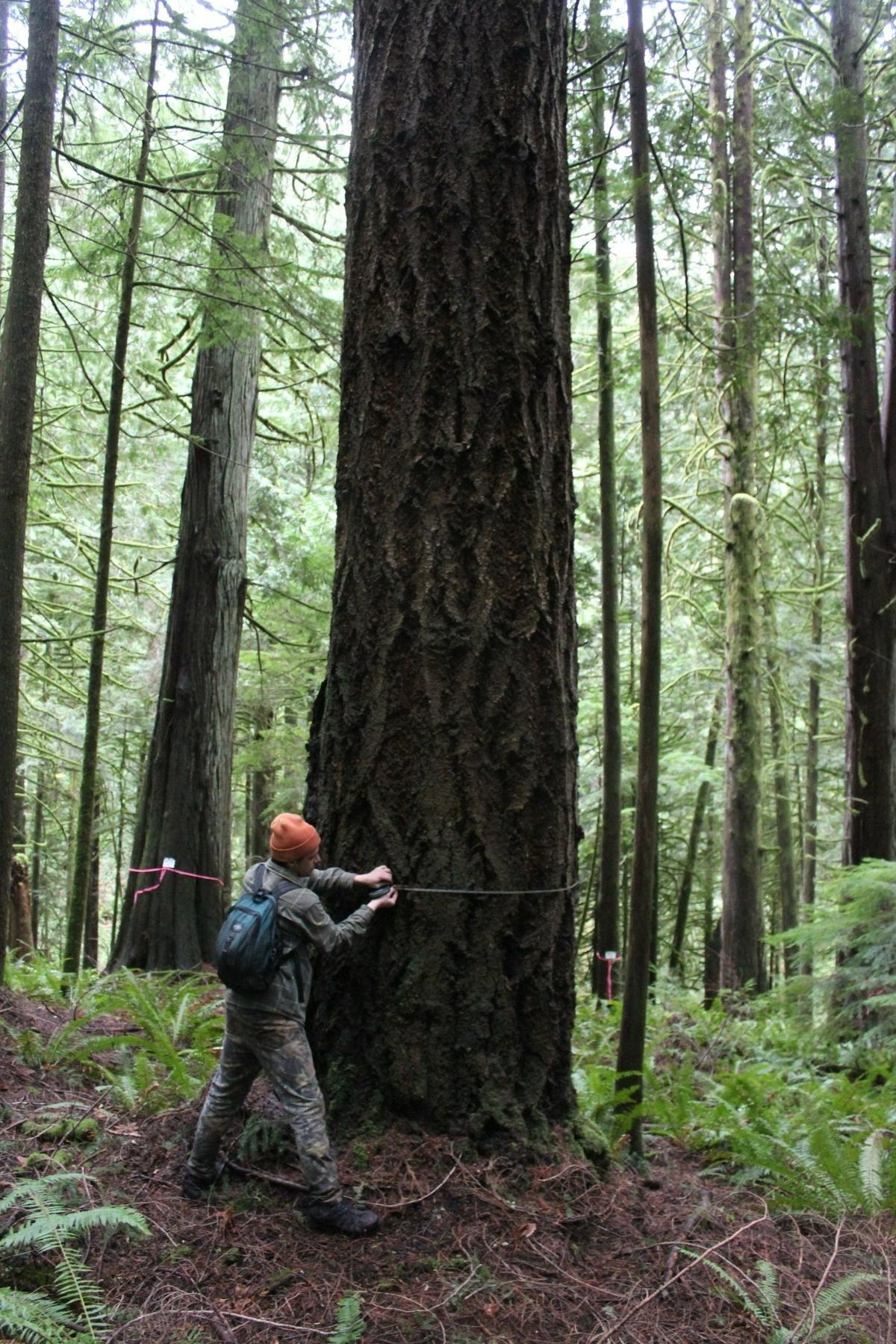
These are trees that have lived through pivotal inventions, world wars and social revolutions. Some are four feet in diameter, a challenge for even the longest-limbed tree hugger.
But it’s a forest on death row, as the Washington State Department of Natural Resources moves forward with plans to sell the estimated $2.2 million in timber in spring 2022.
This is the Bessie timber sale. It sits on Anderson Mountain, between the southern tip of Lake Whatcom and Sedro-Woolley.
To get to it, Kropp must drive more than an hour north from his home in Tacoma and navigate his car up a private road before coming to a locked gate that prevents vehicles from going any further. The public is allowed here, but there are no maintained trails on this part of Anderson Mountain.
Hunters’ gunshots sometimes echo through these types of far-flung state-owned forests, Kropp said, but not here, not today.
“In most cases, nobody knows these forests exists because nobody has any reason to visit,” Kropp said. “These don’t exist on any maps.”
After walking around the locked gate, Kropp bushwhacked his way up steep, untamed terrain for roughly two miles, he said.
Finally, he’s there, and it’s pure magic as the world around him transforms from younger plantation forest, replanted with one or two species after being clearcut, to what Kropp calls “legacy forest,” a term used by the Center for Responsible Forestry for forests allowed to naturally regrow after being logged by the Pacific Northwest’s early settlers. These forests are now approaching the same structural complexity and age as old-growth forests, rare natural marvels that have never been logged, Kropp said.
“You notice a big change,” he said of walking into the older portion of the Whatcom forest. “The forest really opens up. The trees are much bigger.”
Kropp and a handful of Whatcom environmentalists are fighting back against the DNR’s plans to allow the 166-acres of forest in the Bessie timber sale to be cut down. They argue that although the forest isn’t old enough for the state to protect it through its own definition of old-growth, a portion of it is old enough to merit special treatment for its ecological value and capacity to suck planet-warming carbon emissions out of the atmosphere, which would help combat climate change.
The environmentalists are particularly concerned with Unit 2 of the timber sale, a 46-acre swath of forest with some trees that the DNR said originated around 1900. That makes them about 100 to 115 years old, according to an old-growth assessment completed by the DNR in May 2021.
There are century-old trees in this forest, but it is not old-growth as the DNR defines it: Old-growth forests are structurally complex, mostly undisturbed timber stands with natural origin dates prior to 1850, the start of European settlement in the Pacific Northwest. They are “often valued and revered as representatives of what used to exist,” reads the DNR’s 2006 Policy for Sustainable Forests.
The Bessie timber sale is also in the Lake Whatcom watershed, raising water quality concerns for opponents of the timber sale.
“It’s a pretty typical timber sale in a really special, unique place,” said Alexander Harris, the North Sound coordinator for the Center for Responsible Forestry and a graduate student studying environmental policy at Western Washington University.
How old is the forest?
Forests are complex, quiet creatures, and it’s difficult to determine their age with absolute certainty. The DNR estimates tree ages by evaluating physical characteristics and sometimes coring trees to count growth rings.
Although the DNR’s assessments for the Bessie timber sale say that Unit 2’s origin date is around 1900, the Center for Responsible Forestry pushes back on this assertion. Kropp said that the DNR’s own “combined origin” forest inventory data indicates about half of Unit 2 originated in 1876, which would make that portion of the forest about 145 years old.
The data that the Center for Responsible Forestry is referring to is just an estimate, said DNR spokesperson Kenny Ocker, and the recent assessment that determined that Unit 2 originated around 1900 is more accurate.
Unit 2 is a second-growth stand, Ocker said, meaning it is a forest that has regrown after loss of original tree cover. It naturally regenerated, rather than being manually replanted as a plantation forest.
Forest origin dates are not as meaningful when discussing natural forests logged in the late 1800s, Kropp said. Back then, many trees were left behind when a forest was harvested for timber, simply because people did not have the technology to clearcut.
“They were cutting trees down with hand saws and often pushing them down the hill using oxen or even brute manpower to get them to the train tracks,” Kropp wrote in an email to The Bellingham Herald. “Many trees were left behind, and the stand grew back gradually, so that depending on which part of the stand you’re sampling, you might find that the dominant trees that form the upper canopy are many decades apart in age.”
Second-growth forests can eventually regain old-growth characteristics, particularly if they are managed wisely. The DNR itself has invested in this possibility: The agency is trying to restore a second-growth forest to older-growth structure in southwest Washington at the Elk River Natural Resources Conservation Area.
Some of the tallest trees in the Bessie timber sale are about 230 feet tall, according to the DNR. Kropp said his staff went out to the timber sale and measured a number of trees that were more than 4 feet in diameter, as well as many more that were close to 4 feet in diameter. The largest tree they measured was almost 5 feet in diameter, Kropp said.
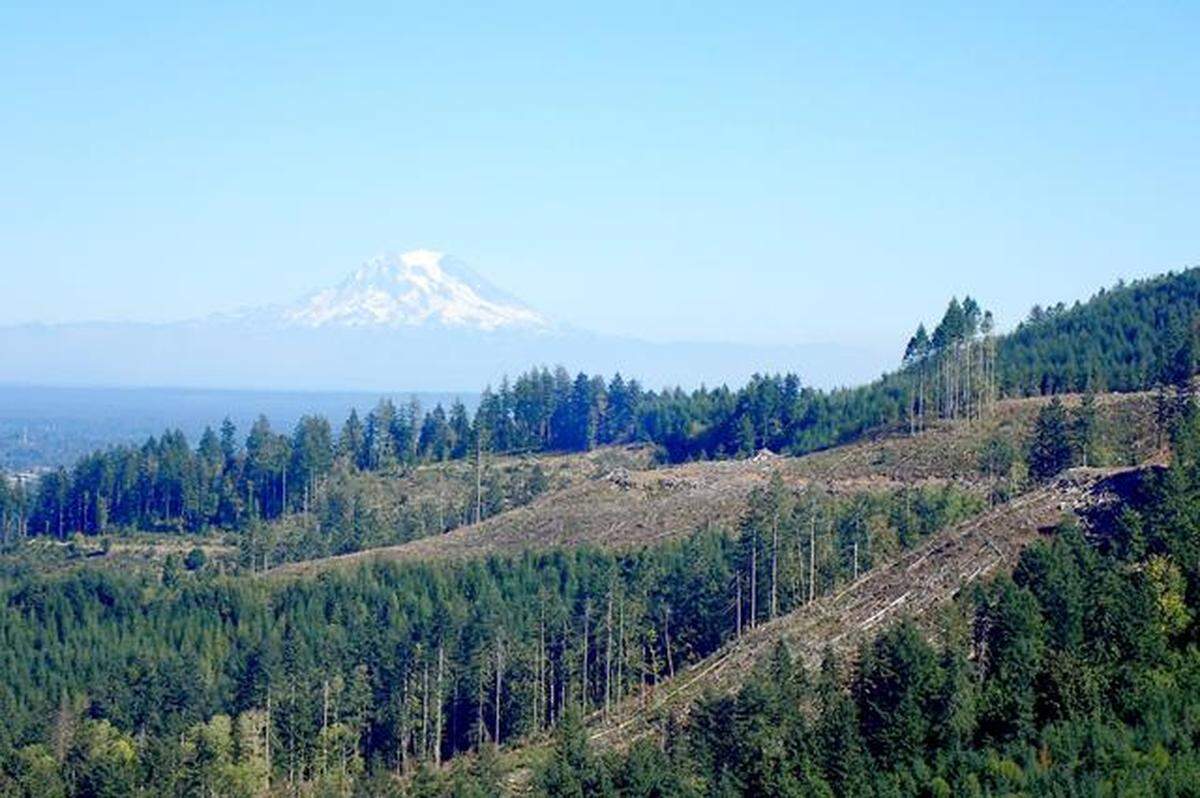
Unit 1 of the Bessie timber sale is 120 acres and originated around 1988, according to an environmental review completed in October by the DNR. It has already lost tree cover twice before, making it a third-growth plantation forest, predominantly comprised of Douglas fir.
That is the fate of Unit 2 if the Bessie timber sale moves forward as is, Kropp said. Plantation forests are typically young and homogeneous, with trees that are tightly packed together.
“They’re everywhere. Plantation forests are much more common than natural forests,” he said. “Walk on DNR land, and most of the forests you will see are plantation forests.”
It’s not just about Bessie
This fight is about Bessie, but it also is the poster child for a bigger issue, said Brel Froebe, a Bellingham resident and communications coordinator for the Center for Responsible Forestry.
“This particular timber sale is representative of many other timber sales happening in the next one to two years,” Froebe said. “This is just one of many that’s coming down the line.”
By the end of June 2024, the DNR plans to harvest 430 acres (including the Bessie timber sale) of the 6,827 acres of forest the agency manages in the Lake Whatcom watershed, Ocker said.
The Center for Responsible Forestry said that the number of acres slated for harvest in the watershed jumps to roughly 1,200 if you look at DNR plans for the next decade, according to DNR planning data the nonprofit received through a public disclosure request. But Ocker said that the state Board of Natural Resources has not yet determined the amount of timber that can be sustainably harvested for the planning decade that starts on July 1, 2024.
“It would be imprudent to speculate how many acres would be harvested across Whatcom County as a whole, let alone a smaller subset of the more than 87,000 acres of trust land DNR manages there,” Ocker told The Herald in an email.
The DNR manages 3 million acres of state-owned trust lands, which bring in revenue for the construction of K-12 public schools, county services, state universities, some state buildings and prisons.
The agency is legally obligated to manage state trust lands to generate revenue and act with undivided loyalty to trust beneficiaries, according to the DNR website.
Over the past 50 years, state trust lands have brought in more than $9 billion in non-tax revenue to state and local governments, according to a November letter from DNR Deputy Supervisor for State Uplands Angus Brodie to the Center for Responsible Forestry.
Forests managed by the DNR keep Washington from having to import timber, Brodie wrote in the letter.
“If we get our timber from elsewhere, it will be harvested in areas with fewer environmental protections, and there will be a large carbon cost to deliver that product to Washington State,” Brodie wrote.
The state agency considers environmental protection in its management practices, Ocker said in an email to The Herald. He touted the state’s Habitat Conservation Plan, which he said safeguards a vast majority of older forests by protecting habitat for species, such as the marbled murrelet, northern spotted owl and salmon.
The DNR also completes an environmental checklist for timber sale projects to understand the proposal’s environmental impact.
But as climate change bears down on the Pacific Northwest, more older forests need to be protected, say the Center for Responsible Forestry and Bellingham-based environmental nonprofit RE Sources, which also submitted a letter to the DNR opposing the Bessie timber sale. Revenue can no longer be the only priority when managing state trust lands, Kropp said.
Forests absorb large amounts of carbon dioxide and are a key tool in the fight against climate change, which is caused by humans burning fossil fuels and pumping greenhouse gases into the atmosphere. And more mature forests sequester, or trap, more carbon.
“Forestry requires a proactive approach,” Harris with the Center for Responsible Forestry said. “You can’t wait until you are really (in trouble) and then protect the forests.”
A warming planet will take a toll on the DNR itself: Drought and high temperatures fuel wildfires that pose a “significant risk” to both the DNR’s short- and long-term revenue forecasts, according to a quarterly forecast updated in October.
Whatcom water quality woes
Water quality is also a concern for the environmentalists who oppose timber harvest near Lake Whatcom.
The lake, which is listed as an impaired water body by the state Department of Ecology, supplies drinking water for nearly 100,000 Whatcom County residents. It has excessive levels of phosphorus and fecal coliform bacteria. Too much phosphorus spurs algae growth and depletes oxygen in the water.
But trees can help: They are experts at filtering nutrients and contaminants out of water runoff, studies have shown.
The pressure on Lake Whatcom’s water quality is “cumulative” and “enormous,” since there are septic tanks and boats in and around the lake, Senior Environmental Advocate Ander Russell with RE Sources said. Russell is concerned that worsened water quality would result in higher water treatment costs for Bellingham residents.
The city of Bellingham did not express concern about the Bessie timber sale’s impact on Lake Whatcom water quality in an email from Riley Grant, the city’s environmental education coordinator, to The Herald..
“The quality of the City’s drinking water is not at any more of an additional risk due to the potential impacts from forest practices, than it is from the increased sediment load that follows significant storm events,” Grant wrote.
Grant pointed to the number of permits that development activities must get before proceeding and said that it is not practical to determine the financial impact of any one source of pollution on water treatment.
How to save a forest
So what do the opponents of the Bessie timber sale want?
Ideally, the DNR would remove all 46 acres of Unit 2 from the timber sale, as well as any remaining trees with origin dates between 1876 and 1926 (an estimated 50 acres), according to letters sent to the DNR by RE Sources and the Center for Responsible Forestry.
The groups also want the DNR to harvest the remaining timber using a method they say would maintain more of the forest’s structural diversity.
The DNR plans on using “variable retention harvest” for the Bessie units, which leaves at least eight trees per acre and provides buffers to protect streams, unstable slopes, waterways, wetlands and cultural resources, Ocker said. This method retains a mix of standing, dying, large and small trees.
Large, structurally unique trees will be prioritized as “leave trees,” which are marked trees that will not be harvested, according to the Forest Practices Application for the Bessie timber sale.
Variable retention harvest is a euphemism for clearcutting in the way that DNR practices it, Kropp said.
The environmental groups would prefer that the DNR use “variable density thinning.” This approach leaves behind a “very messy and more natural” forest by harvesting different trees at different intensities throughout the forest, Harris with the Center for Responsible Forestry said.
The groups would like to see smaller-diameter trees harvested in areas within 250 feet of streams and on certain steep slopes. Larger trees can be harvested in other appropriate areas.
“A forest’s structural diversity is one of the most important drivers of habitat quality,” RE Sources’ Russell wrote in a Nov. 17 letter to the DNR.
If the DNR chooses to leave Unit 2 in the sale, RE Sources wants the agency to harvest it using variable-density thinning as well.
But variable-density thinning isn’t lucrative enough, Ocker wrote in an email to The Herald: It wouldn’t “provide an appropriate return on investment for road maintenance and staff time costs” associated with the Bessie timber sale.
The public can send comments about the Bessie timber sale to the state Board of Natural Resources at bnr@dnr.wa.gov or through verbal public testimony before the sales are eventually presented for auction.
Previous successes
Halting a DNR timber sale is an uphill battle, but not an unwinnable one.
It’s not unheard of for state trust lands to be conserved for ecological benefit rather than timber harvest, Harris said. The Trust Land Transfer Program allows the state to protect trust lands deemed as having special properties for public benefit. Rather than using the money earned from selling the timber for school construction, legislative funds are dedicated to the purpose.
This program was used in 2019 to protect hundreds of acres of DNR-managed forest on Blanchard Mountain, home to Oyster Dome and Samish Overlook.
A more revolutionary idea is to use state trust lands to generate carbon credits, which companies can purchase to offset the climate-warming pollution their operations generate. Selling the carbon credits would help replace timber revenue.
Former DNR Commissioners Jennifer Belcher and Peter Goldmark have called for this approach, but current Commissioner Hilary Franz does not support their proposal to phase out commercial harvest of state forests west of the Cascades.
An example of the carbon credit approach is King County’s Forest Carbon Program, which protects local forests and generates carbon credits, according to Michael Feerer, executive director of the Whatcom Million Trees Project and another opponent of the Bessie timber sale.
Feerer said he understands that timber is a necessary material in our society and that it can serve as a more sustainable alternative to steel and concrete. But there’s a line, he said, and the DNR’s plans to harvest the Bessie timber sale cross that line.
“It’s not saying ‘Hey, let’s stop all logging in Whatcom County,” Feerer said. “It’s saying that there are highly prized ecological spots in Whatcom, and let’s not log there.”
To walk through the forest in the Bessie timber sale is to be humbled and inspired, Kropp said.
People often ask him if he gets depressed when he visits these older forests, he said, knowing it may be a matter of time before they are reduced to shreds of their former ecological glory and condemned to a future as a plantation forest.
But depression isn’t what Kropp feels as he walks among the trees in the Bessie timber sale. He is heartened that these “stunningly beautiful” places — legacies of the old-growth forests that once dominated western Washington — still exist. As long as they stand, quietly but proudly, he has hope.
“This is what brought me to the Northwest when I was 23 years old,” said Kropp, who grew up in North Carolina. “It’s what keeps me here. The idea that these forests still exist and we have an opportunity to save them from the chainsaw.”