Some Whatcom farms may not survive after last week’s heat. Here’s how they’re coping
Rolf Haugen hasn’t seen anything like it in his 40 years farming raspberries and blueberries in Lynden — last week’s record-breaking heat wave scorched his crops, leaving raspberries yellow and cracked and blueberries pink and shriveled.
“That last day just really did them in,” said Haugen, who runs Haugen’s Raspberry Farm and is manager of the Northwest Berry Co-op. He was referring to Monday, June 28, when the high temperature in Lynden reached 106 degrees. “We can see in some varieties that it’s already ruined the new growth for next year. It just burned them down.”
While the county’s dairy farmers also had to ramp up efforts to cope with the heat’s impact on their cows, the consequences were not as severe as for berry farmers.
But berry farmers across the county had their crops, particularly raspberries, boiled by the extreme heat. They’re taking a financial hit on an industry where it’s already difficult to turn a profit.
In the coming weeks, people can expect berry supply to be low at local U-pick farms.
“We are hoping we can apply for some disaster relief,” Haugen said. “There are growers that won’t survive because of this.”
He estimates berry farmers countywide lost 25 percent to 50 percent of their crops. Henry Bierlink, executive director of the Washington Red Raspberry Commission, guesses that there will be at least a 30 percent loss — that’s nearly 20 million pounds of raspberries if you calculate the estimated loss using last year’s total harvest amount of 63.7 million pounds.
Boxx Berry Farm in Ferndale posted Monday on Facebook that its U-pick fields would be closed until further notice, due to the heat wave’s impact on crops. “This hurts pretty bad,” the farm wrote in the post.
Four days later, on Friday, the farm posted that U-pick strawberry and raspberry fields will be open only on Saturday, July 3, from 9 a.m. to 6 p.m.
“Because y’all keep wanting to pick raspberries despite the sun damage, we are opening U-pick raspberries up!” the farm wrote in the Friday post. “There are good raspberries out there and it would be a shame that the good ones don’t get picked.”
The farm will reassess on Monday, July 4, in order to determine when U-pick will fully return. Boxx Berry lost about half of its raspberries, but continues to sell frozen ones from last year, as well as fresh flower bouquets.
At Barbie’s Berries in Ferndale, raspberry crop yield early this week was half of what it was expected to be, said owner Barbie Kraght. The varieties her pickers are currently harvesting should be at their peak right now, but as the fruit overheats internally, it shuts down and ceases ripening, Kraght said. The berry turns white, which she said doesn’t alter the taste, but makes the fruit unappealing to customers who might mistake the color for mold. If the berry gets too sunburned, it becomes hard and crunchy.
“We have had sunburn and dealt with it, but not this extensively sunburned,” Kraght said. “You usually work through it, and you don’t panic. But you don’t see anything like this.”
Berry farms look for aid
Many raspberry farmers are wondering how they’ll make ends meet with so much of their product destroyed by the heat. Some are considering applying for disaster relief to bolster their finances.
A group of local farmers approached Whatcom County Executive Satpal Sidhu asking about financial relief, and while Sidhu said the county does not have the funds, it will support the farmers in applying for aid through federal and state programs.
“The farmers are researching if there is a particular aid program,” Sidhu said. “I asked them to look at FEMA, USDA and the state Department of Commerce. These are the three bodies we can reach out to.”
The Washington Red Raspberry Commission is collaborating with the Washington Blueberry Commission and Oregon berry commissions to seek federal and state relief support for farmers as well, the commission said in its July newsletter.
The damage is particularly disappointing because the region’s berry growers were expecting this to be a profitable year for an industry that is often difficult to make money in, Haugen said. Raspberries are a difficult crop to grow due to stringent regulations, high labor costs and the fruit’s sensitive nature, and the price that buyers are willing to pay is typically low compared to the cost of production.
Plus, while the cost of production has increased over the four decades Haugen has been farming, he is still expected to sell raspberries for the same price he did in the 1980s, he said.
“We always joke that in the raspberry business you make good money every seven years,” Haugen said. “You get two years where you make a little, two years you lose money, three years you break even.”
Fewer people are growing raspberries in the county, Haugen said, since it’s hard to make a profit. Lower supply has driven the price of the fruit up recently, which is why this was supposed to be a profitable year for those still in the game. Haugen said he sold off most of his raspberry fields in the last year, only keeping the nearly 14 acres of U-pick because his grandchildren like to visit it in the summer.
“It’s fun to farm berries,” Haugen said, explaining that raspberries are the hardest fruit he’s grown. “But when you write a big check to do it, you do that for a few years and your wife starts to look at you like you’re crazy.”
If heat waves like last week’s become more frequent and severe — which they are expected to due to human-caused climate change — Haugen doesn’t see how Whatcom County will be able to support small raspberry farms. Unless a new variety becomes available, he predicts raspberry growth in the area will continue to decline.
There’s not much berry farmers can do when a heat wave hits, Haugen said. Perhaps water misters could be set up over blueberry fields, he hypothesized, but most farmers in the county don’t have access to enough water to put in a system like that. Water rights are a contentious issue in the region, with farmers, landowners and tribes competing for access to the resource.
“My hope is that once we get a few pickings into the season, maybe we will pick through this,” he said. “Maybe there will be berries further in the bush that will still be good.”
Brighter future for dairy
Although many dairy farmers were concerned about the potential impacts of the heat, their animals and production seemed to fare better than berry growers’ crops. The biggest challenge for some dairy farmers was keeping themselves healthy and hydrated as they worked up to 14-hour days caring for their herds. At Twin Brook Creamery in Lynden, the nearly 200-cow herd was kept cool with at least eight large fans positioned around the barn.
“The cows probably tolerated it better than we did,” said Larry Stap, a dairy farmer at Twin Brook. “We saw it coming and invested in a lot of great big fans. We had breezes going right through the barn.”
Heat waves often negatively impact milk production, Stap said, as cows are highly sensitive to hot weather. However, this heat event didn’t reduce his farm’s production significantly, he said. Twin Brook raises Jersey cows, a small brown breed that tends to tolerate heat better than Holsteins, the larger black-and-white breed you’ll often see pictured on milk cartons.
Stap and his family spent the day refilling the cows’ cold drinking water and making sure they themselves didn’t succumb to heat-related illness. If heat waves like this became more common, Stap might install water misters in the barn to keep the animals cool, which many dairy farmers do in warmer climates such as Eastern Washington.
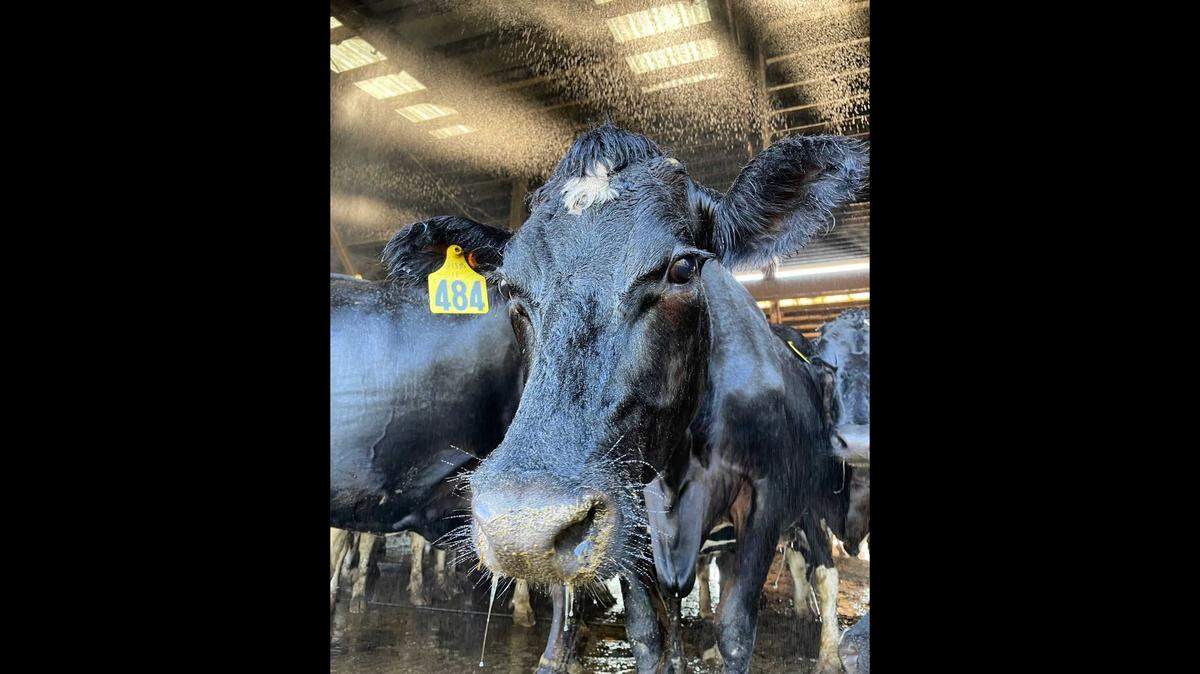
Kate Steensma of Steensma Dairy & Creamery in Lynden had a similar idea — when the heat wave started, she drove to Home Depot and spent about $50 on drip irrigation lines and other supplies to build a makeshift water mister system for the barn. She was afraid some of the animals would die, especially since nighttime temperatures were so high, offering little respite from the heat.
“Once we got them turned on, the cows, you could see almost a sigh of relief,” she said. “Some of them even stuck their tongues out.”
The farm also fed their calves electrolytes throughout the day to keep them healthy. There was a dip in milk production, which Steensma said was to be expected in such heat.
Steensma is a fourth-generation dairy farmer, and she thinks often about how she and her brother will have to adapt their operations to climate change. Luckily, the barn is set up for crosswinds, and she is going to leave the water mister system up for the summer. For now, however, she is thanking her lucky stars that the temperatures have dropped from the triple digits.
“It’s a big relief,” Steensma said. “I went by the farm last night and (the cows) were being their happy grazing selves.”
This story was originally published July 5, 2021 at 5:00 AM.