Bellingham hopes this could help the homeless in vehicles as it tightens shelter security
Returning to a project that was interrupted by COVID-19, the city will ask nonprofits, volunteer and faith-based organizations to open and operate “safe parking” areas for homeless individuals and families living in their vehicles.
The request is expected to go out this week, Rick Sepler, director of the Planning Department, said to the Bellingham City Council on Monday, Sept. 28.
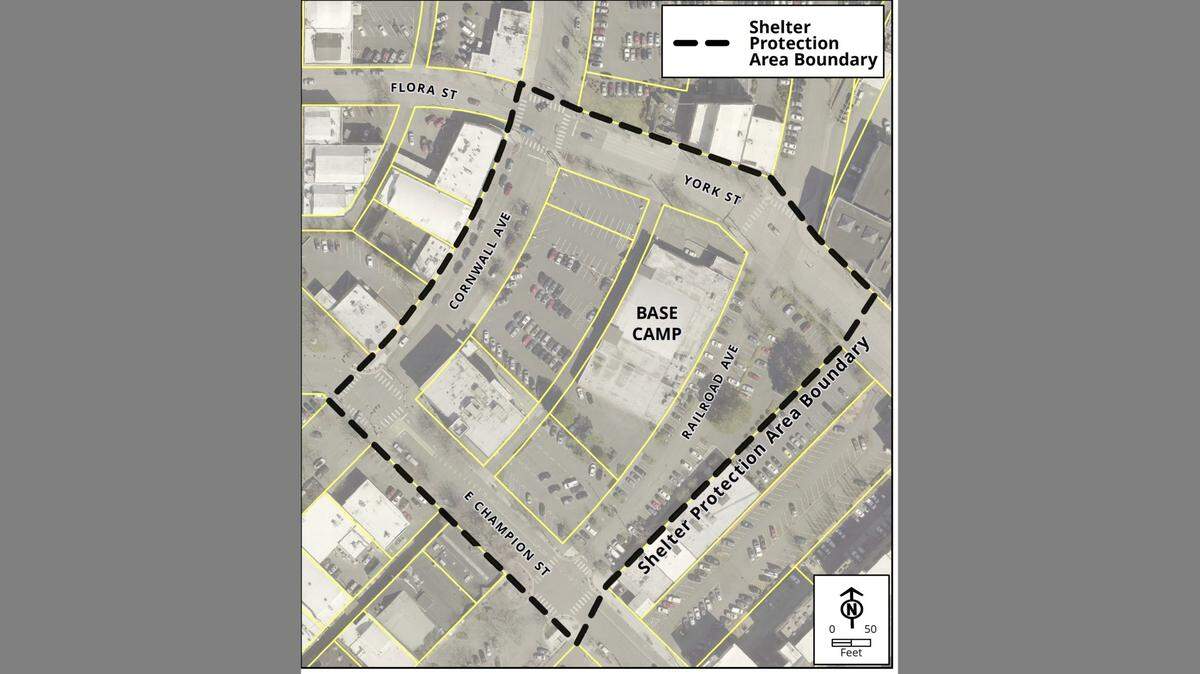
“Safe parking” came up on the day that the City Council voted unanimously — Council member Dan Hammill was absent — to create what’s being called a “protection area” in the public spaces around Base Camp, the emergency shelter for homeless people that opened at 1530 Cornwall Ave. in July, to deter behavior that included leaving trash, public urination, camping and drug activity.
Lighthouse Mission Ministries, the faith-based organization running Base Camp, as well as area business owners asked the city to form the zone, which would be enacted in the block immediately around the shelter. Base Camp provides overnight shelter for up to 200 people as well as services.
The Lighthouse Mission said it was concerned about people hanging around Base Camp — those not using its services or barred from entering because of past behavior — accosting homeless people who were staying there, and possibly deterring their efforts at recovery and leaving homelessness for housing.
People can be ticketed and fined for violating the protection area’s bans on camping as well as sitting and lying on the sidewalk and other public rights of way, such as curbs, medians and landscaping, although Bellingham Police have said their goal is to educate people first. The new restrictions expand the city’s prohibition on sitting and lying on sidewalks in the downtown to cover other public spaces and extends that ban so that it’s in effect around the clock.
On Monday, Sepler stressed again that the city wasn’t criminalizing homelessness, saying there were other areas in Bellingham where people could sit and camp. They just can’t in the public spaces near Base Camp, according to Sepler, adding that the city was once again turning to its effort to create “safe parking” in Bellingham, so that people living in their vehicles would have a supervised place to stay at night.
If the city can find partners for the six-month pilot, the “safe parking” program would provide a place to park for 100 people in each spot, according to information that Sepler sent to The Bellingham Herald.
Details are in the works.
“We may have several safe parking areas. Some may just be a few spaces (like in a church parking lot),” Sepler wrote in an email response to Bellingham Herald questions. “Some may be larger. The maximum allowed at any one site by code is 100 and that is why we put that in the (request for proposals), although we don’t expect a proposal for a single, 100-person location.”
The most recent Point-in-Time count, an annual census conducted in January of those who are homeless in Whatcom County, estimated there were 49 people living in their vehicles, although Bellingham officials said it’s possible there are now more because of the economic hardships caused by the COVID-19 pandemic.
“Our goal would be to provide spaces to accommodate many of the current unsheltered population who are living in cars,” Sepler said to The Herald. “It is unknown yet what proposals we will get and how many spaces can be provided.”
Safe parking is being explored or created by municipalities on the West Coast, including in Washington state, as a temporary option for those who are homeless. The idea is to allow people a place to park the vehicles they’re living in and access services in the hope that they can get back into housing.
Bellingham had previously asked religious organizations in the city, via e-mail and letter, to consider hosting a “safe parking area,” and stated that the “city would be supportive but no one stepped forward,” Sepler said to The Herald.
What the city is doing now represents the first formal request for proposals, he said, adding that the city will reach out to its social service partners, encourage them to review the request, and apply.
The city also will make sure that the request is distributed widely in Bellingham as well as other communities, including Seattle and Everett, he said.
As for the protection area around Base Camp, City Council members said they were concerned about enforcement and fining people who may not have the ability to pay, but noted the zone was a small area surrounding the shelter and necessary.
Council member Hannah Stone said she wanted to protect the residents of Base Camp and to make sure “they have a fighting chance to put those efforts to work.”
Homeless advocates and their supporters blasted the City Council’s decision during the public comment part of the meeting on Monday night. They said officials were criminalizing homelessness and criticized the city for not doing more to provide services, shelter and housing to those without homes.
They chided, sometimes yelled, at the council for not defunding the police to shift money to social services, saying members lead privileged lives and didn’t understand the plight of the homeless, including those who were people of color.
In response, council member Michael Lilliquist said the city, working in conjunction with Whatcom County and the state, has spent millions of dollars a year to shelter the homeless, including setting up Base Camp, providing housing subsidies and creating affordable housing.
Council members Pinky Vargas and Lisa Anderson echoed Lilliquist’s comments, and shared that they both had been homeless themselves — Vargas as a child who lived in hotels and tents until she was 6 years old, and Anderson who lived in a tent while in her 20s with her young daughter for nearly a year.
“We’re doing everything that we can as a community and as a city to make this a good place for everyone to live,” Anderson said.
This story was originally published September 29, 2020 at 12:55 PM.