Bellingham considers this ban near homeless shelter to help curb ‘inappropriate behaviors’
The Bellingham City Council will decide whether to create what’s being called a “protection area” around Base Camp, the emergency shelter for homeless people that opened on Cornwall Avenue this summer, to deter behavior that includes leaving trash, public urination and camping.
The matter goes before the council on Monday, Sept. 28, as nearby business owners ask for help, saying that the behavior of the people the shelter attracts — though they’re not necessarily staying at the shelter — is driving away customers and adding hardship for businesses already struggling because of COVID-19.
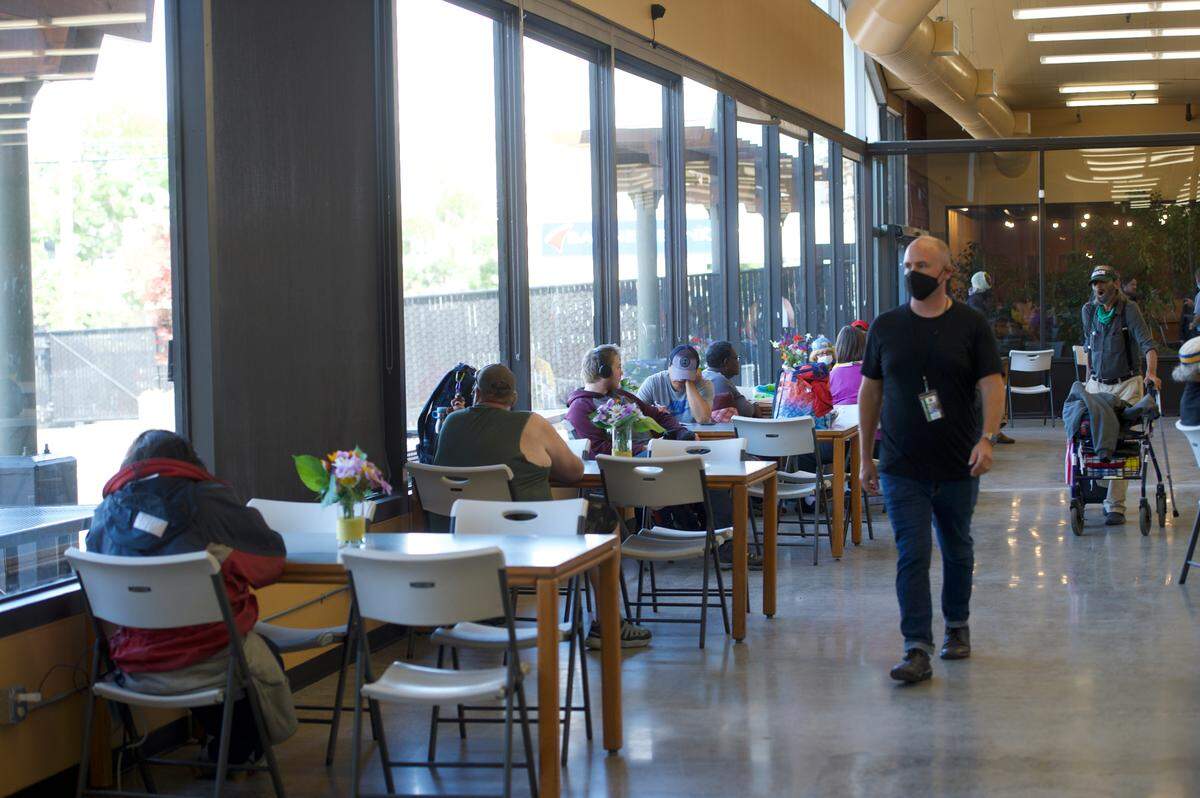
Base Camp opened July 17 to give up to 200 adults a place to sleep at night. It also provides bathrooms, showers, laundry services, drinking water, food, garbage and recycling containers as well as social services to those staying there. The site is partially fenced.
Operated by faith-based Lighthouse Mission Ministries, with financial contributions from the city of Bellingham and Whatcom County, the space in a former grocery store at 1530 Cornwall Ave. is sheltering those who were staying at Bellingham High School since the pandemic’s early days because more room was needed for social distancing to prevent the spread of COVID-19.
The shelter had been at Lighthouse Mission’s Drop-In Center at 1013 W. Holly St., since October 2016, before moving to the high school on March 20. Lighthouse Mission also provides transitional housing at facilities at 910 W. Holly St. and 1215 F St.
The city of Bellingham and Whatcom County are contributing a total of $1.5 million toward leasing and improvements at BaseCamp, while the Lighthouse Mission will pay that much in operating costs during its three years of operation in that space, with a possibility of government assistance for a fourth year.
Restrictions considered
The proposal going before the City Council on Monday would, if approved, restrict where people can park and hang out in the public spaces around Base Camp. Those restrictions would be in place 24 hours a day, seven days a week.
Restrictions would focus on what’s called the north parking lot on Railroad Avenue as well as the metered parking spaces on Railroad, Cornwall and Champion near the shelter. If approved, the measure would expand the hours and locations of the city’s existing sitting-and-lying ordinance in the downtown.
“The expansion is focused on a very specific area, narrowly tailored to the impacts,” Tara Sundin, the city’s Community and Economic Development manager, said to The Bellingham Herald.
The “protection area” would “help minimize inappropriate behaviors in close proximity to Base Camp,” Sundin said.
Bellingham’s existing prohibition against sitting and lying on sidewalks runs 7 a.m. to 9 p.m. in the downtown.
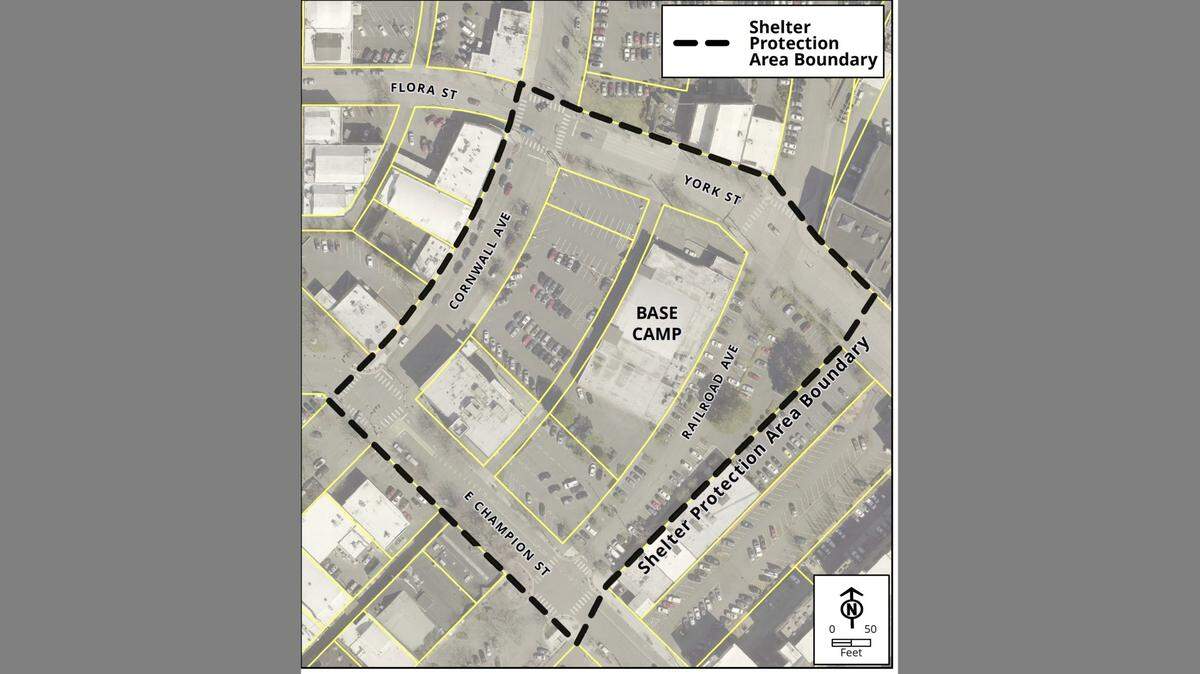
The proposal would expand those hours so the prohibition would occur around the clock around Base Camp, as well as ban people from sitting or lying down in public spaces other than sidewalks — including medians, parking stalls, trails, landscaping beds, streets and curbs.
It also would bar people from camping in their vehicles in parking lots or stalls, or otherwise hanging out in their vehicles, in those areas near Base Camp.
Lighthouse supports restrictions
The Lighthouse Mission supports the restrictions, Hans Erchinger-Davis, its executive director, said to The Bellingham Herald.
At a Sept. 14 update about Base Camp before the City Council, Erchinger-Davis said such restrictions would help protect those who were homeless and staying at the shelter as well as the surrounding area.
“It’s not uncommon that those loitering outside the facility in vehicles are up to illegal behavior and can sometimes become a magnet for our guests that are still in the beginning stages of life recovery,” he explained in a follow-up email interview with The Bellingham Herald.
“Too often, they become unintentional predators a step removed from our accountability, or as we say, ‘protective love,’ and therefore cause harm to the efficacy of the program. People grouped together looking rough can also seem scary to downtown patrons, so it’s a win-win if healthy parking limitations are put in place surrounding our facility,” Erchinger-Davis said.
As for enforcement, Bellingham Police would start by talking to violators. Subsequently, their vehicle could be impounded if they continue to camp in the banned area or they could be cited and fined at least $250 for violating the expanded sitting-and-lying provision, according to a draft of the proposal.
“We’re not looking to criminalize homelessness,” Rick Sepler, director of the Planning Department, said to the City Council on Sept. 14. “It’s a very focused intervention. The protection zone is exactly that, to protect the shelter and to ensure it can function.”
Relief for neighbors
Sepler said the measure also would provide relief to some of the neighbors.
In emails and photos sent to the city of Bellingham, business owners and others said they were worried about people camping in doorways near their business, aggressive behavior that scared staff and deterred customers, trespassing, the increase in trash and feces, and drug activity.
The complaints acknowledged there are homeless people who need help, but wrote that issues are spilling into the community, affecting businesses and could drag down that part of downtown. They needed help, they said, asking for additional measures such as increased patrols to proactively deal with issues.
Other information shared at the Sept. 14 City Council meeting included:
▪ Anecdotally, the number of 911 calls made by shelter staff has probably dropped by half — when compared to the smaller Drop-In Center — because of the “spaciousness of the environment” and the added security that comes with one-way exits from Base Camp’s courtyard and people having to be buzzed in, according to Erchinger-Davis.
The people staying at Base Camp also have room to store their belongings, which adds to their stability, he said.

▪ A dedicated trash patrol, which the city of Bellingham partially pays for, picks up trash in the blocks surrounding Base Camp for a few hours each morning, seven days a week. There also has been an alley cleanup, Erchinger-Davis said.
▪ The Lighthouse Mission has created a downtown liaison as well as a neighborhood advisory group that meets to talk about concerns, which have included loitering and camping on the streets around Base Camp. “Those are very valid concerns,” Erchinger-Davis said.
▪ Bellingham Police Lt. David Crass said there has been a “significant drop in calls” at Base Camp, when compared to the Drop-In Center. He did not provide specific numbers to the City Council and has not yet fulfilled a Bellingham Herald request for those numbers.
Still, Base Camp does have an impact and police do extra patrols there when they have time, Crass said, although that becomes more difficult after-hours when staffing levels drop.
▪ Police don’t automatically ticket someone. “We’re not looking to go straight to enforcement. We want to set clear expectations and let people know where they stand,” Crass said.
▪ Sepler also responded to a number of comments from the community, including criticism of the city for establishing Base Camp.
“We’re in the middle of a worldwide pandemic and a COVID-19 emergency,” he said, adding that people’s lives would be at risk if there wasn’t such a facility that was large enough to allow for social distancing.
Homeless ruling
Sepler reminded the City Council of a 9th U.S. Circuit Court of Appeals’ ruling in 2018 that grew out of a 2009 case in which six homeless people sued the city of Boise, Idaho, because it prohibited sleeping in public places and cited people for doing so under its “anti-camping” ordinance. The court sided with the homeless, saying enforcement of the ordinance violated the Constitution’s prohibition on cruel and unusual punishment.
At the time, Boise had three homeless shelters. But they had a limited number of beds, sometimes restricted who could use the shelters and sometimes required people to take part in religious programming.
The federal appeals court ruled that people can’t be prosecuted for living outside if there aren’t enough shelter beds, essentially if they have no alternative to sleeping outside.
“This provides us that alternative,” Sepler said of Base Camp. “There’s a significant consequence to the city of not having a shelter.”
Base Camp terms
Many in the community have asked the city to limit Base Camp’s presence to four years at its current location or to keep homeless shelters out of downtown by changing zoning.
But state law allows religious organizations, such as Lighthouse Mission, to operate shelters for the homeless on land that they own, lease or otherwise control, Sepler said.
“Cities and counties cannot prohibit or overly burden such uses,” he said to The Bellingham Herald, adding that local governments can only require conditions that relate to public health and safety.
“Under certain conditions, homeless housing may be exempt from local zoning laws,” Sepler said.
As for the request to remove Base Camp from its current location after a maximum of four years, Bellingham can’t do that either, Sepler explained.
The city and county will pay for that space for three years only, he said, although the city permit under which Base Camp is operating runs for four years.
“The Mission and landowner have rights,” Sepler said, “and although neither party has expressed any desire to extend beyond the four-year term, the city has no authority to curtail that private property right.”
This story was originally published September 26, 2020 at 7:00 AM.