State’s first confirmed Asian giant hornet this year found in Whatcom County
The first confirmed sighting of an Asian giant hornet in Washington state this year was in Whatcom County, according to the Washington State Department of Agriculture.
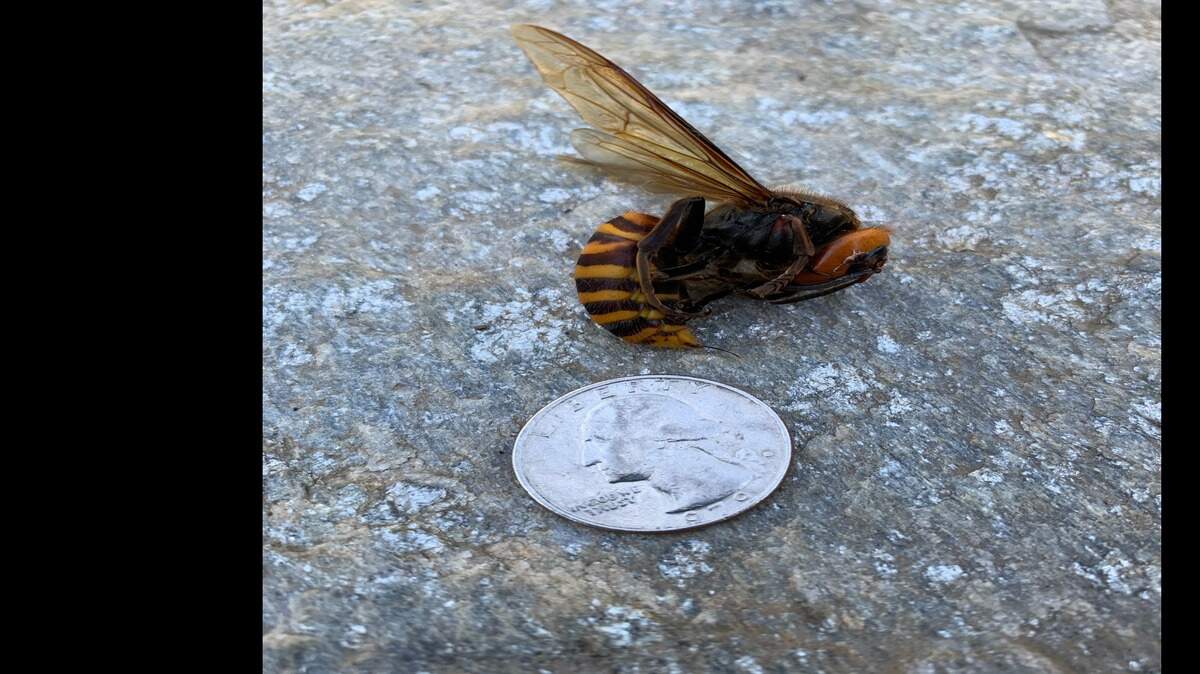
On Wednesday, May 27, a resident near Custer who was walking found a dead hornet lying on a road, the agency said.
The resident reported his find and sent in a photo by using the department’s online Hornet Watch Report Form, agriculture officials said in a news release on Friday, May 29.
On Thursday, May 28, the department’s entomologists concluded that the photo appeared to show an Asian giant hornet. The dead hornet was collected and sent for laboratory testing the same day.
On Friday, May 29, state and federal labs confirmed that the specimen was an Asian giant hornet.
Preliminary indicators are that the dead hornet was a queen, although further testing at a lab in Washington, D.C., is needed to confirm that, according to Sven Spichiger, the WSDA’s managing entomologist.
The Washington State Department of Agriculture and beekeepers in Whatcom County have been setting traps for the invasive pests since spring after they were first seen in the county last year.
A Blaine-area homeowner found a dead one on his property on Dec. 8, 2019, and reported seeing a live one near a hummingbird feeder before it flew into a nearby wooded area.
Those 2019 sightings were the first of the invasive hornets known for their powerful, painful stings in Washington state and the U.S.
About the size of an adult thumb, the Asian giant hornet, or Vespa mandarinia, is the world’s largest hornet and a predator of honeybees and other insects. They are identifiable by their large yellow/orange heads.
The most recent hornet finding in Whatcom follows a May 15 report of one found near Langley, B.C., by a woman who promptly stepped on it. That was the first reported sighting this year in Canada.
The dead hornet found earlier this week in Whatcom was about 1.2 miles south of the one found last year in Blaine and 1 mile north of a suspected bee kill reported the same year in the Custer area, according to Spichiger.
In that instance, a beekeeper reported a massive loss of bees with decapitated heads — a sign of Asian giant hornets in what’s called the slaughter phase, which they enter into toward the fall.
Agriculture officials already planned to set up traps in the area where the dead hornet was found this week and will continue with that plan to try to find any hornet colony that may be there.
Agriculture officials don’t yet know how widespread of a problem the hornets — now widely known as “murder hornets” after a recent New York Times article — are in Whatcom County or Washington state.
And while they said in the release on Friday that there was no evidence at this time that they have become established in the state or elsewhere in the U.S., Spichiger said officials are concerned, especially with the latest find.
“It is extremely likely that there was a colony that was established somewhere near Blaine in 2019,” Spichiger said during a virtual press conference on Friday. “It’s disappointing to know they can make it through the winter and survive here in Washington state.”
He said 2020 is the season for officials “to figure out exactly what we’re dealing with.”
Trapping so far has focused on trying to find queens after they emerge from their winter homes in the ground.
The bulk of trapping will start in July, officials said, when the focus will shift to trying to find worker Asian giant hornets and tracking a live one back to the nest in order to destroy it.
Finding workers will indicate that some colonies have had a chance to form, Spichiger said.
The goal is to find and eliminate nests before the end of September.
Agriculture officials have asked Whatcom County beekeepers and the public for help in finding them, either by trapping or reporting suspected hornets.
The traps — considered experimental because no one has trapped for the hornets before in the U.S. — set up so far have been for the Asian giant hornet queens as they emerge in the spring to set up colonies. The goal is to find and destroy the hornets and prevent the pests from reproducing and taking hold in the Pacific Northwest.
Their native range is Asia, and they are not wanted here.
Federal and state agriculture officials want to trap and kill the hornets in order to protect honeybees and the hundreds of crops in Washington that depend on the bees for pollination, the release said.
Beekeepers are concerned about them because a small number of hornets can destroy hives, leaving behind piles of dead bees outside, within hours.
The hornets also are known as the Japanese hornet, yak-killer hornet and the giant sparrow bee.
Because they’re new to Washington state, officials here are relying on the knowledge of their counterparts in China, Japan and Korea.
Asian giant hornets aren’t usually aggressive toward humans, but they can be a threat.
Their stings are more dangerous than those of local bees and wasps. Those stings can cause severe pain, swelling, necrosis and, in rare cases, death.
People who are allergic to bee or wasp stings shouldn’t approach the hornets or try to trap them, agriculture officials warned.
If you find one, don’t try to kill it.
“We are not recommending that anyone try to tangle with a live hornet,” Spichiger said. “If you bother them they will defend themselves.”
People are encouraged to report suspected sightings.
Asian giant hornets are typically dormant during winter. They’re seen usually from July through October.
They primarily nest in large colonies in the ground — in hollows formed by rotting roots, hollow trunks and rodent burrows. They can, though rarely, nest above ground in hollow trees and human structures, state agriculture officials have said.
State agriculture officials said the “murder hornet” name, which has stuck in the U.S., has caused “a disproportionate amount of fear relative to the threat that they pose.”
Report it
If you think you’ve seen an Asian giant hornet, the Washington State Department of Agriculture wants you to report it. Here’s how:
▪ Go online to the Hornet Watch Report Form.
▪ Email PestProgram@agr.wa.gov.
▪ Call 800-443-6684.
▪ Stay updated at the Asian giant hornet watch Facebook group.
Learn more at agr.wa.gov/hornets, including how to make bottle traps for Asian giant hornets.
This story was originally published May 29, 2020 at 10:44 AM.