Whatcom could get 4 inches of snow Friday. Here’s how the city keeps the roads safe
What’s better at helping people get around in freezing weather — sand, salt or a chemical de-icer? And what’s better for the planet?
If you’re inching your car along a snow-covered road or struggling to keep your balance on an icy sidewalk, you probably aren’t thinking about the science of snow removal, or even its environmental impact.
Truth is, what works best is a combination of the three — and sand is bad news, but chemicals are the worst.
“It depends on where you are and what’s going on” with the weather, said Donald Newman, floor manager at Hardware Sales in Bellingham.
“Anything we do is going to mess things up in the habitat. It’s a delicate balance,” Newman said.
“With salt, we know there are ills, but it works pretty well,” he said. “Some of the synthetic stuff burns your pets’ paws — that’s why they have pet-friendly and not pet-friendly. The salt will take the finish off your floors, synthetic will stain your floor.”
Newman said sand is good for traction on slippery surfaces, but it won’t melt ice and snow.
And for the environment, sand gets a big thumbs-down, said Amy Cloud, spokeswoman for the Bellingham Public Works Department.
“The big problem (with) sand is that it doesn’t break down the ice, it just sits on top. Salt will break down the ice,” Cloud said. “And sand carries phosphorous, which we’re trying like the dickens to keep out of Lake Whatcom — our drinking water source. Phosphorous is a greater hazard to our water than salt.”
Winter storm watch, high wind warning issued
Another snowstorm headed toward Whatcom County is expected to drop 2 to 4 inches of snow starting early Friday morning, the National Weather Service said in a Thursday call with reporters.
Bellingham Public Schools announced Thursday evening its schools will have early dismissal Friday because of the winter storm watch. Buses will be on snow routes in the morning and afternoon and preschools will be closed.
The Ferndale School District also announced Thursday evening that it will close schools early on Friday and that preschools are closed.
Meridian School District reported “normal late Friday schedule” with buses on snow routes.
Snowfall in the Puget Sound region will be higher south of Whatcom County, but the storm will bring sustained northeast winds of 30 to 40 mph with gusts to 60 mph.
A winter storm watch and a high wind warning have been issued for the lowlands of Western Washington.
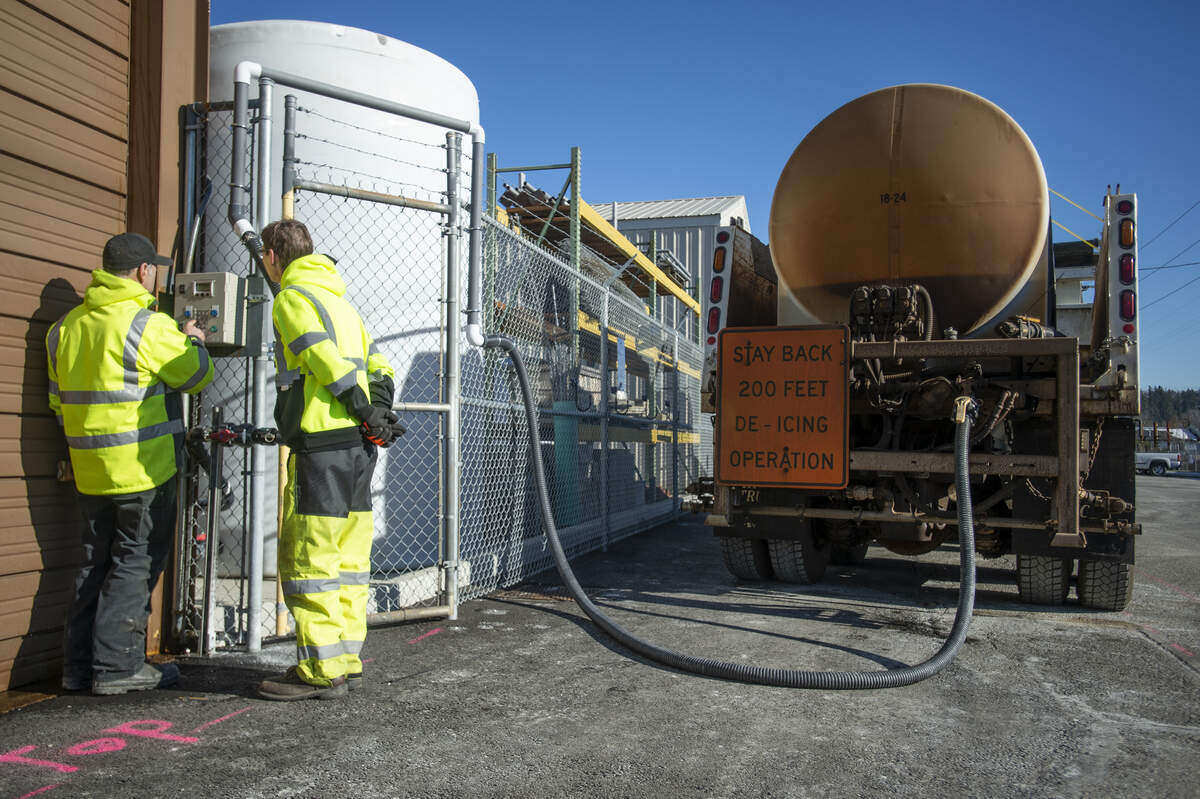
Cloud said that when cold weather and icy conditions are in the forecast, roads crews spray a salt solution.
“We put down salt brine as our de-icing agent when the temps are 25-32,” said Dan Larsen, Streets Division supervisor.

“If the temps dip down below 25, we add 20 percent beet juice to the brine. The organic sugar helps take the freezing temp of the brine down into the low teens. It is all natural. The salt brine is 23 percent salt, very close to the salt content of Bellingham Bay,” Larsen said.
Larsen said that crews try to spread the de-icing solution before a snowstorm because it helps with plowing.
It resembles parallel wet lines along the roadway.
Ice Melt is a no-no for the environment
But the absolute worst, Larsen said, is magnesium chloride — which is found in chemical de-icers such as Ice Melt.
“Not good for fish or streams. We have never used it and won’t. We are all natural with salt, sand and water,” he said.

Newman said that Hardware Sales is restocking its supplies of shovels, salt, sand and de-icer that customers depleted after the Sunday-Monday snowfall.
For homeowners who want to try a DIY method, NBC News suggests mixing a squirt of dish soap and a big splash of rubbing alcohol into a bucket of warm water.
Pour the homemade solution over ice or bare concrete before it snows to help with shoveling later.
Add the solution to a spray bottle to clear frosty car windows, NBC suggests.
This story was originally published February 7, 2019 at 1:50 PM.