COVID-19 leaves these Whatcom businesses struggling to find workers to serve you
A sizable chunk of Whatcom County’s workforce disappeared during the pandemic. When and how those workers come back may depend on fixing problems that pre-date the pandemic.
Whatcom County’s labor force — people working and those actively looking for work — shrunk by a little more than 5,000 people in March 2021 compared to a year earlier, when the pandemic was beginning to impact the region. According to data from the Washington State Employment Security Department, that gap widened to more than 5,300 when comparing April 2021 to April 2020. That’s about a 4% decrease for both years.
The smaller labor force comes at a time when businesses are trying to add staff as restrictions are being lifted from the COVID-19 pandemic. A recent check of the WorkSource job board showed 4,282 jobs listings, although it did have many duplicates and older posts dating back to early March. A cursory look found many restaurant positions offering around $14 an hour (not including tips), while office jobs, landscaping and warehouse positions were offering wages in the $15-$20 an hour range.
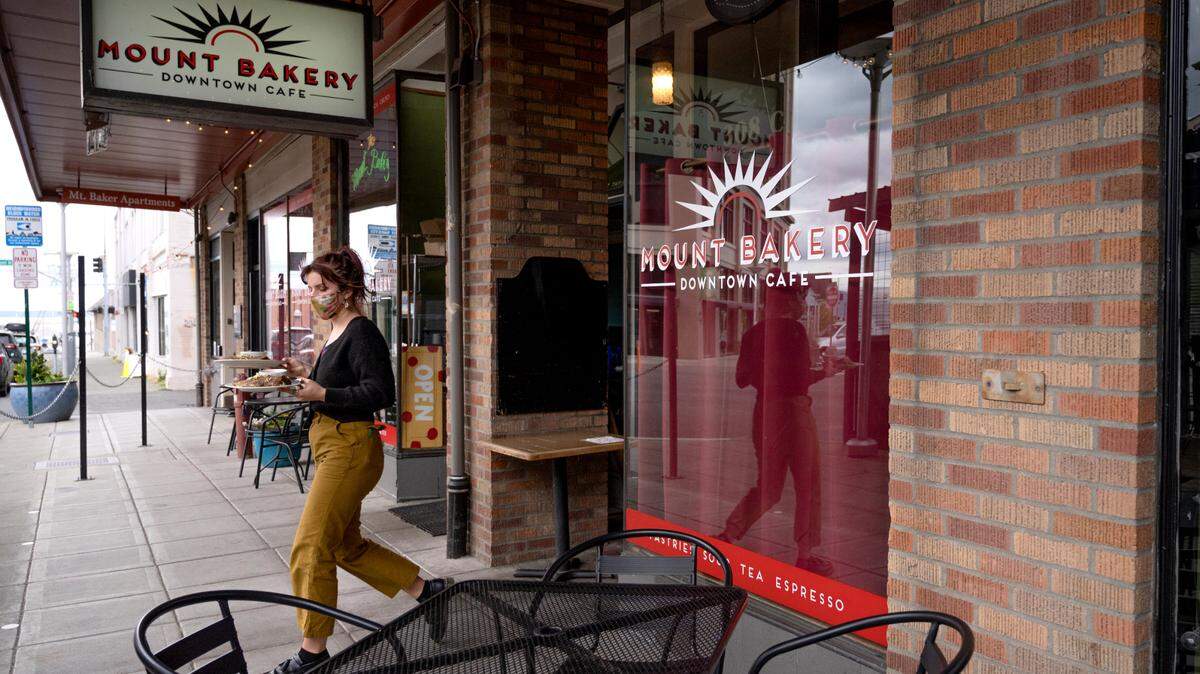
The worker shortage been a challenge for Vince Lalonde, who operates the Mount Bakery restaurants in downtown Bellingham and Fairhaven, as well as the Temple Bar. Lalonde recently had to close the downtown Mount Bakery on Wednesdays until he hires more staff, something he hopes happens soon.
“We are at the mercy of the (labor) market right now but we believe we have a very positive place to work and we hope it will not be too long,” Lalonde said, referring to reopening on Wednesdays. Along with trying to cultivate a positive place to work, Lalonde has given pay raises to current employees and offers benefits not usually seen in the restaurant industry, including paid time off, equitable tip pools and health insurance for full-time workers.
So where are the workers that disappeared during the pandemic, and are they coming back? While the extra unemployment benefits could be a factor, evidence at this point suggests that is not the biggest reason people are not working yet, said Don Goldberg, director of economic development at the Port of Bellingham. He noted that the shortage of workers isn’t just in the entry-level positions, but in ones that pay significantly higher wages.
He said there are many factors why people have left the labor force that came about before and during the pandemic. The biggest ones as a result of the pandemic are childcare and safety issues.
Goldberg said many parents, particularly mothers, quit their jobs or didn’t return after being laid off in order to help their children with remote schooling. Even as schools were bringing back students into the classrooms this spring, after-school programs can be hard to find and full-time daycare for younger children can be well over $1,000 a month, eating up most of a $15-an-hour paycheck.
Safety is another issue that continues to be a factor even as more people are vaccinated. Goldberg said many are trying to balance the risk versus rewards with work: Does a worker feel comfortable interacting with the public for entry-level wages? What about the risks of being yelled at or threatened over mask policies?
Uncertainty is also a factor, said Anneliese Vance-Sherman, a regional labor economist for the state. School are opening up, but what if COVID-19 continues to spread?
“Until the pandemic is better under control, there is still a high level of uncertainty. Once that uncertainty is reduced and stabilized, I expect the rate of return to work to accelerate,” Vance-Sherman said in an email.
Challenges to working in Whatcom County that were around before the pandemic include housing costs, demographic changes and a skills gap.
It was clear before the pandemic that housing costs made it difficult to live here on a lower wage. The pandemic has only accelerated this issue, Goldberg said. The median price for a home sold in the first three months of 2021 was $607,500 in Bellingham and $500,000 in Whatcom County. Rents for available one-bedroom apartments in Bellingham in April were averaging $1,280 a month.
Demographics and skills gaps don’t get as much attention, but are becoming very important, said Hart Hodges, director at the Center for Economic and Business Research at Western Washington University. The overall working-age population is shrinking as the number of baby boomers retiring is outpacing the number of people becoming old enough to work.
As automation continues to transform many aspects of the economy, not enough workers are being trained to adjust for new positions. This is something that started a few years ago and still exists, Hodges said.
Finding workers is tough
The tourism industry and restaurants in Whatcom County are having an especially difficult time finding qualified workers, with many establishments taking to social media to try and find workers.
The Mount Bakery has continued the process of growing while trying to hire workers. Lalonde said they’ve been able to survive the pandemic restrictions by installing outdoor seating, expanding its bread product line and establishing a foothold in Seattle at the Ballard Farmers Market.
“We’re trying to grow, but we really didn’t see this coming,” Lalonde said of the worker shortage.
As Lalonde tries to hire workers, he said the biggest hurdle is that nearly all restaurants are trying to hire at the same time before restrictions are completely lifted next month. The Washington State Department of Revenue estimates that Whatcom County had 446 restaurant and drinking establishments at the end of September.
“That makes it tough when all of a sudden everyone is doing some hiring,” Lalonde said.
Scotty Browns, which recently moved into its new building near the movie theater, was able to have a full staff in place for the reopening, said Allyson Farrar, business manager for the company that operates the restaurant. The reopening has gone well and they are already looking to add to the 45-person staff, but find it challenging. Farrar said they’ve been getting help recruiting from current employees, who are given referral bonuses
“We love looking to our team to help us find our next great hire. They know what it takes to be successful in a restaurant of our volume, and we trust their recommendations when they bring those to us,” Farrar said in an email.
Farrar also helps manage the car repair shop No. 1 Automotive Body Repair, which is also finding it challenging to find workers, particularly the non-specialized positions. The specialized workers, like an auto body technician, require schooling and years of experience and most of them tend to stay with a company, she said.
“In order to run a successful luxury collision repair shop, you have so many integral moving parts — detailers, shop attendant, office administrator, etc., and those are the positions we are looking to fill at this time,” Farrar said.
Bellingham Cider Company is another local business that is finding it challenging to be fully staffed as it ramps up. The company closed the restaurant portion of its business in the middle of the pandemic, focusing on cider production.
As indoor dining came back in the early spring, co-owner Bryce Hamilton said they were excited about the return, but had little notice that it was happening. It took them more than a month to reopen because of staffing shortages. More than half the staff from December 2020 didn’t return because they had left the area or started careers in other industries, he said.
Bellingham Cider has already hired 19 workers, but needs to hire another seven before Whatcom County completely reopens by the end of June.
“We put out a very early job announcement in early February in anticipation of a re-opening and I’m so glad we did,” Hamilton said in an email.
He said the worker shortage in the restaurant industry seems to be getting worse.
“I empathize greatly with our industry folks, many of them were laid off twice in one year. It wasn’t surprising to see people not wanting to return to an industry where that happened, but it’s very difficult to run a business when that is the reality,” Hamilton said. “It creates longer wait times which causes some customers to become impatient because they don’t realize the understaffing is causing issues.”
To attract employees, Hamilton said they implemented a full benefits package for year-round staff and a 30% compensation increase to the kitchen through a tip pooling system.
If Bellingham Cider isn’t fully staffed by the end of June, it may need to stay with reduced capacity.
“We simply don’t have enough employees to handle any more business than we already do. After large increases in pay and benefits, I’m not sure what else to do,” Hamilton said.
This story was originally published June 1, 2021 at 5:00 AM.