Whatcom County sees 39 new COVID-19 cases Friday, long-term care numbers updated
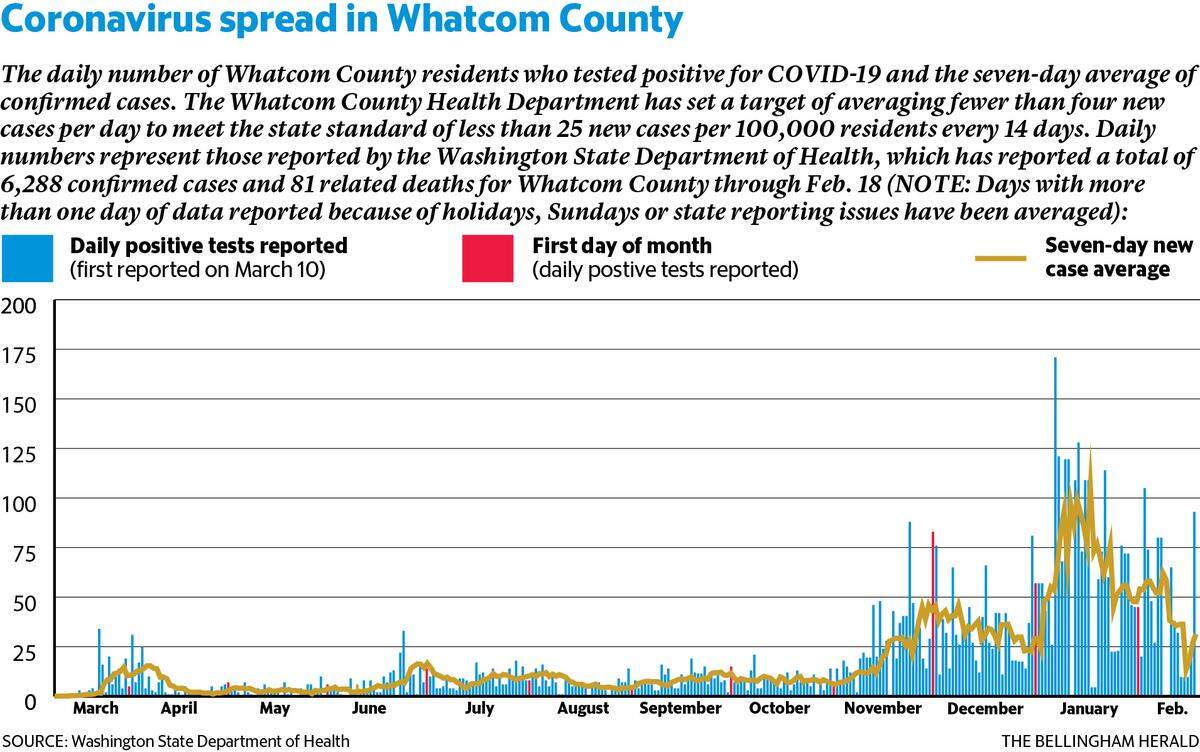
Whatcom County saw 39 new COVID-19 cases, according to the Washington State Department of Health’s coronavirus dashboard on Friday, Feb. 19, but no related deaths were reported.
Overall, Whatcom County has seen 6,327 confirmed cases and 81 related deaths during the pandemic, according to state data as of 11:59 p.m. Thursday, Feb. 18, meaning 1.3% of all COVID cases in Whatcom County have been linked to a death.
An additional 112 probable cases — an increase of one from Thursday’s report — have been reported in Whatcom County during the pandemic, resulting from positive antigen tests not confirmed by a molecular test.
The state said Friday’s case count may include up to 600 duplicates statewide.
The state Department of Health data Friday showed Whatcom County has had 303 hospitalizations during the pandemic, a decrease of three from Thursday’s report.
The state also reported that a total of 169,610 molecular tests have been administered in Whatcom County during the pandemic — an increase of 376 tests from Thursday’s report — meaning 3.73% of all reported tests during the pandemic have come back positive. The state cautioned that negative test results from Nov. 21-30 remain incomplete.
St. Joseph hospital in Bellingham, which is licensed and staffed for 241 beds, reported to The Herald on Friday it was treating 11 patients for COVID-19, up one from Thursday’s report. On Friday, Feb. 19, the hospital began allowing non-COVID patients to have one designated visitor during their stay (two for minor and end-of-life patients).
Long-term care update
Whatcom County had one new COVID-19-related death associated with its long-term care facilities last week, but its total of cases associated with long-term care facilities was reduced by one, according to the Washington State Department of Health’s latest COVID-19 Long-Term Care Report.
According to the report, which was released Wednesday, Feb. 17, and reflected data through Tuesday, Feb. 16, Whatcom County long-term care facilities have had 308 confirmed cases during the pandemic — a decrease of one case from the previous report, which included data through Feb. 8.
The number of COVID-related deaths in long-term care facilities increased by one to 41, according to the state’s data.
The 308 cases mean that long-term care facilities had 5.0% of the 6,191 overall cases reported in Whatcom County on Tuesday — down from 5.1% on Feb. 8 — while the 41 related deaths represent 51.2% of the county’s death total (80) on Tuesday.
Statewide, long-term care facilities have been associated with 17,922 cases (5.8% of the state’s total cases) and 2,316 related deaths (49.2% of the state’s death total), the report showed. Since Feb. 8, the state’s long-term care facilities saw increases of 0.9% in the number of cases (155 cases) and 2.5% in the number of deaths (57 deaths).
Whatcom’s risk assessment
The state’s Risk Assessment Dashboard was last updated Friday evening for data as of 11:59 p.m. Thursday, Feb. 18. With a shift to “Healthy Washington” goals to resume business activities, the state is more specific on reporting dates for some metrics. The dashboard does not update on the weekends.
Whatcom County was missing the marks on two key metrics:
▪ Whatcom is missing the target rate of fewer than 25 new cases per 100,000 residents Jan. 27-Feb. 9 with a rate of 324.0 — a decrease from 337.3 reported Thursday.
▪ Whatcom had an average COVID-19 molecular testing rate per 100,000 people Jan. 26-Feb. 1 of 375.0. No goal was stated for this metric, however, the overall statewide number was 276.2, and Whatcom’s average was a decrease from the 392.4 reported Thursday.
▪ Whatcom is missing the target of less than 2.0% of individuals testing positive for COVID-19 Jan. 26-Feb. 1 with a rate of 6.5% — an increase from Thursday’s 6.0%.
The latest Healthcare System Readiness risk assessment dashboard, updated Thursday evening for data through Thursday, shows for the North region, which combines Whatcom, Skagit, Snohomish, San Juan and Island counties:
▪ Occupied beds: 1,011 of the region’s 1,249 adult hospital beds (80.9%) were occupied, missing the state’s goal of 80% or less but a decrease of 10 occupied beds from data Thursday.
▪ COVID occupied beds: 58 of the region’s 1,249 adult hospital beds (4.6%) were occupied by COVID patients, making the state’s goal of 10% or less but an increase of two occupied beds from data Thursday.
▪ Occupied ICU beds: 88 of the region’s 136 adult ICU beds (64.7%) were occupied. The state does not have a goal for this metric, and there was no change from beds being used from data Thursday.
▪ COVID occupied ICU beds: 19 of the region’s 136 adult ICU beds (14.0%) were occupied by COVID patients. The state does not have a goal for this metric, but it was a decrease of one bed being used from data Thursday.
Marine Life Center reopens
The Port of Bellingham’s Marine Life Center will reopen for visits by appointment starting Monday, March 1.
Appointments will be limited to five people from the same household, visiting for 30 minutes. No food or drink are allowed and face coverings need to be worn at all times.
The center, which is on the waterfront at 1801 Roeder Ave., showcases the marine life of Bellingham Bay and the Washington coast.
Appointments are available between 10 a.m. and 2 p.m. on Mondays, Wednesdays, Fridays and Saturdays. To make an appointment, email marinelifecenter@portofbellingham.com. More information is available by calling 360-671-2431.
—Dave Gallagher, dgallagher@bhamherald.com
Numbers elsewhere
New coronavirus cases and deaths according to Johns Hopkins University Friday evening:
▪ The U.S. has more than 27.97 million reported cases, the most of any nation, and more than 495,469 deaths.
▪ Worldwide, there are more than 110.65 million reported cases and 2.45 million deaths.
Washington state reported these numbers from the Department of Health Friday evening:
▪ 315,419 confirmed cases, an increase of 764 from reported cases on Thursday.
▪ 17,485 probable cases, an increase of 133 from Thursday’s data.
▪ 18,969 coronavirus-related hospitalizations, an increase of 35 from data Thursday.
▪ 5,048,054 total molecular tests, an increase of 22,760 from Thursday’s data.
▪ 4,822 deaths related to COVID-19 were reported, an increase of 19 from Thursday’s data. That means 1.4% of all Washington residents who have tested positive for coronavirus have died.
Washington state actions
In the “Healthy Washington” plan introduced by Gov. Jay Inslee Jan. 5, business resumption is tied to targets by health system regions. Whatcom is tied to Skagit, San Juan and Island counties in the plan.
The state will run analyses every other Friday to determine whether regions will move backward or forward in phases the following Monday, officials said.
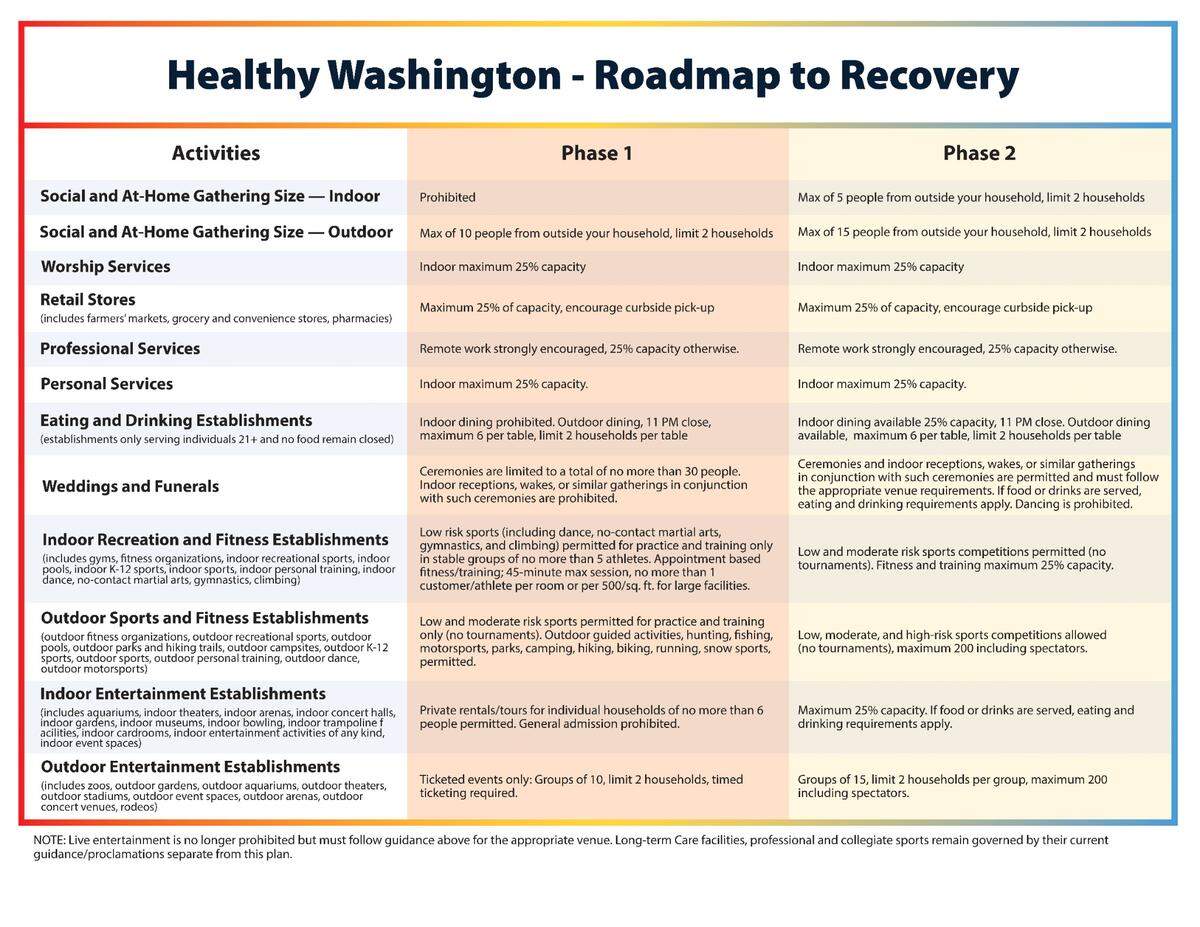
All regions began in Phase 1 on Jan. 11, and the Puget Sound and West Region moved to Phase 2 on Feb. 1.
On Feb. 11, Inslee announced the North region, which includes Whatcom, Island, San Juan and Skagit counties will move Sunday, Feb. 14, to Phase 2 along with the East, North Central, Northwest and Southwest regions. All eight regions have now moved to Phase 2, allowing for live entertainment with ticketed groups of up to 10 people and very limited fitness activities such as appointment-based training in gyms.
Phase 2 also allows restaurants and indoor fitness centers to open indoors at 25% capacity and allows for sports competitions to resume with limited spectators, and wedding, and funeral ceremonies can increase capacities.
New metrics for Phase 3 and what activities will be allowed in that phase have not yet been released by Inslee.
This story was originally published February 20, 2021 at 8:00 AM.