Whatcom sees 97 new COVID cases, as Lynden schools report 5 incidents so far this month
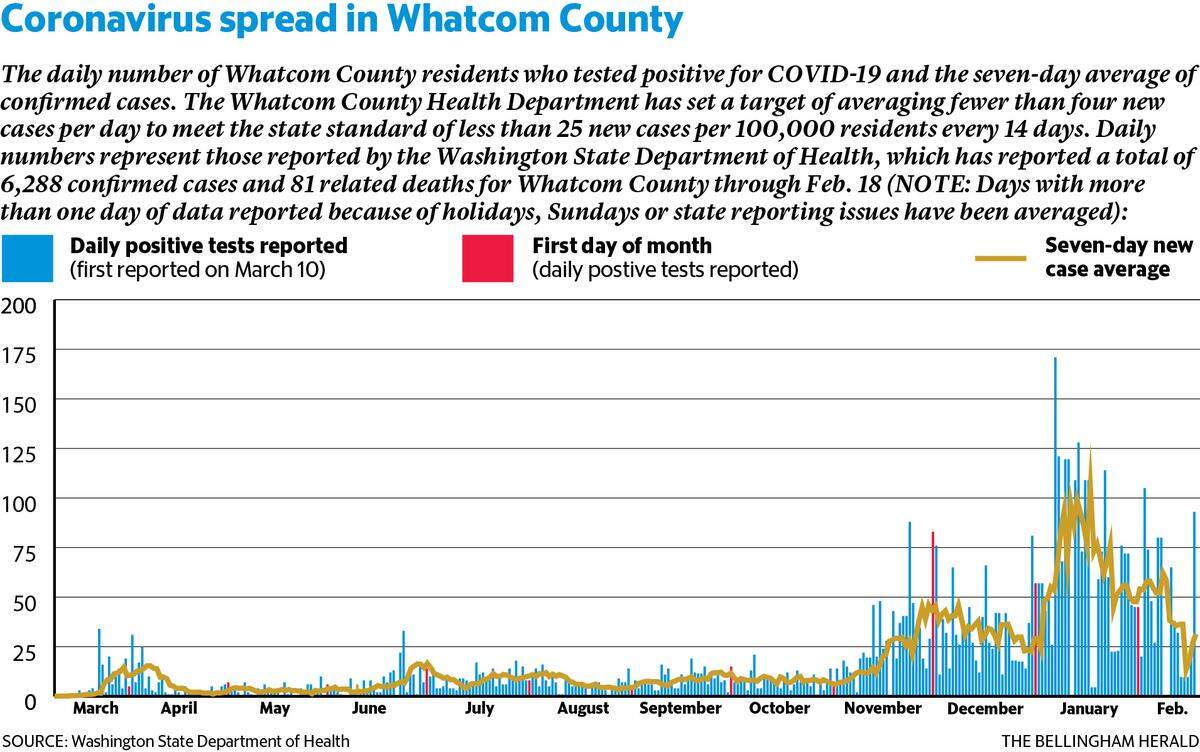
Whatcom County saw its largest jump in reported COVID-19 cases in a week and a half with 97 new confirmed infections, according to the Washington State Department of Health’s coronavirus dashboard on Thursday, Feb. 18, but no related deaths were reported.
Overall, Whatcom County has seen 6,288 confirmed cases and 81 related deaths during the pandemic, according to state data as of 11:59 p.m. Wednesday, Feb. 17, meaning 1.3% of all COVID cases in Whatcom County have been linked to a death.
An additional 111 probable cases — an increase of two from Wednesday’s report — have been reported in Whatcom County during the pandemic, resulting from positive antigen tests not confirmed by a molecular test.
The 97 new cases reported Thursday mean Whatcom County has had 2,819 cases — or 44.8% of its pandemic total — reported during the first 48 days of 2021. The county’s daily average of new reported cases the past week increased to 31.4 per day, two days after it saw its lowest weekly average (18.1) in three months.
The state said Thursday’s case count may include up to 400 duplicates statewide.
The state Department of Health data Thursday showed Whatcom County has had 306 hospitalizations during the pandemic, an increase of two from Wednesday’s report.
The state also reported that a total of 169,234 molecular tests have been administered in Whatcom County during the pandemic — an increase of 458 tests from Wednesday’s report — meaning 3.72% of all reported tests during the pandemic have come back positive. The state cautioned that negative test results from Nov. 21-30 remain incomplete.
Wednesday’s vaccination report said that as of 11:59 p.m. Monday, Feb. 15, Whatcom County had administered 25,848 vaccinations — an increase of 4,364 vaccinations from Friday’s report, which was through 11:59 p.m. Feb. 10. An average of 881 Whatcom County residents per day received a vaccination dose from Feb. 9-15, up from the 512 seven-day average on Friday. Vaccination data is released Mondays, Wednesdays and Fridays, but was not updated Monday in observance of President’s Day.
The state estimates that 10.77% of the county (or 24,254 residents) has received its first dose of a COVID-19 vaccine and 3.98% of the county (or 8,958 residents) is fully vaccinated. The number of vaccines given and people vaccinated may not match, according to the dashboard, because people may be vaccinated in counties other than where they live.
In fact, Whatcom County residents are having to travel outside the county to receive the vaccine at a higher rate than most of the rest of the state, according to data anaylysis by The Bellingham Herald, as the total number of vaccine doses received by Whatcom County residents (33,212 combined first and second doses received) is 22.2% higher (7,364 doses) than the 24,848 doses administered in the county. The only counties with higher rates are Douglas, which is next to a state mass vaccination site in Wenatchee, and Franklin, which is next to a state mass vaccination site in Kennewick.
According to the data released Wednesday, Whatcom residents have received approximately 2.8% of the 1,201,120 total vaccine doses given in the state — up from 2.6% in Friday’s report. But the county has administered only 2.2% of the state’s total — up from 2.0% in Friday’s report — and has administered the 11th-most doses in the state. For comparison, Whatcom County represents 3.0% of the state’s total population and is the state’s ninth-largest county, according to 2019 U.S. Census estimates.
St. Joseph hospital in Bellingham, which is licensed and staffed for 241 beds, reported to The Herald on Friday it was treating 11 patients for COVID-19, up one from Thursday’s report. On Friday, Feb. 19, the hospital began allowing non-COVID patients to have one designated visitor during their stay (two for minor and end-of-life patients).
Lynden schools see cases
The Lynden School District’s COVID-19 dashboard, showed eight new COVID-19 cases in five incidents in its schools when it was updated on Thursday.
The new incidents, according to the dashboard, included:
▪ One new case reported the week of Feb. 1-5 at Lynden High School. The incident required some individuals to return to remote learning or quarantine with an expected return date of Feb. 16.
▪ Two new cases reported the week of Feb. 8-12 at Isom Elementary School. The incident required one class return to remote learning with an expected return date of Feb. 16.
▪ Three new cases reported the week Feb. 8-12 at Lynden High School. The incidents required some individuals to return to remote learning or quarantine with an expected return date of Feb. 24.
▪ One new case reported the week of Feb. 8-12 at Lynden Middle School. The incident did not require anyone else to return to remote learning or quarantine.
▪ One new case reported the week of Feb. 8-12 at Bernice Vossbeck Elementary School. The incident required a return to remote learning or quarantine with an expected return date of Feb. 26, though the dashboard did not say if it was an entire class or just individuals.
Overall, the district’s dashboard reports there have been 38 cases spread across 25 incidents since Lynden students began returning to classes. Fifteen incidents have required some students or whole classes to temporarily return to remote learning.
Lummi receives COVID grant
The Lummi Nation has been awarded a $100,000 grant from the Seattle Foundation on behalf of the All In Washington COVID Relief Fund, according to a post on the Lummi Communications Facebook page.
The money will be used to provide rental assistance, food vouchers and energy assistance to Lummi Nation families that have faced barriers accessing other resources and services due to the financial impacts of the COVID-19 pandemic, the release states. Applications will be available beginning at 9 a.m. Monday, Feb. 22, and must include proof of income, rental agreement, energy bill and proof of enrollment.
“Lummi Nation would like to thank the Seattle Foundation, All in Washington and their COVID relief partners for the generous contribution to serve rural tribal communities and Lummi Nation families,” the release read.
The Lummi Tribal Health Center reported in a Facebook post Thursday that it had 25 new confirmed cases, bringing the total number of cases in the Lummi community during the pandemic to 434. The Lummi health department reported it has 57 active cases and no current hospitalizations. During the pandemic, 12 community members have been hospitalized, three have died and the health center has conducted 4,474 tests. Positive tests for the last two weeks are at 21.93%. The Lummi Indian Business Council’s Phase 1 Shelter in Place Order is in place until Feb. 23.
Whatcom’s risk assessment
The state’s Risk Assessment Dashboard was last updated Thursday evening for data as of 11:59 p.m. Wednesday, Feb. 17. With a shift to “Healthy Washington” goals to resume business activities, the state is more specific on reporting dates for some metrics. The dashboard does not update on the weekends.
Whatcom County was missing the marks on two key metrics:
▪ Whatcom is missing the target rate of fewer than 25 new cases per 100,000 residents Jan. 26-Feb. 8 with a rate of 337.3 — an increase from 335.6 reported Wednesday. Whatcom County has the ninth-highest infection rate in the state according to Thursday’s data.
▪ Whatcom had an average COVID-19 molecular testing rate per 100,000 people Jan. 25-31 of 392.4. No goal was stated for this metric, however, the overall statewide number was 281.6, and Whatcom’s average was an increase from the 386.2 reported Wednesday.
▪ Whatcom is missing the target of less than 2.0% of individuals testing positive for COVID-19 Jan. 25-31 with a rate of 6.0% — unchanged from Wednesday’s report and the 16th-lowest rate in the state.
The latest Healthcare System Readiness risk assessment dashboard, updated Thursday evening for data through Wednesday, shows for the North region, which combines Whatcom, Skagit, Snohomish, San Juan and Island counties:
▪ Occupied beds: 1,021 of the region’s 1,255 adult hospital beds (81.4%) were occupied, missing the state’s goal of 80% or less and an increase of 21 occupied beds from data Wednesday.
▪ COVID occupied beds: 56 of the region’s 1,255 adult hospital beds (4.5%) were occupied by COVID patients, making the state’s goal of 10% or less and a decrease of one occupied bed from data Wednesday.
▪ Occupied ICU beds: 88 of the region’s 136 adult ICU beds (64.7%) were occupied. The state does not have a goal for this metric, but it was an increase of four beds being used from data Wednesday.
▪ COVID occupied ICU beds: 20 of the region’s 136 adult ICU beds (14.7%) were occupied by COVID patients. The state does not have a goal for this metric, but it was an increase of two beds being used from data Wednesday.
COVID vaccine scam
Skagit Public Health reported that it has been notified of a scam in Skagit County, with people attempting to steal personal information by calling information and posing as representatives of the county, according to a release.
The fraudulent representatives call and say they are attempting to sign individuals up for a vaccine appointment, then ask for personal information, such as a mother’s maiden name or a Social Security number to confirm appointments.
“Skagit County will never ask for your Social Security number,” the release stated.
Anyone receiving a call from Skagit Public Health that they are not expecting is advised to hang up and call back at 360-416-1500 to confirm they are speaking to a Public Health employee.
As of Friday, Feb. 12, the Bellingham Police Department and Whatcom County Sheriff’s Office told The Bellingham Herald that they had not received any reports of vaccine-related scams.
Numbers elsewhere
New coronavirus cases and deaths according to Johns Hopkins University Friday morning:
▪ The U.S. has more than 27.8 million reported cases, the most of any nation, and more than 493,000 deaths.
▪ Worldwide, there are more than 110.4 million reported cases and 2.4 million deaths.
Washington state reported these numbers from the Department of Health Thursday evening:
▪ 314,655 confirmed cases, an increase of 1,022 from reported cases on Wednesday.
▪ 17,352 probable cases, an increase of 178 from Wednesday’s data.
▪ 18,934 coronavirus-related hospitalizations, an increase of 73 from data Wednesday.
▪ 5,025,294 total molecular tests, an increase of 27,554 from Wednesday’s data.
▪ 4,803 deaths related to COVID-19 were reported, an increase of 44 from Wednesday’s data. That means 1.4% of all Washington residents who have tested positive for coronavirus have died.
According to the state’s latest vaccination report, which is updated Mondays, Wednesdays and Fridays:
▪ 1,201,120 vaccinations had been given through Wednesday, an increase of 143,276.
▪ The state has averaged administering 26,204 doses of vaccines the past seven days — more than half of the Department of Health’s stated daily goal of 45,000, and a slight decrease from the average 26,761 reported Friday.
▪ The state estimated Friday that 11.73% of the state’s residents have received their first dose of a COVID-19 vaccine and 4.10% percent of residents are fully vaccinated.
▪ Approximately 1,294,500 doses have been delivered to Washington state providers (an increase of 17,550 from Friday’s report) and 158,925 doses have been delivered for the CDC’s long-term care program (an increase of 6,825 from Friday’s report).
▪ Of the approximately 1,294,500 doses delivered, 82.64% have been given.
How safe is Washington?
Washington state was recently ranked the eight-safest state in the United States during the COVID-19 pandemic, according to a ranking study by personal finance website wallethub.com.
The study compared all 50 states and the District of Columbia across five key metrics — COVID vaccination rate, positive COVID test rate, COVID-related hospitalization rate, COVID-related death rate and COVID transmission rate — to determine which states were the safest.
The rankings, which were through data available through 9:30 a.m. Wednesday, Feb. 17, had Alaska, Hawaii and Maine as the top three safest states during the pandemic, while New York, South Carolina and Ohio were the bottom three.
In the five metrics, Washington ranked:
▪ 21st in vaccination rate.
▪ Second in positive testing rate.
▪ 13th in hospitalization rate.
▪ 18th in death rate.
▪ 10th in transmission rate.
Washington state actions
In the “Healthy Washington” plan introduced by Gov. Jay Inslee Jan. 5, business resumption is tied to targets by health system regions. Whatcom is tied to Skagit, San Juan and Island counties in the plan.
The state will run analyses every other Friday to determine whether regions will move backward or forward in phases the following Monday, officials said.
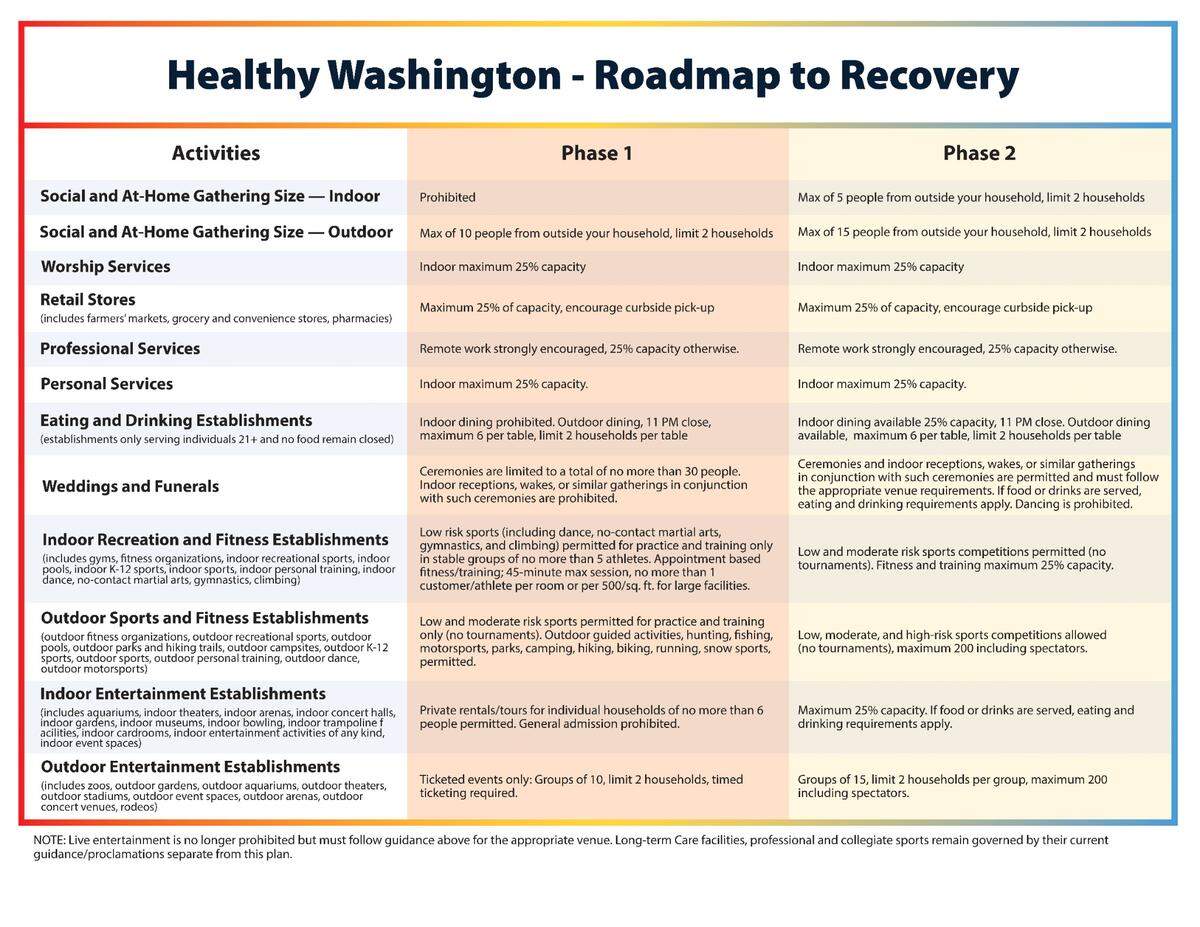
All regions began in Phase 1 on Jan. 11, and the Puget Sound and West Region moved to Phase 2 on Feb. 1.
On Feb. 11, Inslee announced the North region, which includes Whatcom, Island, San Juan and Skagit counties will move Sunday, Feb. 14, to Phase 2 along with the East, North Central, Northwest and Southwest regions. All eight regions have now moved to Phase 2, allowing for live entertainment with ticketed groups of up to 10 people and very limited fitness activities such as appointment-based training in gyms.
Phase 2 also allows restaurants and indoor fitness centers to open indoors at 25% capacity and allows for sports competitions to resume with limited spectators, and wedding, and funeral ceremonies can increase capacities.
New metrics for Phase 3 and what activities will be allowed in that phase have not yet been released by Inslee.
This story was originally published February 19, 2021 at 8:27 AM.