Whatcom surges past 1,000 confirmed COVID cases in 2021 with 128 reported Thursday
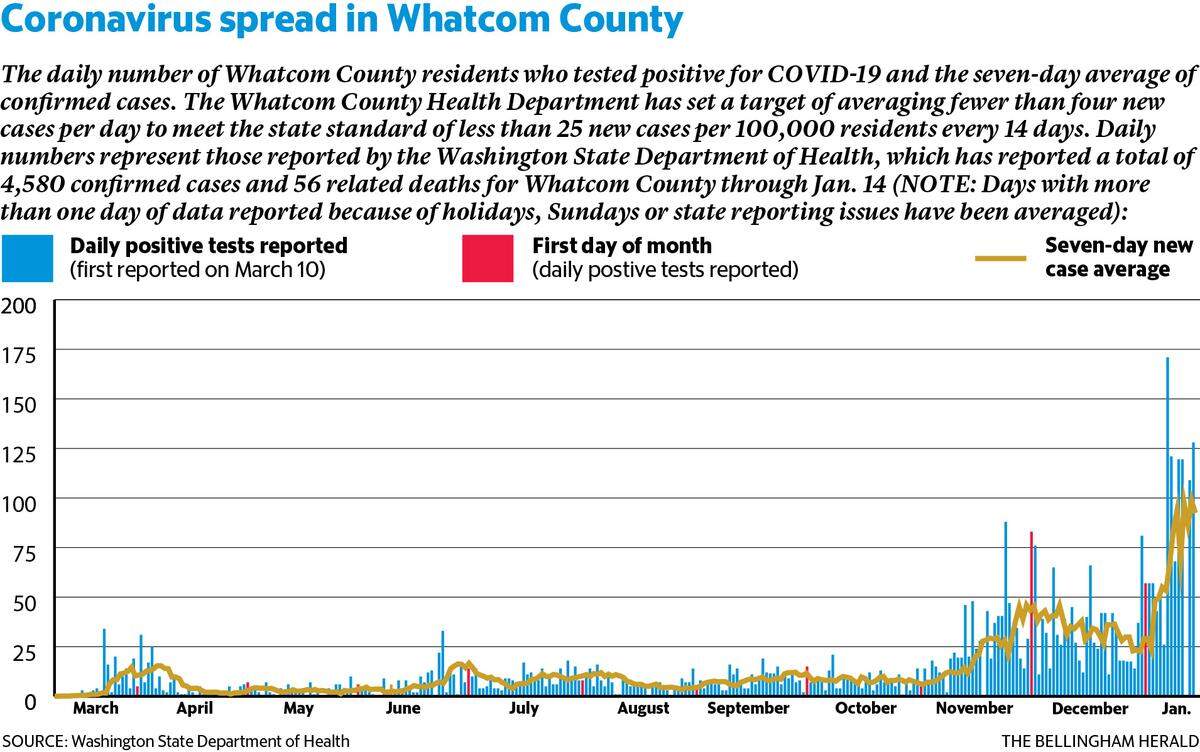
For the sixth time in 12 days, Whatcom County’s reported number of confirmed new COVID-19 cases was in triple figures, as 128 new cases were reported on the Washington State Department of Health dashboard Thursday, Jan. 14.
Before Jan. 3, Whatcom had not seen a reported increase of more than 84 throughout the entire pandemic.
It took Whatcom County only 14 days to top 1,000 reported cases in 2021 — there have been 1,111 so far this year — but it’s seven-day average did drop slightly from 98.6 Wednesday, Jan. 13, to 92.4 Thursday. The 1,111 cases in 2021 represents 21.0% of the county’s total for the pandemic.
No new deaths were reported Thursday, though.
Overall, Whatcom County has seen 4,580 confirmed cases and 56 related deaths during the pandemic, according to state data as of 11:59 p.m. Wednesday. That means that 1.2% of the Whatcom residents who have tested positive for COVID during the pandemic have died.
Fourteen additional probable cases — an increase of one from Wednesday report — have been reported in Whatcom County during the pandemic, resulting from positive antigen tests, but those cases were not confirmed by a molecular test.
The state Department of Health data Thursday showed Whatcom County has had 221 hospitalizations during the pandemic, a decrease of one from Wednesday’ report, though the state said hospitalization counts were again incomplete Thursday due to an interruption in the data reporting process. Full counts are expected to be updated Friday, Jan. 15.
The state also reported that a total of 135,034 molecular tests have been administered in Whatcom County during the pandemic — an increase of 588 tests from Wednesday’s report.
The state cautioned that case counts Thursday may include up to 660 duplicates statewide and that negative test results Nov. 21-30 and from Dec. 30 still are incomplete.
St. Joseph hospital in Bellingham, which is licensed and staffed for 241 beds, reported to The Bellingham Herald on Friday it was treating 18 patients for COVID-19, four fewer than Thursday and 12 less than the record-high 30 it reported Wednesday. St. Joseph began banning visitors at the medical center until further notice, starting at 5 a.m. Monday, Jan. 11, while COVID-19 remains a public health threat, according to a Friday, Jan. 8, Facebook post.
The Nooksack Indian Tribe announced in a Facebook post Thursday that it has seen one more confirmed case within its community, bringing the pandemic total to 38. Six cases are active, while 31 have recovered, according to the post. So far, the Nooksack health team has conducted 2,568 tests during the pandemic, with results for 15 pending. Nooksack instituted a Shelter in Place Order on Wednesday, Jan. 6, mandating that all residents stay in their homes except for essential reasons and restricted them from gatherings with people outside their households until further notice.
The Lummi Tribal Health Center reported in a Facebook post seven new cases Thursday, bringing the total number of cases in the Lummi community during the pandemic to 199. The Lummi health department reported it had 36 active cases and one current hospitalization. During the pandemic, seven community members have been hospitalized, one has died and the health center has conducted 3,512 tests. Positive tests for the last two weeks are at 14.33%. The Lummi Indian Business Council has extended its Phase 1 Shelter in Place Order until Feb. 23.
State situation report
Whatcom County’s post-Christmas rebound in COVID-19 cases was singled out in the statewide situation report as being particularly steep with the potential for case counts “far higher than the November peak.”
Counties seeing similar late-December increases after declining case numbers on smaller scales include Benton, Chelan, Clark, Cowlitz, Douglas, King, Kittitas, Kitsap, Pierce, Snohomish, Spokane, Thurston and Yakima, according to the report.
Overall, the report said 31 of Washington’s 39 counties have rates of more than 200 new cases per 100,000 people the past two weeks, and 11 have rates higher than 500.
COVID-19 transmission rates on both sides of the mountain are higher than 1.0, with rates in western Washington at 1.09 and eastern Washington at 1.13. A rate of 1.0 means that there is no COVID growth in a community as, on average, each person who is infected with COVID infects only one other.
“We are continuing to see flat trends at a high level of disease activity, with signs of a concerning uptick in the most recent data,” Dr. Scott Lindquist, the state epidemiologist for communicable diseases, said in a release accompanying the report. “If we want to maintain the progress we made in the fall and move forward with reopening, we must redouble our efforts to control the virus by avoiding gatherings with people who don’t live with us, wearing masks, watching our distance and washing our hands.”
Whatcom’s risk assessment
The state’s Risk Assessment Dashboard was last updated Thursday evening for data as of 11:59 p.m. Wednesday, Jan. 13. With a shift to “Healthy Washington” goals to resume business activities, the state was more specific on reporting dates for some metrics. The dashboard does not update on the weekends.
Whatcom County was missing the marks on two key metrics:
▪ Whatcom is missing the target rate of fewer than 25 new cases per 100,000 residents Dec. 22-Jan. 4 with a rate of 237.9.
▪ Whatcom had an average COVID-19 molecular testing rate per 100,000 people Dec. 28-Jan. 3 of 116.4. No goal was stated for this metric, however, the overall statewide number was 180.8.
▪ Whatcom is missing the target of less than 2.0% of individuals testing positive for COVID-19 Dec. 28-Jan. 3 with a rate of 20.7%.
The latest Healthcare System Readiness risk assessment dashboard, updated Thursday evening for data through Wednesday, shows for the North region, which combines Whatcom, Skagit, Snohomish, San Juan and Island counties:
▪ Occupied beds: 1,103 of the region’s 1,254 adult hospital beds (88.0%) were occupied, missing the state’s goal of 80% or less.
▪ COVID occupied beds: 165 of the region’s 1,254 adult hospital beds (13.2%) were occupied by COVID patients, missing the state’s goal of 10% or less.
▪ Occupied ICU beds: 94 of the region’s 138 adult ICU beds (68.1%) were occupied. The state does not have a goal for this metric, but it was a decrease of four beds being used from data Wednesday.
▪ COVID occupied ICU beds: 27 of the region’s 138 adult ICU beds (19.6%) were occupied by COVID patients. The state does not have a goal for this metric, but it was an increase of four beds being used from data Wednesday.
BTC helping with vaccinations
Registered nursing students at Bellingham Technical College along with nursing faculty have been administering COVID-19 vaccine to long-term care facility residents in Whatcom, Skagit and Snohomish counties, according to an email to The Bellingham Herald from nursing faculty member Kathy Follman.
So far, the BTC student nurses and staff have delivered 500 doses, Follman reported.
“This opportunity gives the students experience in administering vaccines while helping with the nursing shortage in delivery, even saving money,” Follman wrote. “The nursing students are ecstatic about this opportunity, giving them a chance to improve their skills and working with clients. Especially in the time of COVID when their clinical time to work in facilities has been tenuous.”
Bellingham delays more returns
Bellingham Public Schools Superintendent Greg Baker announced in a letter Thursday that the district will not announce any more dates for bringing back other students while Whatcom County is seeing a high number of COVID-19 cases.
“For our staff and students who are currently in-person, we will continue to follow protocols to mitigate risks: maintain space, wear masks and keep groups consistent,” Baker wrote.
The district welcomed second graders back into the building on Thursday, Baker said.
The district’s COVID dashboard shows that there have been eight separate cases since Bellingham students began returning. All eight cases, including the most recent reported earlier this week at Fairhaven Middle School, have required remote learning or quarantine of at least select contacts.
So far, the district estimates 1,600 students are participating in in-person learning and 875 staff are working on site.
WWU goes mostly remote
Western Washington University announced that it will move most classes for the spring and summer 2021 quarters to online, utilizing the same format it used for fall 2020 and winter 2021, according to a letter from WWU Incident Manager and Vice President for Business and Financial Affairs Rich Van Den Hul.
“We are glad to see COVID-19 vaccines being distributed in our region and state. However, given that the projected availability of vaccinations during spring/early summer to the general public (including students and employees who are not in a high-risk category) will be limited, to increase our presence on campus may serve as a means of spreading infection as opposed to containing the number of cases,” Van Den Hul wrote.
WWU’s most recent on-campus student COVID testing data show Thursday that, since Sept. 15, WWU has tested 15,6311 students, 52 of whom had positive tests — an increase of nine since Tuesday’s report. The college has now seen 14 new cases since the school resumed testing following the winter break.
Numbers elsewhere
New coronavirus cases and deaths according to Johns Hopkins University Friday morning:
▪ The U.S. has more than 23.3 million reported cases, the most of any nation, and more than 388,000 deaths.
▪ Worldwide, there are more than 93.2 million reported cases and 1.9 million deaths.
Washington state reported these numbers from the Department of Health Thursday afternoon:
▪ 271,643 confirmed cases, an increase of 2,442 from reported cases on Wednesday.
▪ 12,134 probable cases, an increase of 133 from Wednesday’s data.
▪ 16,074 coronavirus-related hospitalizations, a decrease of six from data Wednesday, though the state said hospitalization data Thursday was incomplete because of an interruption in the data reporting process.
▪ 4,153,214 total molecular tests, an increase of 24,797 from Wednesday’s data.
▪ 3,876 deaths related to COVID-19, which was an increase of 38 from Wednesday’s data, meaning that 1.4% of the state residents who have tested positive for COVID during the pandemic have died.
Vaccination update
As Washington state nears moving to Phase 1B, the Department of Health is encouraging healthcare workers in Phase 1A who haven’t already been vaccinated to make an appointment to do so.
“Opening up Phase 1B doesn’t ‘turn off the spigot’ for people Phase 1A,” Assistant Secretary Michele Roberts, one of the state’s leaders for vaccine rollout, said in a release, “but we want to make sure that the people prioritized now take advantage of the opportunity to get vaccinated in the next few days.”
As of Monday, Jan. 11, the state reported that providers in Washington have given 201,660 doses of vaccine since vaccination began. That number includes first and second doses. As of Tuesday, Jan. 12, the state reported receiving 624,975 doses of the vaccine, including both Moderna and Pfizer.
The state is expecting 123,275 doses this week.
The Whatcom County Health Department reported that as of Monday it had been allocated a little more than 9,000 vaccines, including 800 that were shipped this week.
Crunching the numbers, that means that Whatcom County has been allocated approximately 4.4% of the 201,660 doses the state has received. With 229,247 residents according to 2019 U.S. Census updates, Whatcom County represents approximately 3.0% of the state’s total population (approximately 7.6 million).
The Department of Health also plans to begin releasing vaccination statistics on its COVID-19 dashboard, including the county-by-county numbers of first and second doses administer, in the next couple of day, according to the release.
Washington state actions
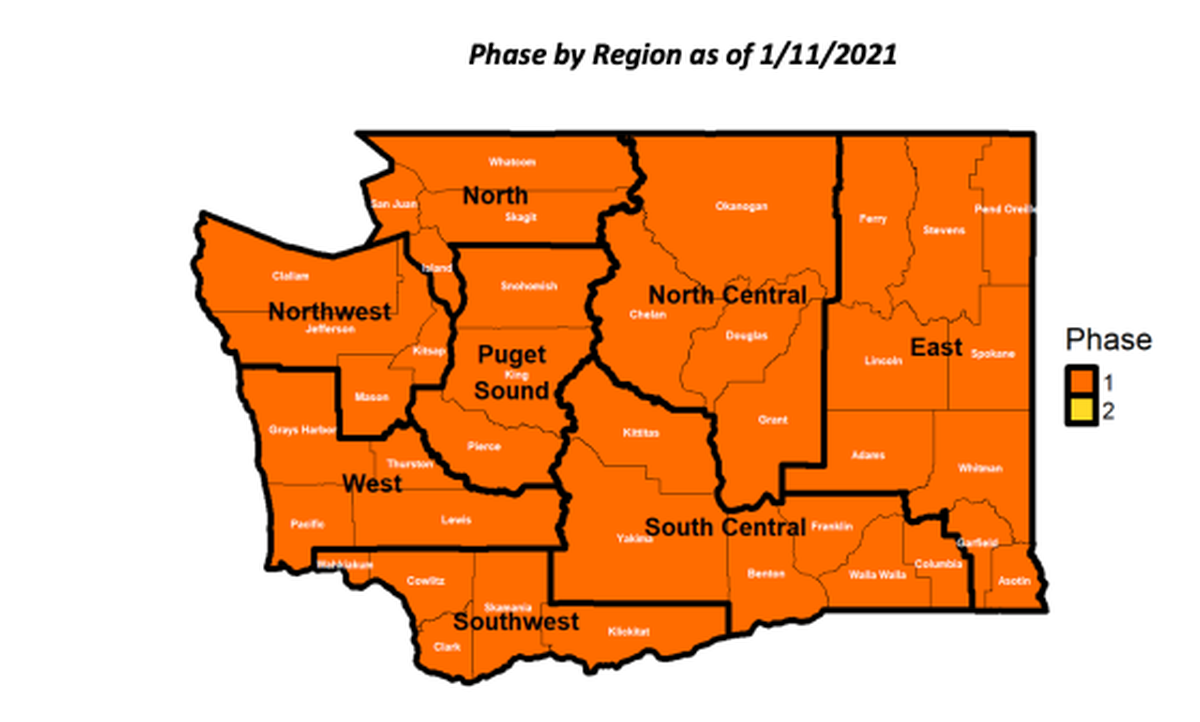
In the “Healthy Washington” plan introduced by Gov. Jay Inslee Tuesday, Jan. 5, business resumption is tied to targets by health system regions. Whatcom is tied to Skagit, San Juan and Island counties in the plan.
The state will run analyses each Friday to determine whether regions will move backward or forward in phases the following Monday, officials said.
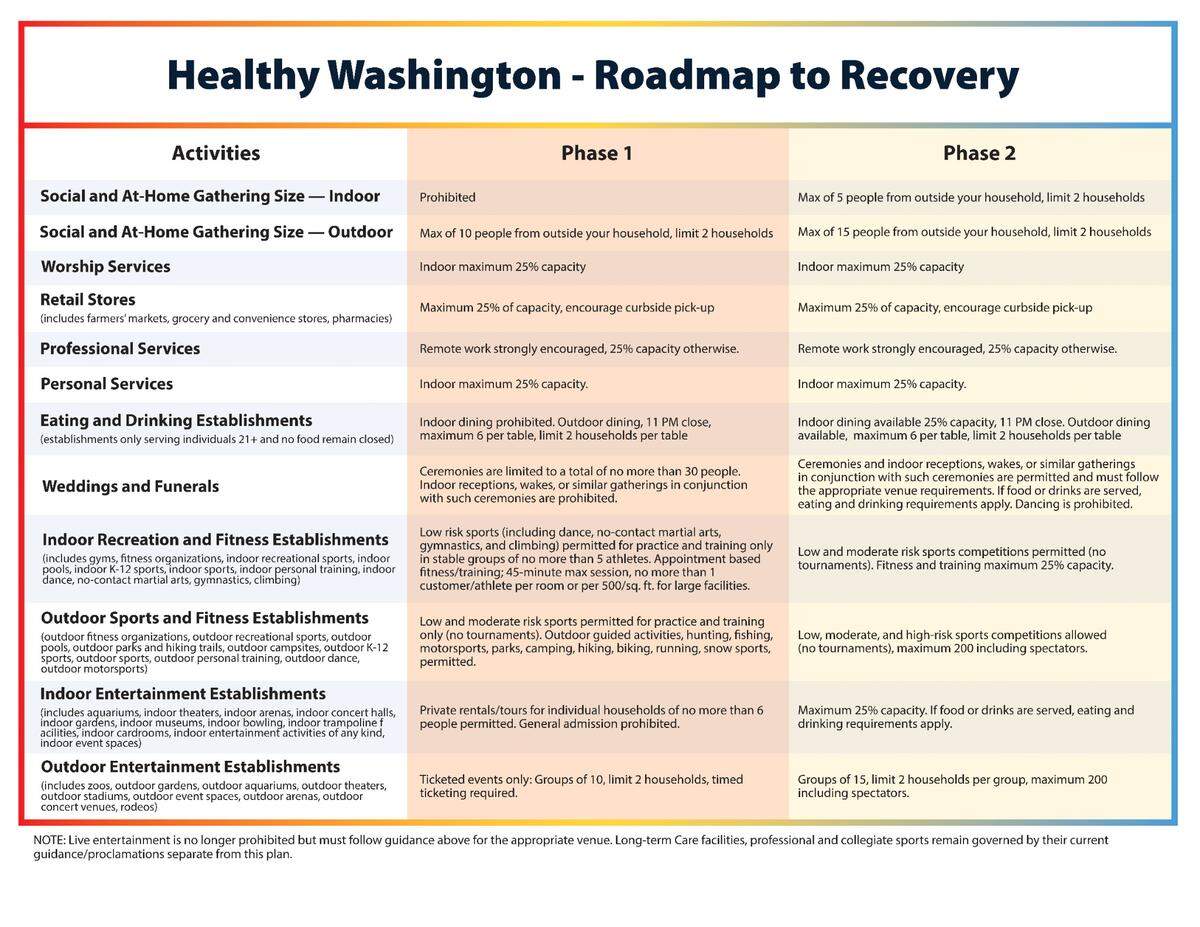
All regions began in Phase 1 on Monday. It allows live entertainment with ticketed groups of up to 10 people and very limited fitness activities such as appointment-based training in gyms.
This story was originally published January 15, 2021 at 7:46 AM.