Whatcom’s record pace continues with 53 confirmed COVID-19 cases Tuesday, state reports
Whatcom County has 53 new confirmed cases of COVID-19, according to the Washington State Department of Health on Tuesday, Jan. 5, but no new deaths were reported.
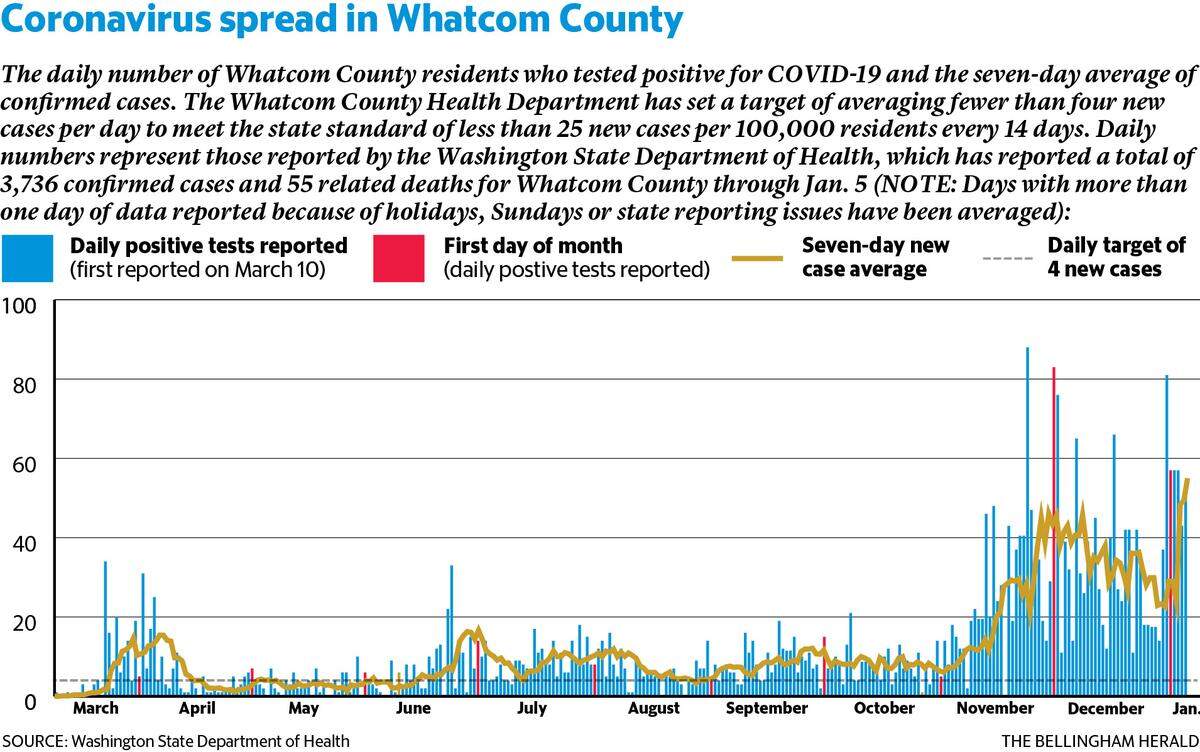
Overall, Whatcom County has seen 3,736 confirmed cases and 55 related deaths during the pandemic, according to state data as of 11:59 p.m. Monday. That means that 1.5% of the Whatcom residents who have tested positive for COVID during the pandemic have died.
Ten additional probable cases have been reported in Whatcom County during the pandemic resulting from positive antigen tests, but those cases were not confirmed by a molecular test.
The state cautioned that case counts Tuesday may include up to 700 duplicates statewide and that negative test results since Nov. 21 still may be incomplete.
With 267 confirmed cases reported since Dec. 31, Whatcom County is now averaging 55.0 new cases per day over the past seven days — the highest rate it has seen during the pandemic. Before the past three days, Whatcom’s highest rolling seven-day average was 46.0 on Nov. 27.
The state Department of Health data Tuesday also showed Whatcom County has had 205 hospitalizations, an increase of 15 from Monday’s report.
The state reported that a total of 130,271 molecular tests have been administered in Whatcom County during the pandemic — an increase of 396 tests from Monday’s report.
St. Joseph hospital in Bellingham, which is licensed and staffed for 241 beds, reported to The Bellingham Herald on Wednesday it was treating a 18 patients for COVID-19, down two from Tuesday’s report and three from Monday’s record-matching total of 21.
Base Camp, Camp 210 update
A total of 10 confirmed cases of COVID-19 combined have been found among residents at Base Camp, a homeless shelter operated by the Lighthouse Mission, and Camp 210, an encampment outside Bellingham City Hall and the Bellingham Public Library, according to a Facebook post by the Whatcom County Health Department. The post did not break down how many cases have been seen at each.
“We are continuing to work with camp organizers to minimize and respond to COVID-19 risks to everyone involved,” the post read. “At this time, there are no signs that there is a greater risk from COVID-19 at Camp 210 than at other locations or in other populations in Whatcom County.”
The health department said on its website that it is working with Camp 210 by:
▪ Offering weekly no-cost, on-site COVID testing to residents.
▪ Encouraging residents who experience COVID symptoms or anyone who believes they were in contact with a confirmed case of COVID-19 to stay at the county’s Isolation and Quarantine Facility.
▪ Providing daily transportation to the Isolation and Quarantine Facility from Camp 210.
▪ Assessing potential COVID risks with weekly check-ins and outreach at the encampment.
▪ Encouraging mask wearing, physical distancing and other actions to reduce the risk of COVID spread.
Last month, Base Camp announced that it was using rapid testing to help screen residents seeking to be admitted at the shelter. Admittance to Base Camp was restricted after Lighthouse Mission Ministries was notified on Nov. 28 that a homeless man who stayed at the shelter had tested positive for COVID-19.
Whatcom’s risk assessment
The state’s Risk Assessment Dashboard was last updated Tuesday evening for data as of 11:59 p.m. Monday. It showed that Whatcom County was missing the marks on two key metrics goals.
▪ Whatcom is missing the target rate of fewer than 25 new cases per 100,000 residents every 14 days with a rate of 161.1.
▪ Whatcom had an average COVID-19 molecular testing rate per 100,000 people over a week of 265.0. No goal was stated for this metric, however, the overall statewide number was 213.4. The state Department of Health has said that testing data since Nov. 21 is incomplete and that is likely impacting this metric.
▪ Whatcom is missing the target of less than 2.0% of individuals testing positive for COVID-19 during the past week with a rate of 3.6%. The state Department of Health has said that testing data since Nov. 21 is incomplete and that is likely impacting this metric.
The latest Healthcare System Readiness risk assessment dashboard, updated Tuesday evening for data through Monday, shows for the North region, which combines Whatcom, Skagit, Snohomish, San Juan and Island counties:
▪ Occupied beds: 1,061 of the region’s 1,183 adult hospital beds (89.7%) were occupied, missing the state’s goal of 80% or less.
▪ COVID occupied beds: 174 of the region’s 1,183 adult hospital beds (14.7%) were occupied by COVID patients, missing the state’s goal of 10% or less.
▪ Occupied ICU beds: 97 of the region’s 125 adult ICU beds (77.6%) were occupied. The state does not have a goal for this metric, but it was an decrease of one from Monday’s report.
▪ COVID occupied ICU beds: 34 of the region’s 125 adult ICU beds (27.2%) were occupied by COVID patients. The state does not have a goal for this metric, but it was a decrease of seven from Monday’s report.
Vaccine eligibility tool
The Washington State Department of Health has launched a new online tool to help residents determine if they are currently eligible to receive the COVID-19 vaccine.
Residents are asked to answer a series of questions through a form provided by the state Department of Health.
Contact information will be kept private, the form says, and only used to notify residents when they become eligible to receive the vaccine, if they are not already.
“Currently, this tool will only determine if you are eligible for the vaccine right now as the initial part of Phase 1,” the form says. “In the coming weeks as plans for future phases are confirmed, this tool will allow people to determine into which future phase they fall.”
The Pfizer vaccine has been authorized for people ages 16 and older, while the Moderna vaccine has been authorized for people ages 18 and older.
The form cautions women who are pregnant that they are welcome to complete the form, but should speak with a health care provider about vaccination options.
The form “does not apply to anyone living in Indian Country or within tribal jurisdictions.”
Questions residents are asked include their age, the county they live in (to help determine where the vaccine is needed), whether they live in a “community-based, congregate living setting” where most residents are older than 65, whether they work in a health care setting and if they plan to get vaccinated when eligible.
If not yet eligible, the state Department of Health can notify those who fill out the form when they become eligible via text message or email.
—Lauren Smith, lsmith@thenewstribune.com
Stimulus check tracker
American adults can now check the status of their COVID-19 stimulus checks with a new online tool the Internal Revenue Service launched Monday.
The status of both the first round of stimulus checks issued last spring and summer, as well as the status of the latest $600 relief payment can be checked on the IRS website with the “Get My Payment” tool.
Users will be able to find out if their latest check will be distributed by direct deposit or mail.
Stimulus checks were set to start arriving through direct deposit on Dec. 29 and paper checks were beginning to be mailed out Dec. 30, the IRS announced last week.
The latest round of payments under the federal government’s $900 billion relief package includes $600 for Americans making up to $75,000 per year and $1,200 for married couples making up to $150,000, plus $600 per child dependent.
Anyone eligible to receive stimulus checks that hasn’t can claim them when filing their 2021 taxes.
—Lauren Smith, lsmith@thenewstribune.com
Vaccines at pharmacies
QFC and Fred Meyer pharmacies will offer the COVID-19 vaccine under federal guidelines as soon they are able to receive it, said QFC spokeswoman Tiffany Sanders.
“We are still waiting for it,” Sanders told The Bellingham Herald.
“We’ll be following all the government guidelines as for actually who gets access,” she said.
Fred Meyer parent company Kroger was the nation’s first retailer to offer rapid antibody tests for just $25, Sanders said in a statement issued in mid-December.
Such tests let patients if they have been infected recently with the virus that causes COVID-19, she said.
Results are often ready in less than an hour.
—Robert Mittendorf, rmittendorf@bhamherald.com
Numbers elsewhere
New coronavirus cases and deaths according to Johns Hopkins University Wednesday morning:
▪ The U.S. has more than 21.0 million reported cases, the most of any nation, and more than 357,000 deaths.
▪ Worldwide, there are more than 86.5 million reported cases and 1.8 million deaths.
Washington state reported these numbers from the Department of Health Tuesday afternoon:
▪ 248,580 confirmed cases, an increase of 2,204 from reported cases on Monday.
▪ 10,187 probable cases, an increase of 128 from Monday’s data.
▪ 15,327 coronavirus-related hospitalizations, an increase of 167 from data Monday.
▪ 3,949,63235 total molecular tests, an increase of 13,872 from Monday’s data.
▪ 3,541 deaths related to COVID-19 were reported Sunday, the most recent data available. That reflected an increase of 59 deaths from data reported Monday meaning that 1.4% of the state residents who have tested positive for COVID during the pandemic have died.
Washington state actions
In the “Healthy Washington” plan introduced by Gov. Jay Inslee Tuesday, Jan. 5, business resumption is tied to targets by health system regions. Whatcom is tied to Skagit, San Juan and Island counties in the plan.
The state will run analyses each Friday, including this week, to determine whether regions will move backward or forward in phases the following Monday, officials said.
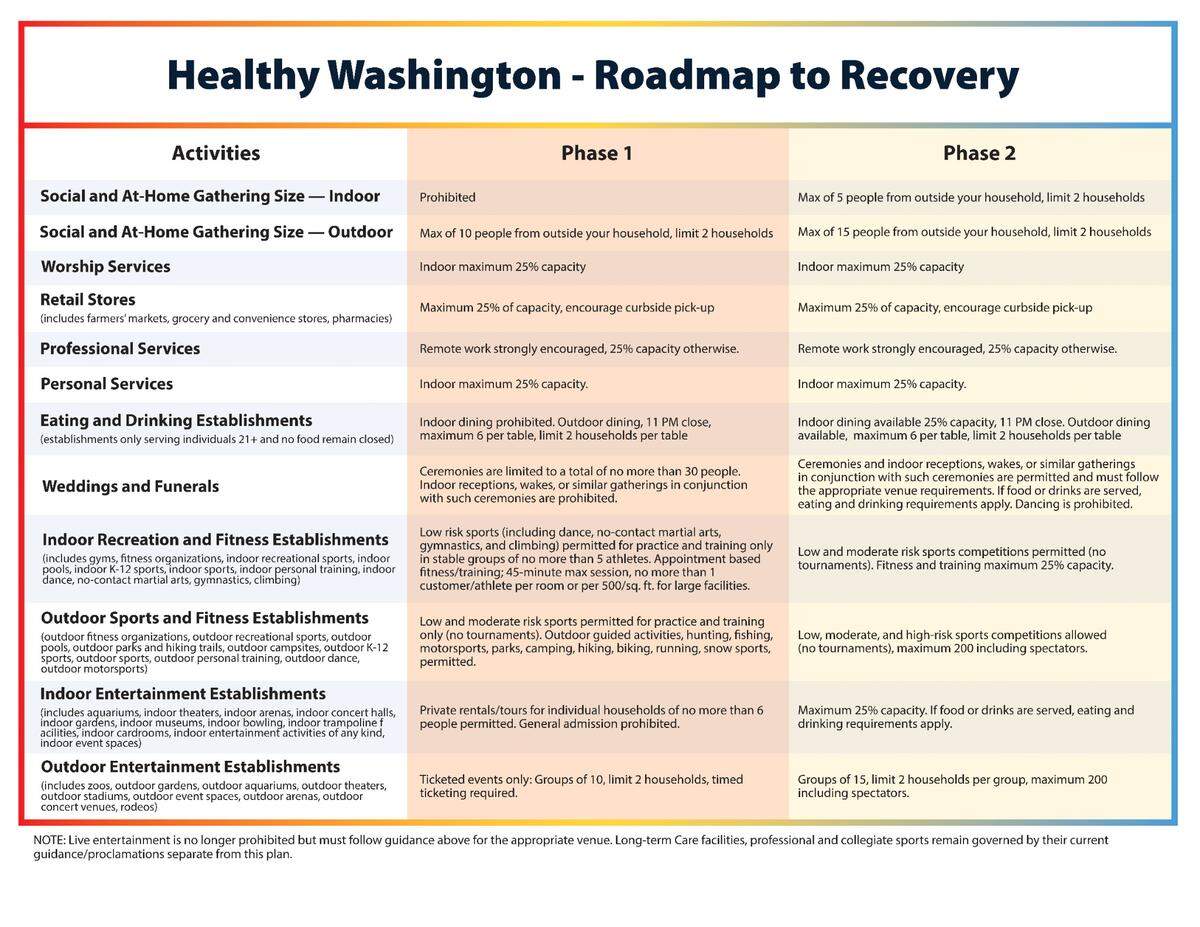
All regions will begin in Phase 1 on Jan. 11. It allows live entertainment with ticketed groups of up to 10 people and very limited fitness activities such as appointment-based training in gyms.
Phase 2 allows restaurants and indoor fitness centers to open indoors at 25% capacity and allows for sports competitions to resume with limited spectators, and wedding, and funeral ceremonies can increase capacities.
Regions must meet these targets to move to Phase 2:
▪ A 10% decline in case rates over the last 14 days compared to the prior two weeks.
▪ 10% decline in COVID hospital admission rate in the last 14 days.
▪ ICU occupancy rates below 90% for COVID-19 and non-COVID patients.
▪ A test positivity rate below 10%.
To stay in Phase 2, regions have to keep meeting at least three of the metrics, though the trend metrics will have a little more flexibility than ICU occupancy and test positivity rates.
This story was originally published January 6, 2021 at 7:35 AM.