Whatcom sees two new deaths, 14 confirmed COVID-19 cases, state reports Tuesday
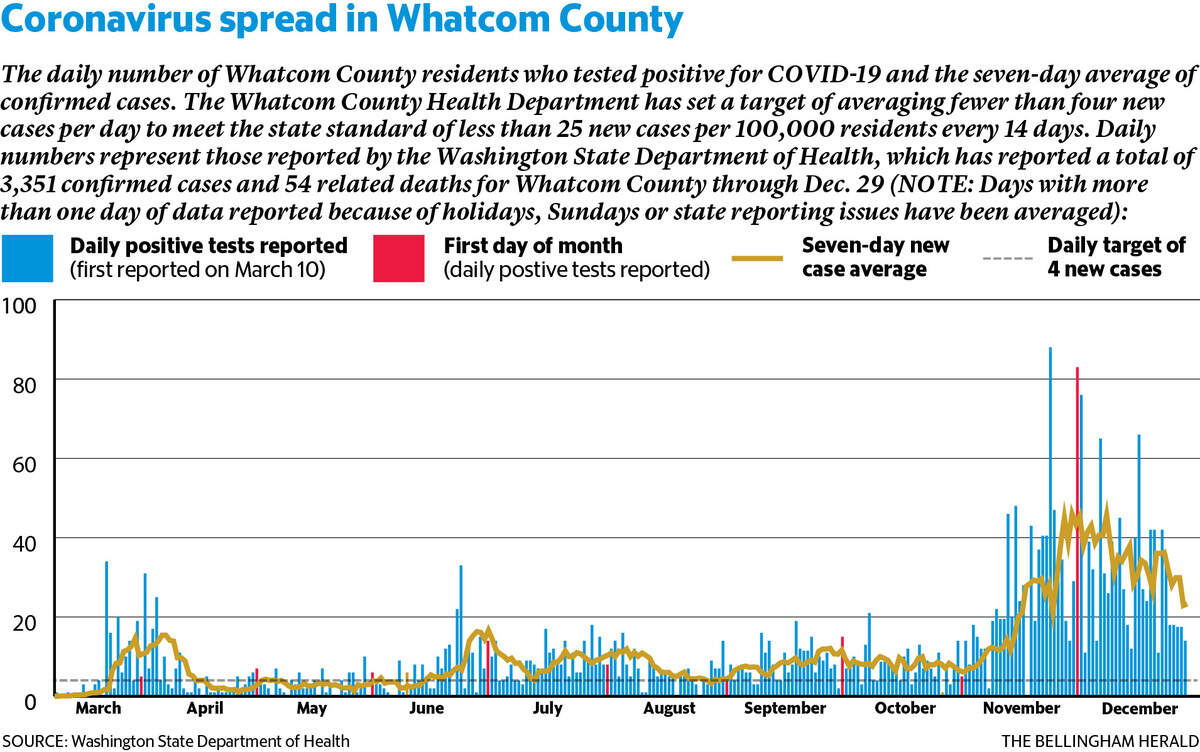
Whatcom County has recorded two new deaths of people with COVID-19 and 14 new confirmed cases of the illness, according to the Washington State Department of Health on Tuesday, Dec. 29.
The state reported the death data included a backlog of roughly 200 cases that were previously unreported due to a processing issue.
Overall, Whatcom County has seen 3,351 confirmed cases and 54 related deaths during the pandemic, according to state data as of 11:59 p.m. Monday, Dec. 28 That means that 1.6% of the Whatcom residents who have tested positive for COVID during the pandemic have died.
Nine additional probable cases have been reported in Whatcom County during the pandemic resulting from positive antigen tests, but those cases were not confirmed by a molecular test.
The state Department of Health data Tuesday also showed Whatcom County has had 179 hospitalizations, an increase of one since Monday’s report.
The state reported that a total of 125,991 molecular tests have been administered in Whatcom County during the pandemic — an increase of 1,513 tests from Monday’s report. The state continues to caution that test data from Nov. 21 to Nov. 30 are incomplete.
St. Joseph hospital in Bellingham, which is licensed and staffed for 241 beds, reported to The Bellingham Herald on Tuesday that it was treating 16 patients for COVID-19 — a decrease of one from Monday.
The Nooksack Indian Tribe announced in a Facebook post Monday that it has seen 22 confirmed cases within its community. Two more people are presumed to be positive for COVID-19 but are awaiting test results. So far, the Nooksack health team has conducted 2,136 tests during the pandemic, with results for 15 pending.
Race and ethnicity data
The percentage of Whatcom County COVID-19 cases impacting people identifying as Hispanic increased for the fourth straight week, as the estimated number of new cases among Whatcom County’s Hispanic community has grown by approximately 42% during the month of December — substantially higher than the combined 33% growth all other races saw over the same period.
The increase in case percentage in December comes after eight straight weeks in decreases that dropped the percentage of cases from 30.3% on Sept. 28 to 26.6% Dec. 1. Since then, the percentage has increased to 27.9%, according to data released Tuesday by the Whatcom County Health Department.
The county health department breaks down the percentage of cases each for eight race or ethnicity categories represented in Whatcom’s total count and released its latest data Tuesday evening. The Bellingham Herald used those percentages and the county’s total number of cases to estimate the number of cases each race or ethnicity has seen during the pandemic.
Here is what the latest data, which is through Dec. 29, shows:
▪ White, non-Hispanic: 58.6% of cases, unchanged from data Dec. 22 (people identifying as white represent 78.7% of Whatcom’s total population). Using that percentage, The Herald estimates 1,564 cases in people who identify as white — a 5.0% increase over the Dec. 22 estimate of 1,489 cases.
▪ Hispanic: 27.9% of cases, up from 27.8% on Dec. 22 (people identifying as Hispanic represent 9.5% of Whatcom’s total population). Using that percentage, The Herald estimates 745 cases are in people who identify as Hispanic — a 5.4% increase over the Dec. 22 estimate of 707 cases.
▪ American Indian/Alaska Native, non-Hispanic: 5.1% of cases, unchanged from Dec. 22 (people identifying as American Indian or Alaska native represent 2.5% of Whatcom’s total population). Using that percentage, The Herald estimates 136 cases are in people who identify as American Indian or Alaska Native— a 5.0% increase over the Dec. 22 estimate of 130 cases.
▪ Multiracial, non-Hispanic: 2.8% of cases, unchanged from Dec. 22 (people identifying as multiracial represent 3.6% of Whatcom’s total population). Using that percentage, The Herald estimates 75 cases are in people who identify as multiracial — a 5.0% increase over the Dec. 22 estimate of 71 cases.
▪ Asian, non-Hispanic: 2.3% of cases, unchanged from Dec. 22 (people identifying as Asian represent 4.3% of Whatcom’s total population). Using that percentage, The Herald estimates 61 cases are in people who identify as Asian — a 5.0% increase over the Dec. 22 estimate of 58 cases.
▪ Black, non-Hispanic: 1.1% of cases, unchanged from Dec. 22 (people identifying as Black represent 1.0% of Whatcom’s total population). Using that percentage, The Herald estimates 29 cases are in people who identify as Black — a 5.0% increase from the Dec. 22 estimate of 28 cases.
▪ Native Hawaiian or other Pacific Islander, non-Hispanic: 0.7% of cases, up from 0.6% on Dec. 22 (people identifying as Native Hawaiian or other Pacific Islander represent 0.3% of Whatcom’s total population). Using that percentage, The Herald estimates 19 cases are in people who identify as Native Hawaiian or other Pacific Islander — a 22.5% increase from the Dec. 22 estimate of 15 cases.
▪ Other race, non-Hispanic: 1.6% of cases, unchanged from Dec. 22 (people identifying as some other race or ethnicity represent 0.0% of Whatcom’s total population). Using that percentage, The Herald estimates 43 cases are in people who identify as a race or ethnicity other than the seven listed above — a 5.0% increase over the Dec. 22 estimate of 41 cases.
Approximately 20% of all cases (an estimated 667 cases) do not have a known race or ethnicity.
Overall, the number of cases reported in the county increased by 5.0% (160 cases) between Dec. 22 and 29, according to the state Department of Health.
Whatcom’s risk assessment
The state’s Risk Assessment Dashboard Tuesday evening for data as of 11:59 p.m. Monday showed that Whatcom County is missing the marks on two key metrics goals.
▪ Whatcom is missing the target rate of fewer than 25 new cases per 100,000 residents every 14 days with a rate of 190.9.
▪ Whatcom had an average COVID-19 molecular testing rate per 100,000 people over a week of 400. No goal was stated for this metric, however, the overall statewide number was 325.7. The state Department of Health has said that testing data since Nov. 21 is incomplete and that is likely impacting this metric.
▪ Whatcom is missing the target of less than 2.0% of individuals testing positive for COVID-19 during the past week with a rate of 3.4%. The state Department of Health has said that testing data Nov. 21-30 is incomplete and that is likely impacting this metric.
The latest Healthcare System Readiness risk assessment dashboard cautioned information for Dec. 21-25 is incomplete due to an interruption in hospital data submissions. The dashboard, updated late Tuesday for data through Monday, shows for the North region, which combines Whatcom, Skagit, Snohomish, San Juan and Island counties:
▪ Occupied beds: 967 of the region’s 1,199 adult hospital beds (80.7%) were occupied, missing the state’s goal of 80% or less.
▪ COVID occupied beds: 170 of the region’s 1,199 adult hospital beds (14.2%) were occupied by COVID patients, missing the state’s goal of 10% or less.
▪ Occupied ICU beds: 76 of the region’s 136 adult ICU beds (55.9%) were occupied. The state does not have a goal for this metric, but it was an increase of four from Monday’s report.
▪ COVID occupied ICU beds: 36 of the region’s 136 adult ICU beds (26.5%) were occupied by COVID patients. The state does not have a goal for this metric, but it was an increase of five from Monday’s report.
Numbers elsewhere
New coronavirus cases and deaths according to Johns Hopkins University Tuesday afternoon:
▪ The U.S. has more than 19.52 million reported cases, the most of any nation, and 337,829 deaths.
▪ Worldwide, there are more than 81.90 million reported cases and 1.78 million deaths.
Washington state reported these numbers from the Department of Health Tuesday afternoon:
▪ 231,724 confirmed cases, an increase of 2,052 from reported cases on Monday.
▪ 9,112 probable cases, an increase of 122 from Monday’s data.
▪ 14,445 coronavirus-related hospitalizations, an increase of 169 from data Monday.
▪ 3,798,321 total molecular tests, an increase of 29,659 from Monday’s data.
▪ 3,369 deaths related to COVID-19, an increase of 174 deaths from data reported Friday, Dec. 25, meaning that 1.4% of the state residents who have tested positive for COVID during the pandemic have died.
Washington state actions
Gov. Inslee announced rules Nov. 15 that eliminate indoor service at restaurants and bars, close indoor activity at gyms, and limit occupancy at retail stores to 25% in an effort to curb the dramatic rise in COVID-19 cases in Washington state.
Those restrictions were originally scheduled to last until Dec. 14, but on Dec. 8, Inslee announced they have been extended another three weeks to Jan. 4.
Inslee issued a travel advisory for Washington state on Nov. 13, recommending Washington state residents self-quarantine for 14 days when they return home after traveling out of the state. The governors of Oregon and California joined Inslee in making similar advisories for their states.
On Oct. 13, Inslee moved all counties in modified Phase 1 to Phase 2, but his July 28 extension of an indefinite pause on counties moving ahead in the Safe Start Washington plan remains in place. That came a week after Inslee loosened some restrictions for activities and businesses.
That means 22 counties — including Whatcom — are in Phase 2 and 17 counties are in Phase 3.
This story was originally published December 29, 2020 at 5:12 PM.