Whatcom sees 66 new confirmed COVID-19 cases on Thursday, 975 vaccine doses, state reports
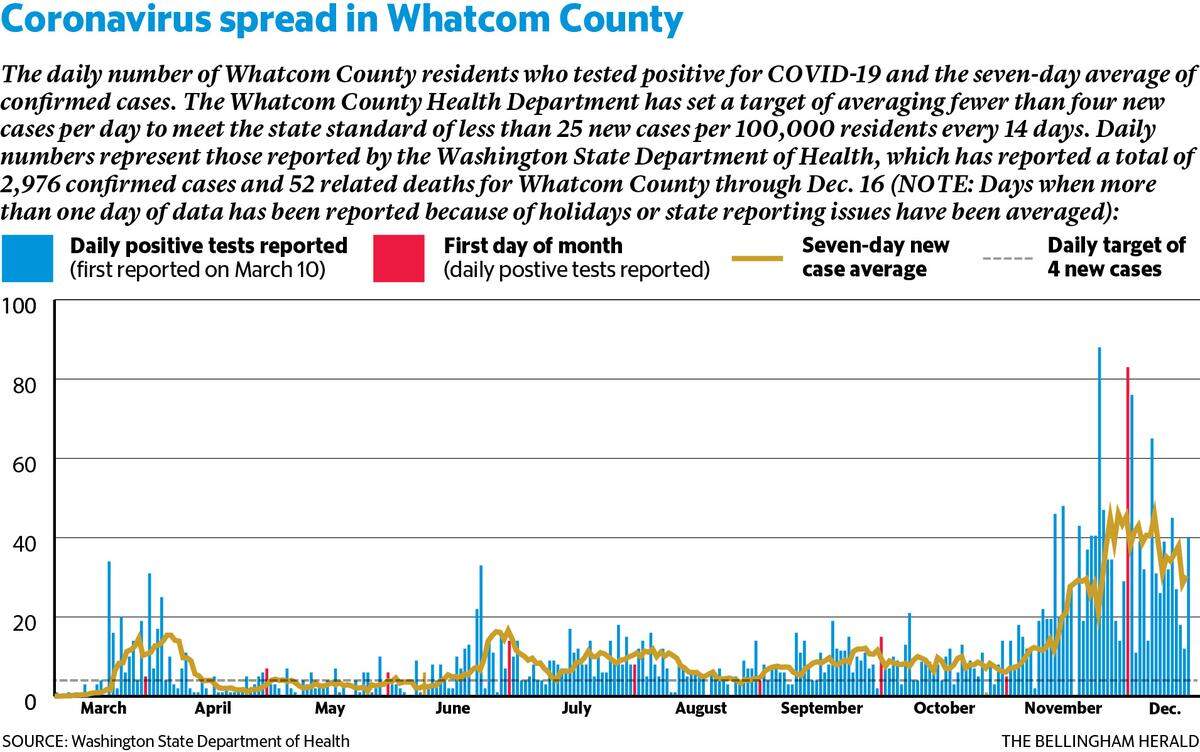
Whatcom County recorded 66 new confirmed COVID-19 cases and eight new probable cases, according to the Washington State Department of Health Thursday, Dec. 17. No additional deaths were reported for Whatcom County
Whatcom County now has seen 3,042 confirmed cases, and 52 related deaths during the pandemic, according to state data as of 11:59 p.m. Wednesday, Dec. 16. That means that 1.7% of the Whatcom residents who have tested positive for COVID during the pandemic have died.
An additional eight probable cases have been reported in Whatcom County during the pandemic resulting from positive antigen tests, but those cases were not confirmed by a molecular test.
On Wednesday, the state added probable cases reported since June 2020 to all case, hospitalization, and death counts. “Probable cases are those where individuals had a positive antigen test result for COVID-19, but no positive molecular test result,” according to the state Health Department website.
The state Department of Health data Thursday also showed Whatcom County has had 166 hospitalizations (no change from Wednesday’s report).
The state also reported that a total of 87,935 molecular tests have been administered in Whatcom County during the pandemic — a decrease of 11,184 tests from Wednesday’s report. The state continues to caution that “test data from Nov. 21 through today are incomplete and should be interpreted with caution.”
St. Joseph hospital in Bellingham, which is licensed and staffed for 241 beds, reported to The Bellingham Herald on Thursday that it was treating 11 patients for COVID-19 — a decrease of one from Wednesday.
Testing data update
The Washington State Department of Health did not release an estimate on when reliable negative lab testing data would resume on its COVID-19 dashboard in response to a question from The Bellingham Herald.
The state stopped releasing negative testing data on Nov. 21 because of a data overload. It resumed releasing negative testing data on Dec. 4, though it cautioned that it was still trying to catch up and negative testing data was incomplete and that testing numbers “should be interpreted with caution.”
“Collecting negative lab test data is a complex and challenging practice that involves multiple systems and processes,” Department of Health spokesperson Teresa McCallion told The Herald in an email. “The volume of tests we are receiving is, on average, more than 25 times what we received prior to COVID-19. This volume of tests is extremely challenging for our systems to manage.
“We are actively working internally and with laboratory and information technology partners to both increase the capacity of our systems and increase their stability so that we can provide complete data in a timely fashion.”
As of Wednesday’s data release, the state had reported 4,491 tests in Whatcom County since Nov. 21 — an average of 179.6 per day over 25 days. In the 25 days before Nov. 21, the state reported Whatcom had 16,196 tests — an average of 647.8 per day.
Without an accurate count of the number of tests conducted, other data, such as test positivity rates, are impossible to compute.
Whatcom’s risk assessment
The state’s Risk Assessment Dashboard was last updated Thursday for data as of 11:59 p.m. Wednesday. It showed that Whatcom County is missing the marks on two key metrics goals.
▪ Whatcom is missing the target rate of fewer than 25 new cases per 100,000 residents every 14 days with a rate of 219.3.
▪ Whatcom had an average COVID-19 molecular testing rate per 100,000 people over a week of 39.6. No goal was stated for this metric, however, the overall statewide number was 264.0. The state Department of Health has said that testing data since Nov. 21 is incomplete and that is likely impacting this metric.
▪ Whatcom is missing the target of less than 2.0% of individuals testing positive for COVID-19 during the past week with a rate of 42.8%. The state Department of Health has said that testing data since Nov. 21 is incomplete and that is likely impacting this metric.
The latest Healthcare System Readiness risk assessment dashboard, which was last updated Thursday for data through Wednesday, shows for the North region, which combines Whatcom, Skagit, Snohomish, San Juan and Island counties:
▪ Occupied beds: 1,033 of the region’s 1,234 adult hospital beds (83.7%) were occupied, missing the state’s goal of 80% or less.
▪ COVID occupied beds: 131 of the region’s 1,234 adult hospital beds (10.6%) were occupied by COVID patients, missing the state’s goal of 10% or less.
▪ Occupied ICU beds: 92 of the region’s 140 adult ICU beds (65.7%) were occupied. The state does not have a goal for this metric, but there was no change from Wednesday’s report.
▪ COVID occupied ICU beds: 34 of the region’s 140 adult ICU beds (24.3%) were occupied by COVID patients. The state does not have a goal for this metric, but it was two fewer from Wednesday’s report.
New school guidelines
According to the revised guidelines from the Washington state Department of Health announced Wednesday by Gov. Jay Inslee, six of Whatcom County seven school districts would have moderate risk in returning to in-person learning, while Nooksack Valley would fall in the high-risk category.
Under the plan announced by Inslee and State Superintendent of Public Instruction Chris Reykdal, school districts are at a low risk if the area they cover is seeing fewer than 50 new COVID-19 cases per 100,000 residents over a two-week period and test positivity is less than 5%. District in the low range are encouraged to provide in-person learning for all students.
Districts fall in the moderate risk level if the areas they cover have infection rates between 50 and 350 and test positivity between 5% and 10%. Phased-in, in-person learning is recommended at this level.
The high-risk level is reserved for area that are seeing infection rates greater than 350 and test positivity higher than 10%, and districts are encourage to phase in in-person learning in groups of 15 or fewer students only in kindergarten through fifth grade and students with highest needs.
The latest location data released by the Whatcom County Health Department on Tuesday, Dec. 15, shows infection rates in Bellingham (201), Blaine (233), Ferndale (251), Lynden (311), Meridian (121) and Mount Baker (120) would all fall in the moderate risk level, while Nooksack Valley would be in the high-risk level with an infection rate of 632.
“My initial take is that we are in a great position as a district to keep moving forward with our plans, which include bringing back second graders on Jan. 14 and Promise Kindergarten students on Jan. 25,” Bellingham Public Schools Superintendent Greg Baker said in a letter Wednesday afternoon. “We will continue to prepare to bring back students in grades 3-12, with some ideally as soon as the end of January or beginning of February.
“After winter break, we will assess our health metrics and guidance from our health department to inform our decisions regarding next steps.”
Vaccination update
Whatcom County received 975 doses of Pfizer’s COVID-19 vaccine this week, according to a news release late Wednesday from the state Department of Health. All 975 doses came from the second shipment of the vaccine the state received.
Only 29 of of the state’s 39 counties received vaccine shipments this week, according to the release. King, (17,550 doses), Pierce (5,850), Clark (3,900), Snohomish (3,900), Spokane (3,900), Benton (1,950), Kitsap (1,950) and Yakima (1,950) were the only counties to receive more doses than Whatcom.
Three Native American tribes and urban Indian Health Programs received 1,950 doses combined and one long-term care facility received another 975, according to the release.
The state said it is anticipating receiving 29,250 more doses later this week.
Late Thursday, the state Department of Health reported it was contacted by Operation Warp Speed Wednesday evening and told that Washington’s Pfizer-BioNTech COVID-19 vaccine allocation will be 44,850 doses rather than the 74,100 doses the state expected to receive.
“We were not given an explanation as to why our allocation was reduced, and we do not currently have allocation numbers beyond next week. We still expect to receive the remaining Pfizer-BioNTech doses we ordered for this first week (62,400 total doses),” the news release stated.
As of midday Wednesday, the release said 410 doses had been administered to frontline health workers and long-term care residents and staff across the state, who are the only people eligible to receive the vaccine at this time. The department estimates it will take until mid- to late-January to finish vaccinating these groups and move on to the next eligible groups.
Numbers elsewhere
COVID-19 cases and deaths according to Johns Hopkins University Thursday evening:
▪ The U.S. has more than 17.19 million reported cases, the most of any nation, and 310,424 deaths.
▪ Worldwide, there are more than 74.87 million reported cases and 1.66 million deaths.
Washington state reported these numbers from the Department of Health Thursday evening:
▪ 209,344 confirmed cases, an increase of 2,750 from reported cases on Wednesday. Up to 1,000 duplicate cases may be included in statewide totals, according to the state.
▪ 7,861 probable cases, an increase of 190 from Wednesday’s data.
▪ 13,235 coronavirus-related hospitalizations, an increase of 161 from data Wednesday.
▪ 2,765,404 total molecular tests, a decrease of 667,488 from Wednesday’s data for overall tests.
▪ 3,117 deaths related to COVID-19, 75 more than were reported Wednesday, meaning that 1.4% of the state residents who have tested positive for COVID during the pandemic have died.
Washington state actions
Gov. Inslee announced rules Nov. 15 that eliminate indoor service at restaurants and bars, close indoor activity at gyms, and limit occupancy at retail stores to 25% in an effort to curb the dramatic rise in COVID-19 cases in Washington state.
Those restrictions were originally scheduled to last until Dec. 14, but on Dec. 8, Inslee announced they have been extended another three weeks to Jan. 4.
Inslee issued a travel advisory for Washington state on Nov. 13, recommending Washington state residents self-quarantine for 14 days when they return home after traveling out of the state. The governors of Oregon and California joined Inslee in making similar advisories for their states.
On Oct. 13, Inslee moved all counties in modified Phase 1 to Phase 2, but his July 28 extension of an indefinite pause on counties moving ahead in the Safe Start Washington plan remains in place. That came a week after Inslee loosened some restrictions for activities and businesses.
That means 22 counties — including Whatcom — are in Phase 2 and 17 counties are in Phase 3.
This story was originally published December 17, 2020 at 6:32 PM.