Whatcom tops 2,500 total COVID cases with 76 new positive tests reported Wednesday
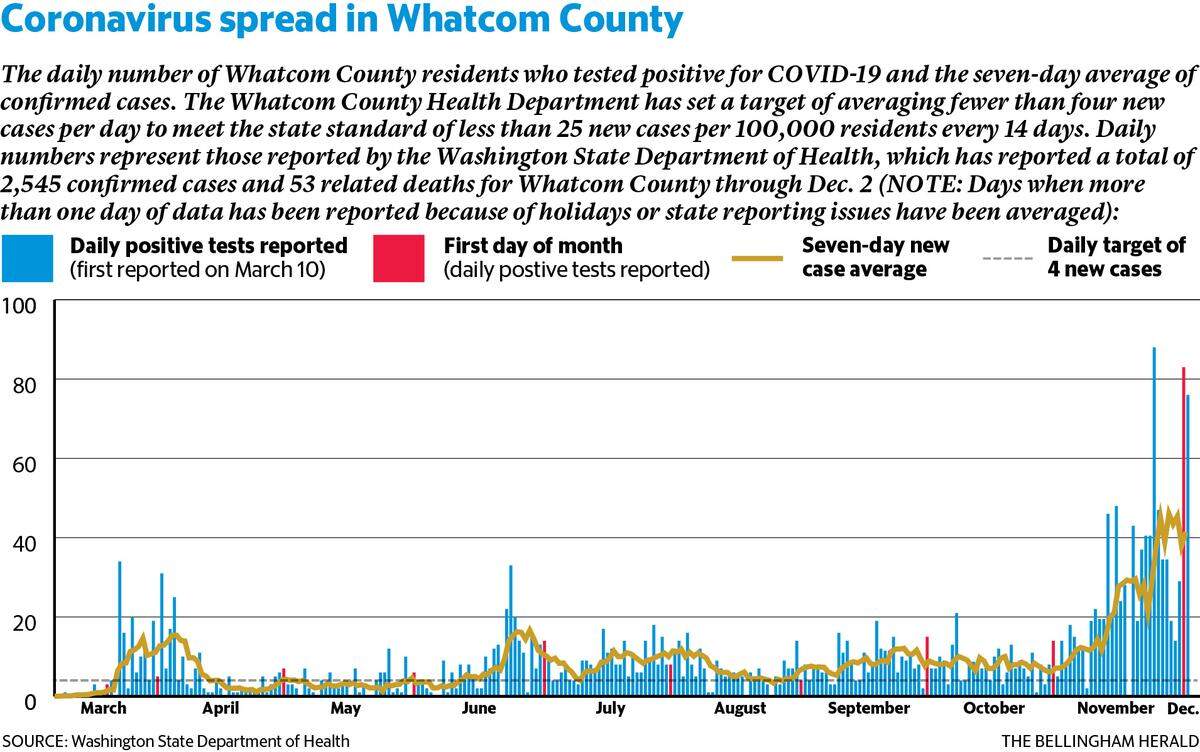
Whatcom County saw 76 more residents test positive for COVID-19, the Washington State Department of Health reported on Wednesday, Dec. 2, but no new deaths related to coronavirus were reported.
Whatcom County now has seen 2,545 confirmed cases and 53 related deaths during the pandemic, according to state data as of 11:59 p.m. Tuesday, Dec. 1. That means that 2.1% of the Whatcom residents who have tested positive for COVID during the pandemic have died.
The 76 cases reported Wednesday come on the heels of 83 being reported Tuesday and marks the fifth time the county has had more than 50 cases reported in a day — all five have come in the past 10 days — including a record 88 cases Nov. 24.
Whatcom County also surpassed 2,500 cases just 12 days after surpassing the 2,000 plateau on Nov. 20. For comparison, it took Whatcom 105 days to surpass 500 cases during the pandemic (on June 23), 50 more days to reach 1,000 cases (on Aug. 12), 66 days to reach 1,500 total cases (on Oct. 17) and 34 more days to reach 2,000.
On Monday, the state delayed when it plans to resume reporting negative test data until Friday, Dec. 4, as it attempts to catch up from the surge in testing data.
The state Department of Health data Wednesday did show Whatcom County has had 143 hospitalizations (unchanged from Tuesday).
The Lummi Tribal Health Center reported two new cases late Tuesday, bringing the total number of cases in the Lummi community during the pandemic to 119. The Lummi community had 39 cases in November and 55 since Oct. 1.
As of Tuesday, the Lummi health department reported it had 14 active cases — down seven from what was reported Monday — and no hospitalizations. During the pandemic, four people have been hospitalized, but there have been no related deaths and the health center has conducted 2,789 tests.
The Lummi Indian Business Council moved the community back into Phase 1 of its Shelter in Place Order until at least Dec. 15.
St. Joseph hospital in Bellingham, which is licensed and staffed for 241 beds, reported to The Bellingham Herald on Wednesday that it was treating 18 patients for COVID-19 — down three from Tuesday’s record high of 21.
Race and ethnicity data
The percentage of Whatcom County COVID-19 cases impacting people identifying as white increased by a full percentage point, according to the latest data released by the Whatcom County Health Department. Every other race or ethnicity category, except Native Hawaiian or other Pacific Islander, non-Hispanic, saw its percentage either decrease or remain unchanged.
The county health department breaks down the percentage of cases each of eight race or ethnicity categories represented in Whatcom’s total count and released its latest data Wednesday.
Here is what the latest data, which is through Dec. 1, shows:
▪ White, non-Hispanic: 59.7% of cases, up from 58.7% on Nov. 24 (represents 78.7% of Whatcom’s total population). Using that percentage, The Herald estimates 1,179 cases in people who identify as white — a 13.7% increase over the Nov. 24 estimate of 1,037 cases.
▪ Hispanic: 26.6% of cases, down from 27.2% on Nov. 24 (represents 9.5% of Whatcom’s total population). Using that percentage, The Herald estimates 525 cases are in people who identify as Hispanic — a 9.4% increase over the Nov. 24 estimate of 480 cases.
▪ American Indian/Alaska Native, non-Hispanic: 5.0% of cases, down from 5.1% on Nov. 24 (represents 2.5% of Whatcom’s total population). Using that percentage, The Herald estimates 99 cases are in people who identify as American Indian or Alaska Native— a 9.6% increase over the Nov. 24 estimate of 90 cases.
▪ Multiracial, non-Hispanic: 2.8% of cases, down from 3.0% on Nov. 24 (represents 3.6% of Whatcom’s total population). Using that percentage,The Herald estimates 55 cases are in people who identify as multiracial — a 4.4% increase over the Nov. 24 estimate of 53 cases.
▪ Asian, non-Hispanic: 2.4% of cases, unchanged from Nov. 24 (represents 4.3% of Whatcom’s total population). Using that percentage, The Herald estimates 47 cases are in people who identify as Asian — an 11.8% increase over the Nov. 24 estimate of 42 cases.
▪ Black, non-Hispanic: 1.2% of cases, unchanged from Nov. 24 (represents 1.0% of Whatcom’s total population). Using that percentage, The Herald estimates 24 cases are in people who identify as Black — an 11.8% increase over the Nov. 24 estimate of 21 cases.
▪ Native Hawaiian or other Pacific Islander, non-Hispanic: 0.7% of cases, up from 0.6% on Nov. 24 (represents 0.3% of Whatcom’s total population). Using that percentage, The Herald estimates 14 cases are in people who identify as Native Hawaiian or other Pacific Islander — a 30.5% increase over the Nov. 24 estimate of 11 cases.
▪ Other race, non-Hispanic: 1.6% of cases, down from 1.8% on Nov. 24 (represents 0.0% of Whatcom’s total population). Using that percentage, The Herald estimates 32 cases are in people who identify as a race or ethnicity other than the seven listed above — unchanged from the Nov. 24 estimate.
Approximately 20% of all cases (an estimated 494 cases) do not have a known race or ethnicity.
Overall, the number of cases reported in the county increased 11.8% (261 cases) between Nov. 24 and Dec. 1, according to the state Department of Health.
The county health department also reported that it expects to release its weekly location data on Thursday, Dec. 3.
Whatcom’s risk assessment
The state’s Risk Assessment Dashboard was updated Wednesday for data as of 11:59 p.m. Tuesday. It showed that Whatcom County is missing the marks on two key metrics goals.
▪ Whatcom is missing the target rate of fewer than 25 new cases per 100,000 residents every 14 days with a rate of 225.0.
▪ Whatcom had an average COVID-19 testing rate per 100,000 people over a week of 324.5. No goal was stated for this metric, however, the overall statewide number was 289.6.
▪ Whatcom is missing the target of less than 2.0% of individuals testing positive for COVID-19 during the past week with a rate of 3.0%.
Here is what the latest Healthcare System Readiness risk assessment dashboard, which was last updated Wednesday for data through Tuesday, shows for the North region, which combines Whatcom, Skagit, Snohomish, San Juan and Island counties:
▪ Occupied beds: 1,008 of the region’s 1,293 adult hospital beds (78.0%) were occupied, meeting the state’s goal of 80% or less.
▪ COVID occupied beds: 135 of the region’s 1,313 adult hospital beds (10.3%) were occupied by COVID patients, missing the state’s goal of 10% or less.
▪ Occupied ICU beds: 94 of the region’s 140 adult ICU beds (67.1%) were occupied. The state does not have a goal for this metric, but four more beds were occupied than in Tuesday’s report.
▪ COVID occupied ICU beds: 36 of the region’s 140 adult ICU beds (25.7%) were occupied by COVID patients. The state does not have a goal for this metric, but three fewer beds are occupied than in Tuesday’s report.
Long-term care update
Whatcom County’s long-term care facilities have not seen any more COVID-related deaths, but the number of cases associated to facilities climbed by more than 10% since the Washington State Department of Health’s last COVID-19 Long-Term Care Report was released last month.
According to data in the report, which was released Tuesday, Dec. 1, and reflected data through Monday, Nov. 30, Whatcom County long-term care facilities have had 249 confirmed cases and 40 related deaths during the pandemic. That marks an increase of 27 cases since Nov. 9.
The 249 cases mean that long-term care facilities had 10.4% of the 2,386 overall cases reported in Whatcom County on Monday, while the 40 related deaths represented 75.5% of the county’s death total during the pandemic.
Statewide, long-term care facilities have been associated with 10,036 cases (6% of the state’s total cases) and 1,467 related deaths (53% of the state’s death total), the report showed. Since Nov. 9, the state’s long-term care facilities saw increases of 14.2% in the number of cases (1,249 cases) and 8.3% in the number of deaths (113 deaths).
Numbers elsewhere
COVID-19 cases and deaths according to Johns Hopkins University Wednesday afternoon:
▪ The U.S. has more than 13.9 million reported cases, the most of any nation, and 273,170 deaths.
▪ Worldwide, there are more than 64.3 million reported cases and 1.4 million deaths.
Washington state reported these numbers from the Department of Health Wednesday:
▪ 170,342 reported cases, an increase of 3,126 from data on Tuesday.
▪ 10,954 coronavirus-related hospitalizations, an increase of 34 from data Tuesday.
▪ 2,850 deaths related to COVID-19, an increase of 45 from Tuesday, meaning that 1.7% of the state residents who have tested positive for COVID during the pandemic have died.
Washington state actions
Gov. Inslee announced rules Sunday, Nov. 15, that eliminate indoor service at restaurants and bars, close indoor activity at gyms, and limit occupancy at retail stores to 25% in an effort to curb the dramatic rise in COVID-19 cases in Washington state.
The restrictions are scheduled to last until Dec. 14.
Inslee issued a travel advisory for Washington state on Friday, Nov. 13, recommending Washington state residents self-quarantine for 14 days when they return home after traveling out of the state. The governors of Oregon and California joined Inslee in making similar advisories for their states.
On Tuesday, Oct. 13, Inslee moved all counties in modified Phase 1 to Phase 2, but his July 28 extension of an indefinite pause on counties moving ahead in the Safe Start Washington plan remains in place. That came a week after Inslee loosened some restrictions for activities and businesses.
That means 22 counties — including Whatcom — are in Phase 2 and 17 counties are in Phase 3.
This story was originally published December 2, 2020 at 4:13 PM.