‘It’s a statement to our kids and to future generations’ as Sidhu becomes Whatcom Executive
When Satpal Sidhu was elected Whatcom County executive in November 2019, it was a symbol of hope for minorities across Whatcom County.
“The election of Satpal as county executive is really a statement to every person of color in every community that public office is open to everyone,” said Tim Ballew, CEO of the Lummi Commercial Co., in an interview with The Bellingham Herald.
“This just opens that door even more,” Ballew said.
Sidhu, a businessman, farmer and former dean of engineering at Bellingham Technical College, served one four-year term on the County Council before he ran for county executive.
He was born in India, immigrated to the U.S. from Canada and is one of only a handful of members of the Sikh faith who hold public office across the U.S.
“It’s a statement to our kids and to future generations. The first person of color elected to that office — I think that’s worth noting. We’re all going to benefit from this,” said Ballew, who is a former Lummi Nation chairman and was appointed in 2018 to complete a term on the Whatcom County Council.
Western Washington University President Sabah Randhawa called it an “historic” election victory.
“I think it speaks volumes about how far this community has come,” Randhawa told The Herald in an email.
Randhawa, a Pakistani immigrant, spoke at the dedication of the Arch of Healing and Reconciliation, a downtown Bellingham monument to honor the region’s native inhabitants and immigrants and recognize the historic discrimination they faced.
Whatcom’s history of racism
Whatcom County’s population of 225,685 people is 85% white, according to 2019 census estimates.
Despite Bellingham’s current reputation as a progressive city, it has a dark history of racism that stretches from its taking of indigenous peoples’ lands, to the 1907 riots targeting East Asian immigrants, and the presence of the KKK in the 1920s.
A cross was burned at a migrant worker camp near Lynden in 1994, and in the summer of 2019, a white supremacist group called the Patriot Front posted fliers with racist messages from Bellingham to Ferndale and Lynden.
During the election campaign, Sidhu reported that several of his large signs had vanished or had been damaged and one sign was vandalized with bullet holes and a racist slur. That incident was investigated by the FBI and Whatcom County Sheriff’s Department as a hate crime.
But in several interviews about the incidents, Sidhu remained optimistic.
“I got elected in this county,” he told the League of Women Voters during a campaign event. “This county is not racist. But there is a racist element.”
Becoming a role model
State Attorney General Bob Ferguson, who was scheduled among several speakers Saturday at a special swearing-in ceremony at Meridian High, called Sidhu an “inspiring” leader in an email to The Herald.
“Satpal is a wonderful person, and I know he will be an exceptional county executive,” said Ferguson, who supported the formation of a statewide panel to seek better enforcement of hate crimes.
“On top of his obvious qualifications, his election is significant to many communities in Whatcom County and around the state,” Ferguson said. “In 1907, Sikhs were literally driven from their jobs and homes in Bellingham. Now, Whatcom County voters have chosen Satpal Sidhu as their leader. It is an honor to participate in this very special event.”
Sidhu said he understands that he’s become a role model for many.
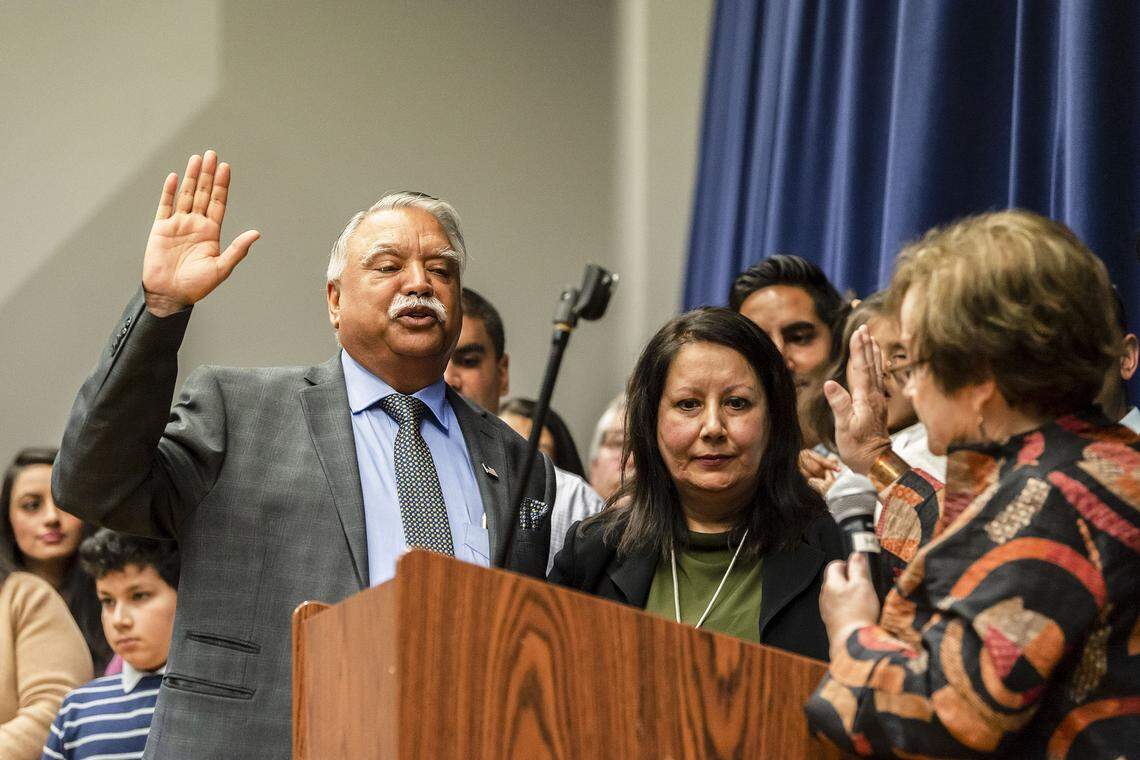
“I ran on my qualifications and my abilities,” Sidhu told The Herald. “This shows other minority communities that this is possible.”
He said he was particularly grateful for the support of Lummi Nation, because their members have been marginalized politically.
“I can relate to all minority communities,” Sidhu said. “(Lummi Nation) is a sovereign government, but they have always felt in county and state politics that they have been cast aside.”
Immigrant monument
During the election campaign, Sidhu said one of his goals was to help create consensus on divisive local issues.
That was partly what drove him to organize the project to build the Arch of Healing and Reconciliation. Originally, it was intended to mark the 1907 mob violence against East Indians but was expanded to include the expulsion of Chinese and the imprisonment of U.S. citizens with Japanese ancestry during World War II. Earlier this year, greetings in six immigrant languages were added.
“Two years ago when Satpal asked me to speak at the dedication of the Arch of Healing and Reconciliation it was not only about recognizing the complexities of our shared history, but also celebrating the more inclusive and equitable future we can build together,” WWU’s Randhawa said. “Satpal’s election is a wonderful vote of confidence from the people of Whatcom County in that future.”
Larry Estrada, a professor emeritus in American Cultural Studies at WWU’s Fairhaven College, praised Sidhu’s wisdom and vision in an interview with The Herald.
“If you look at the history of racism in Whatcom County, and now our county executive is East Indian background — it’s a fabulous turnaround,” Estrada said.
“He does have wisdom and a vision for our county. I think that’s what people voted for,” he said.