
Thinking about boycotting salmon to help save the Orcas? Here’s a much better idea | Opinion
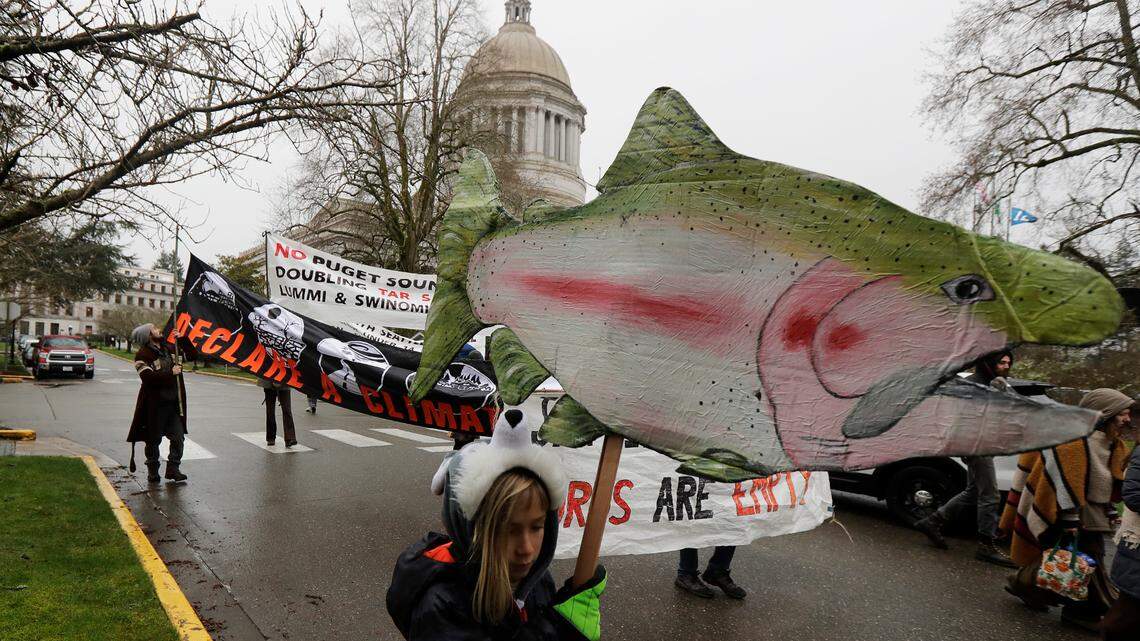
Growing up in the Pacific Northwest, I took salmon for granted. I saw them running up the creeks and rivers to spawn, and enjoyed the Chinook, Coho and steelhead caught by my father for dinner. To a 10-year-old me fishing with my father for the first time on the open ocean, salmon were a seemingly inexhaustible bounty. Daily limits were achieved on every trip, and our freezer was full heading into the fall.
But, it seems I was not the only one to believe in this fallacy, as evidenced by the state of salmon stocks across the region today. In the nearly 30 years since that first salmon fishing season with my father, we’ve seen more bad years than good, and the good years are rarely as good as they were just a few decades prior.
For a state associated with salmon, the state of the salmon is bleak. And with them, so are the Southern Resident Orca who rely solely on salmon for their diet.
In response, some environmental groups have called for consumers not to purchase Chinook, thereby preserving the fish for Orca to eat. The idea is to put economic pressure on commercial salmon fishermen — many of whom are Indigenous — to force them to curtail their harvests. While I agree that there is room for improvement when it comes to commercial salmon fisheries, this blanket approach harms Indigenous communities who have already lost so much due to European colonialism.
Even if we were to end or severely limit salmon harvests, salmon populations would likely continue to decline. Look no further than the Nisqually River where steelhead numbers are so low that the remaining run is only a few dozen fish where there used to be many thousands. Fish passage barriers, land use and resource extraction have greatly reduced their numbers to such a degree that closing the fishery has not resulted in their numbers coming back in over 30 years. The same has played out in rivers and streams around Puget Sound, such as the Stillaguamish and Skagit rivers.
If closing a fishery were a panacea, then we’d be seeing rising spawning populations in Puget Sound rivers. Unfortunately, this has not been the case. Combined with the inequitable effects of such a policy on Indigenous communities, this simply is not a viable solution.
Instead of closing fisheries — many of which are “terminal” commercial fisheries operated by tribal fishermen — or boycotting Chinook in the grocery store, we should instead accelerate the restoration of salmon habitat from Puget Sound to spawning grounds miles upstream, and aggressively fight climate change to improve ocean conditions for salmon as well as a wide number of fish and wildlife species.
Funding for these efforts is exceedingly difficult to secure. Projects take years to design, property is difficult to acquire, and the restoration work is expensive to complete. When resources do come together, we’ve seen salmon utilize the habitat. But it is painstakingly slow. Conservation and restoration efforts simply aren’t keeping pace with the need, let alone the promise made by legislators in 1998 when the Salmon Recovery Funding Program was established.
To restore salmon and increase the food supply for endangered Southern Resident Orca, we need political will to create opportunities for salmon habitat conservation and restoration activities as well as resources to fund the work. If you are looking for a way to help the Orcas, you can: urge Congress to increase funding for the Pacific Coast Salmon Recovery Fund; urge your state legislators to increase funding for salmon recovery programs (of which there are several); and urge the Pierce County Council and Executive to support to the County Conservation Futures funding programs as well as provide the political support to accelerate the on-the-ground work.
And go buy a salmon, but do so from a tribal fisherman along the Puyallup River.
Jordan Rash is a freelance writer, podcaster, outdoorsman and conservation advocate in Tacoma. He’s spent a career on and around the forests, mountains, wetlands, and rivers of the Pacific Northwest fighting wildfires, developing public policy and leading conservation efforts. He can be reached via Instagram at @jordan_rash1.
This story was originally published July 13, 2023 at 5:00 AM with the headline "Thinking about boycotting salmon to help save the Orcas? Here’s a much better idea | Opinion."