
She helped clean up after Hurricane Michael ripped apart lives. Here’s what she learned.
Editor’s note: Robin Bailey originally wrote this to friends this month as she was helping a friend of her daughter Nelea Fenumiai recover from Hurricane Michael. While Whatcom County is unlikely to have a hurricane, her experience highlights that everyone should be prepared to deal with an emergency.
-----
I’m visiting in Florida, helping a friend clean up their house after Hurricane Michael ripped it apart. It is the first day of cleanup, and we have made progress.
Three-plus truckloads of wet drywall, insulation, roofing material and wet everything else (furniture, and many other fabrics, too) has been shoveled up and hauled to the county road several hundred feet away to be placed in a pile alongside the road where it will be picked up (not sure when) by some refuse company that picks up garbage by giant claw before taking it away to some garbage center. This does not include the downed trees or wooden furniture or damaged books or brush that is slowly being burned in a huge pile for the best part of several days to come — cabinets, wooden walls, and unfixable antiques included.
The price of getting back to normal is much higher than the labor. Everything being done for our friend is being done by volunteer labor — there’s not much money to replace all those things lost: broken pottery and dishes; ruined food, clothing, bedding, books, records; any electronic device and most electric appliances, not to mention roof, walls, insulation, carpets, blinds, window coverings, and art.
Memories can’t be taken away but they may be hard to recall without some visual helpers that have been stolen by the wet and wind.
Everyday living is tough. Already two months of living in a tent in fall/winter weather conditions. No power for the first week — no way to dry out or warm up or cook or even read after dark. No way to charge batteries or find the way to the bathroom in the dark (so glad that’s working).
After power is restored, it’s only through an extension cord, one appliance at a time. After dark choices include electric blanket or radio? Charge phone or light for reading? Mold reeks.
The winds of the hurricane caused much of the damage.
A few miles away from the homestead occasional broken trees appear in otherwise normal-appearing woods.
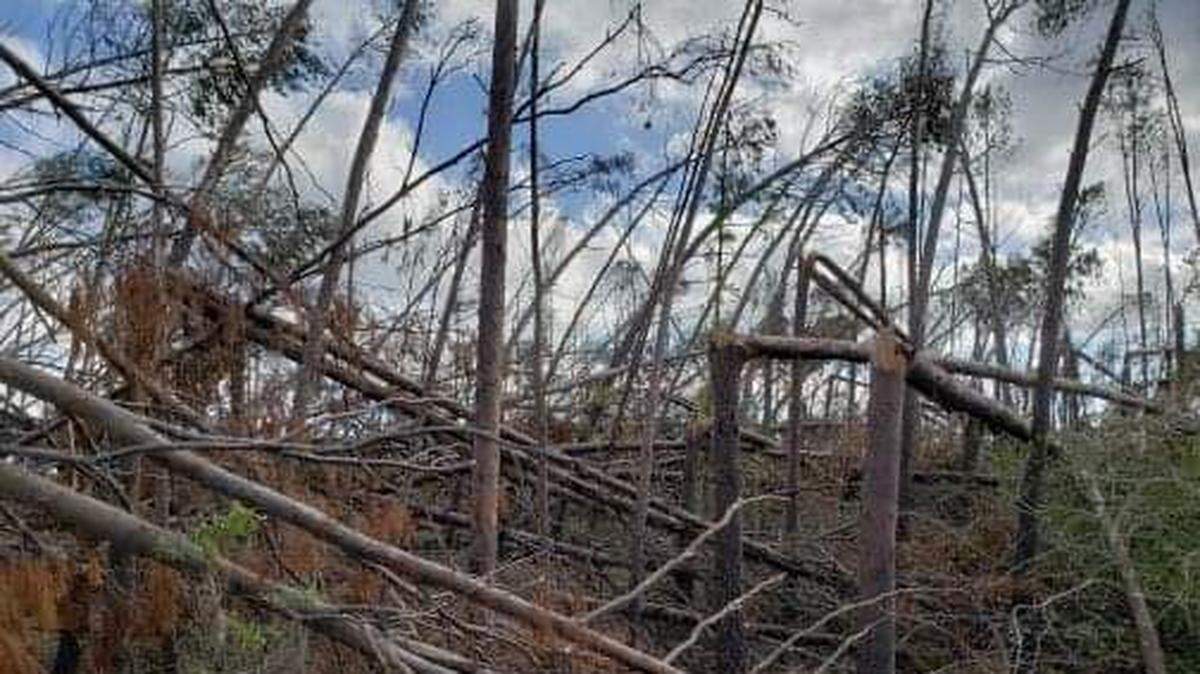
Closer to the path of its eye, where the wall of the storm passed, whole stands of trees lean at a 30-degree angle, all parallel to each other, but none perpendicular to the earth. Some stands aren’t just bending — some look like matchsticks snapped by a giant hand. I’d imagined what those trees would look like, but didn’t even come close to feeling what I felt driving down the miles of roads which were bordered by these trees. Sheer devastation.
All sizes and varieties of trees were hit — those decades old, at least two feet in diameter, too-skinny tall pines, maybe in their first 10 years of growth and maybe four inches across. The raw ends of many of the trees lie exposed to the road where they were cut after falling across the roadways.
Driving by houses, property damage was everywhere: blue tarps on many, many buildings, pieces of metal roofing scattered along the roadway, ditches and parking strips full of branches, garbage and junk, missing windows evident, dented and collapsed walls are frequent. Piles and piles of debris. Piles and piles. And, further, many many businesses closed and shut down.
The constant rain caused even more damage. Those folks who were unable to access tarps and had open roofs were subject to frequent rains falling on already wet areas.
Rain falling on fallen drywall and other materials makes it impossible for underlying surfaces to dry, increasing mold and rot.
Roadways subject to frequent grading eroded more frequently with the rain as the already swollen ground cannot absorb any more.
River, lake and swamplands fail to drain, making cleanup more difficult and wet conditions to remain.
It makes me wonder how these folks and those in places whose homes are destroyed by wildfire do it. How do they maintain jobs and repair their lives at the same time? How do they afford to even have a home if they have no financial security or insurance or other financial help? How do they afford to pay for what their insurance doesn’t cover? How long do they continue to live in a tent?
Folks around here are getting help from FEMA — at least some are.
On the trip to Home Depot today, there was a FEMA table in the main aisle and folks ready to answer questions, but it’s evident more help is needed.
Like every other situation, we’ve also had both good and bad results from FEMA. The Baptist and Mennonite women’s groups are ready to help, we hear, but only found out today how to contact them.
We’ve contacted folks through Craigslist and have found some help but another who came, and offered suggestions but implied that because of the great need in the community, many of his associates were falling prey to greed and doing whatever they could to make as much money as possible and not help out of kindness.
I don’t have any answers. But I do know I don’t hear anything more on the news about what’s going on in terms of recovery in this or other disasters.
People everywhere deserve more.
You deserve to know that the damage is lasting, that it doesn’t go away quickly no matter how much money is poured into it; that the long-term psychological effects are real and that it hurts — physically hurts — to witness the destruction.
Whatever you can do to support, encourage, collaborate, fund, assist or standby folks who find themselves in similar situations is not only kind, it’s critical. And it’s love.
Robin Bailey is secretary of the YWCA Board and a staff member at Whatcom Community College.