
‘There isn’t an extra safe corridor in (Whatcom) County that you can travel on’
This is the second of a six-part series by The Bellingham Herald examining Whatcom County’s vehicle crash fatalities and how every driver can play a role in reducing those numbers.
As you might expect, fatal collisions are most likely to occur where cars are traveling fastest — more speed equals more danger when a vehicle comes to a sudden stop.
“In a city, where speed limits on your arterials are 35 (mph) and your other streets are 25, you might have a higher number of crashes, but many of them will be non-injury or minor-injury crashes,” Doug Dahl, the Washington Traffic Safety Commission’s Target Zero manager for Region 11, told The Bellingham Herald in a September interview. “Whereas, if you drive off East Pole Road at 60 mph, it’s a lot different than running into another car at 20 mph.
“The faster you go, the higher probability that a crash is going to be fatal.”
Nowhere are speeds higher in Whatcom County than along the approximately 36 miles of Interstate 5 between Lake Samish Road and the Canadian border, where speed limits range between 60 and 70 mph.
Not surprisingly, I-5 is also the county’s deadliest road. Between Jan. 1, 2010, and Oct. 31, 2018, the Washington State Department of Transportation Crash Data Portal recorded 12 fatal crashes along I-5 in Whatcom County, accounting for 10.5 percent of the 114 total fatal crashes in the county during that time frame. I-5 was the only road in Whatcom County to reach double-digit fatal crashes during that nearly eight-year period.
Living up to its reputation, Mount Baker Highway (Highway 542, including Sunset Drive in Bellingham) was the second deadliest stretch of road in the county with eight fatal crashes during the period. The Birch-Bay Lynden Road and Badger Road (Highway 546) each had six fatal crashes, while Pole Road (Highway 544) rounded out the deadliest five roads with five fatal collisions since 2010.
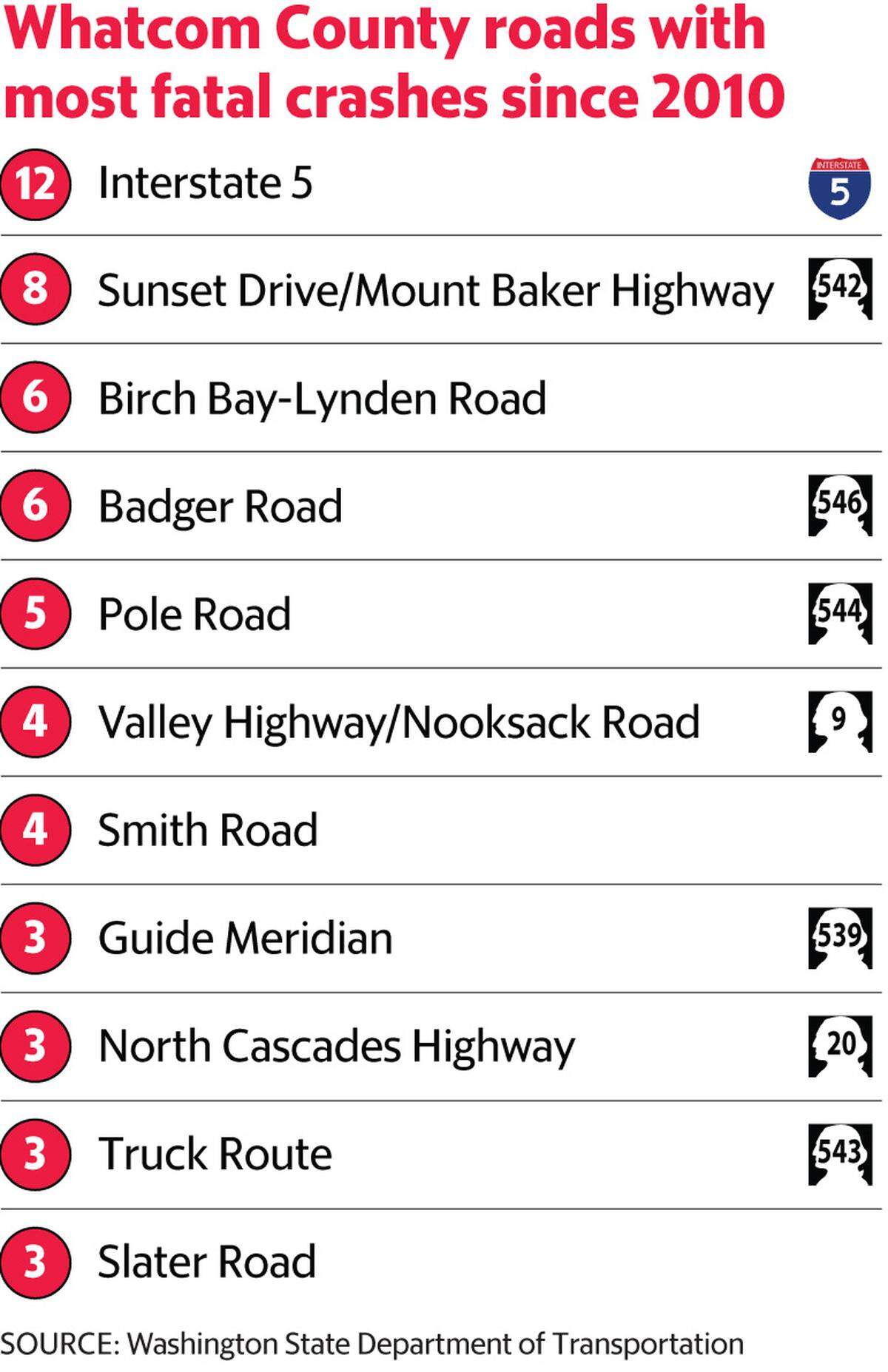
Unfortunately, avoiding those deadly roads guarantees nothing, other than it will take you a whole lot longer to get where you’re going and that you’re not going to be able to get to the Mt. Baker Ski Area or Artist Point.
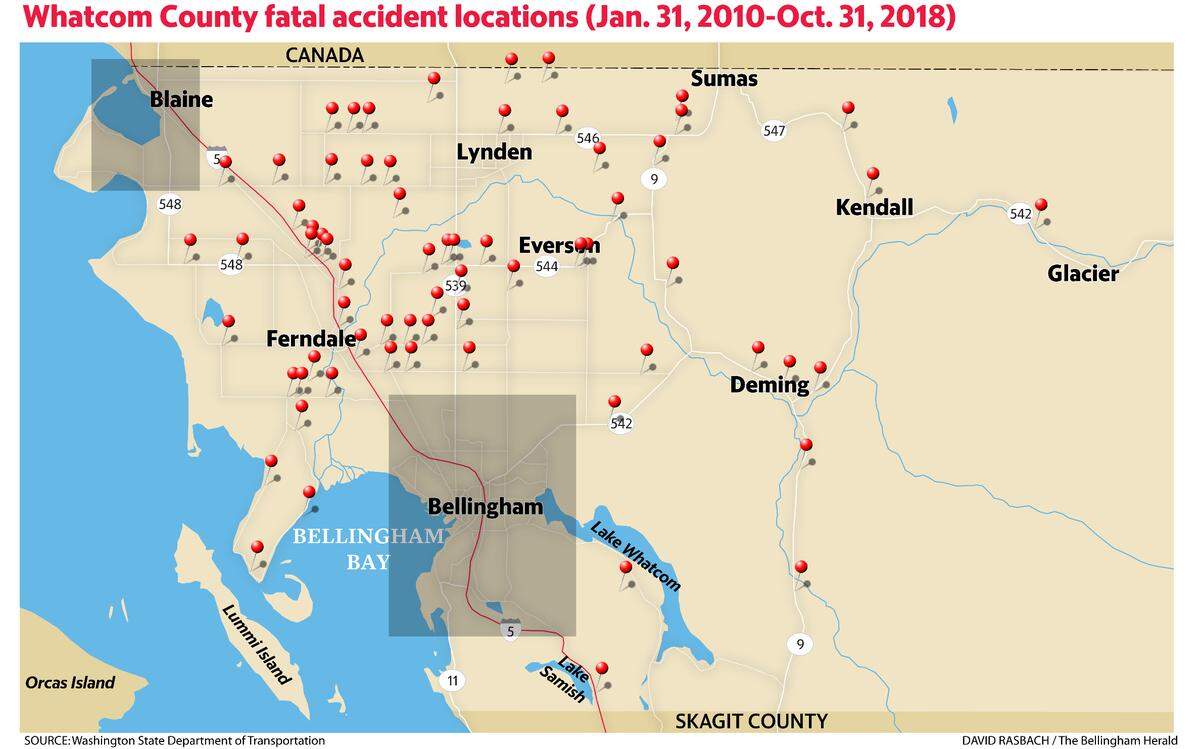
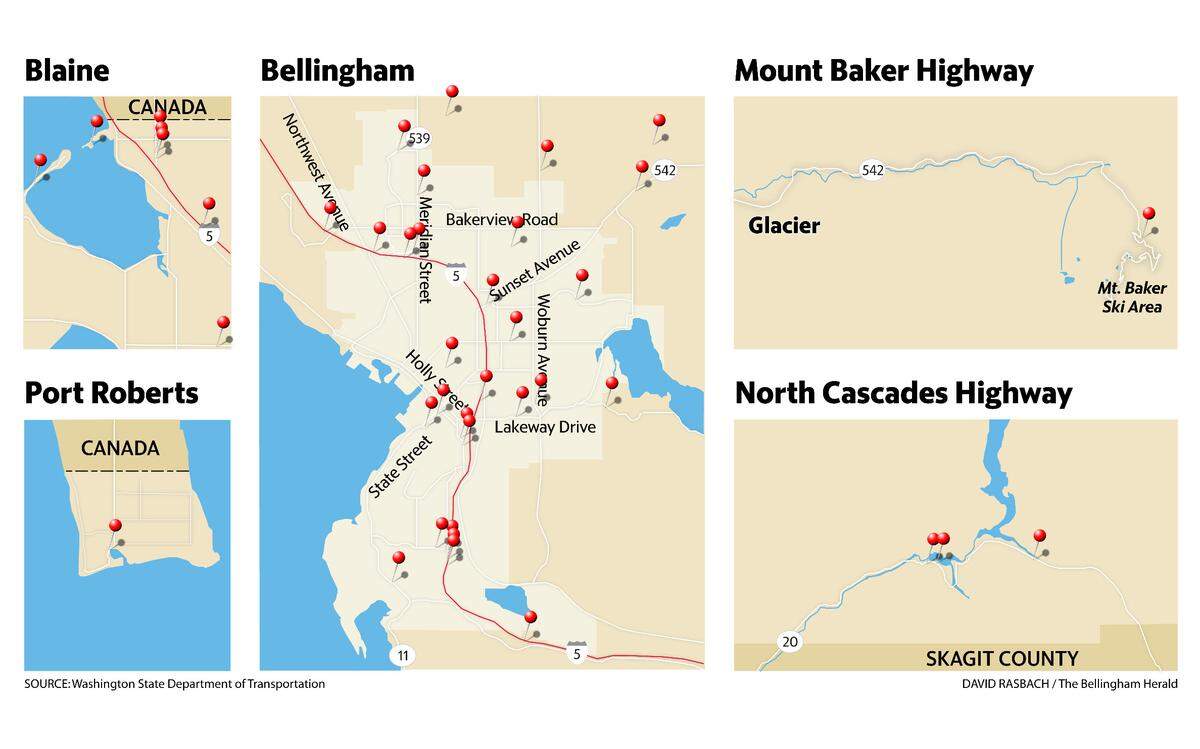
Plotting Whatcom County’s fatal crashes on a map — as The Herald did with the 114 fatal wrecks logged by WSDOT since 2010 — shows that tragedy can strike just about anywhere there are roads in the county.
“When I look at this map, I see that the crashes follow our major corridors — I-5, Birch Bay-Lynden Road, Highway 9, Badger Road, Mount Baker Highway,” Dahl told The Herald. “It’s not surprising, really. Fatalities are happening where people are.
“One of the things I do find interesting, though, is you think most people live along the I-5 corridor, and that’s obviously where most of the crashes are. But you look at how many rural fatalities we have, per mile traveled, rural roads have a higher fatality rate. Even though there are fewer cars out there, they’re over represented.”
Whatcom County’s fatality statistics certainly bear that out, as nearly twice as many fatal collisions occur in rural portions of the county, according to WTSC’s Fatal Collision Dashboard, which collected data between 2013 and 2017. During that period 62.2 percent of all fatal crashes (46 of 74) occurred in rural parts of the county, while 36.5 percent (27 crashes) happened in the county’s urban settings.
That differs from statewide stats for the same period, according to the WTSC database, where 54.4 percent of the fatal crashes in Washington were in urban areas, leaving only 45 percent in rural areas.
“I would guess that’s because we have more rural roads here than other parts of the state,” Dahl said.
According to the 2016 WSDOT Annual Traffic Report, Whatcom County has nearly three times as many miles of rural roads as there are roads in urban areas — 157,460 miles of rural roads vs. 55,020 miles of urban roads. Statewide that percentage is nearly 4-to-1, with 5,515,240 miles of rural roads and 1,541,080 miles of urban roads.
But Whatcom County drivers travel more on rural roads, according to the report — 42 .7 percent (367,305,100 miles) of the county’s 859,439,900 annual vehicle miles traveled are on rural roads, vs. 33.6 percent for the state.
The type of road also plays a role.
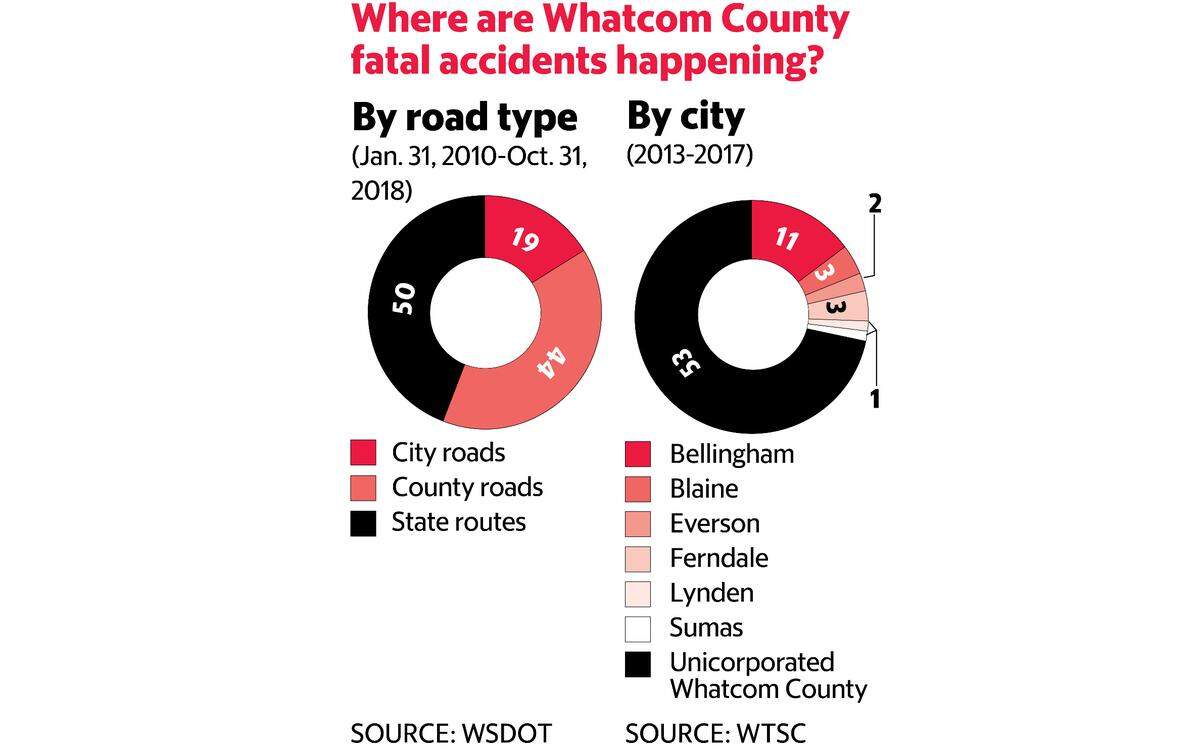
According to WSDOT data, only 16.7 percent (19 crashes) of the fatal wrecks since 2010 occurred on city streets — slightly lower than the state average of 22.1 percent for city streets for the same period.
Most of Whatcom’s fatal accidents — 50 (43.9 percent) — occurred on state highways, while the remaining 44 were on county roads, representing 38.6 percent of all fatal accidents. The state, meanwhile, only had 27.7 percent of fatal crashes on county roads.
More specifically, 71.6 percent (53) of Whatcom’s 74 fatal crashes between 2013 and 2017 occurred in unincorporated portions of the county, according to WTSC data. Despite nearly half of the county’s population living in Bellingham, only 14.9 percent (11) of the fatal collisions occurred within Bellingham city limits during the same period, while 10 crashes resulted in deaths on the city streets of Blaine, Ferndale, Everson, Lynden and Sumas, combined.
“There isn’t an extra safe corridor in the county that you can travel on,” Dahl said. “Wherever people live, wherever people drive impaired or distracted, that’s where crashes are going to occur. All you have to do is look around and see distracted drivers. It’s not a specific location we have traffic problems or safety hazards — it’s all over.”
This story was originally published November 20, 2018 at 5:00 AM.