
Where are targets in Washington if there’s nuclear war? See if you’re at risk
As global tensions tighten, Americans are increasingly concerned about the threat of nuclear war. In addition to supporting Israel in strikes against Palenstine and Iran, the United States has sparred with Russia and China over issues including the war in Ukraine and an escalating trade war with the Asian superpower.
On May 20, Chinese President Xi Jinping and Russian President Vladimir Putin condemned President Donald Trump’s nuclear policies and Golden Dome missile defense plans.
In the event of a nuclear war, which locations in the United States could be targeted? Are any areas in Washington state identified as potential targets?
Here’s what we know:
.jpg "GettyImages-1342028724 (1).jpg")
Who could initiate nuclear war with the United States?
There are eight countries that have formally acknowledged possession of nuclear weapons: the United States, Russia, the United Kingdom, France, China, India, Pakistan and North Korea.
Of them, Russia has the largest nuclear weapon arsenal, according to the Arms Control Association.
“Israel has not publicly conducted a nuclear test but is universally believed to possess nuclear arms,” the Arms Control Association said.
Only the United States, Russia, the United Kingdom, France and China are recognized nuclear weapons states under the Non-Proliferation Treaty.
In addition to a domestic stockpile, the United States has nuclear weapons deployed in other countries, including Germany, Italy and Turkey. Russia has nuclear weapons deployed in Belarus.
Other nations have developed the capacity to build nuclear weapons, including Iran.
Some have had nuclear weapons or related programs at one point, but are not considered large concerns in this regard.
Where are the most likely nuclear targets in the US?
In the event that political tensions escalate to nuclear war, it’s difficult to know exactly which locations in the United States could become targets.
That said, some locations are more likely to be targeted than others.
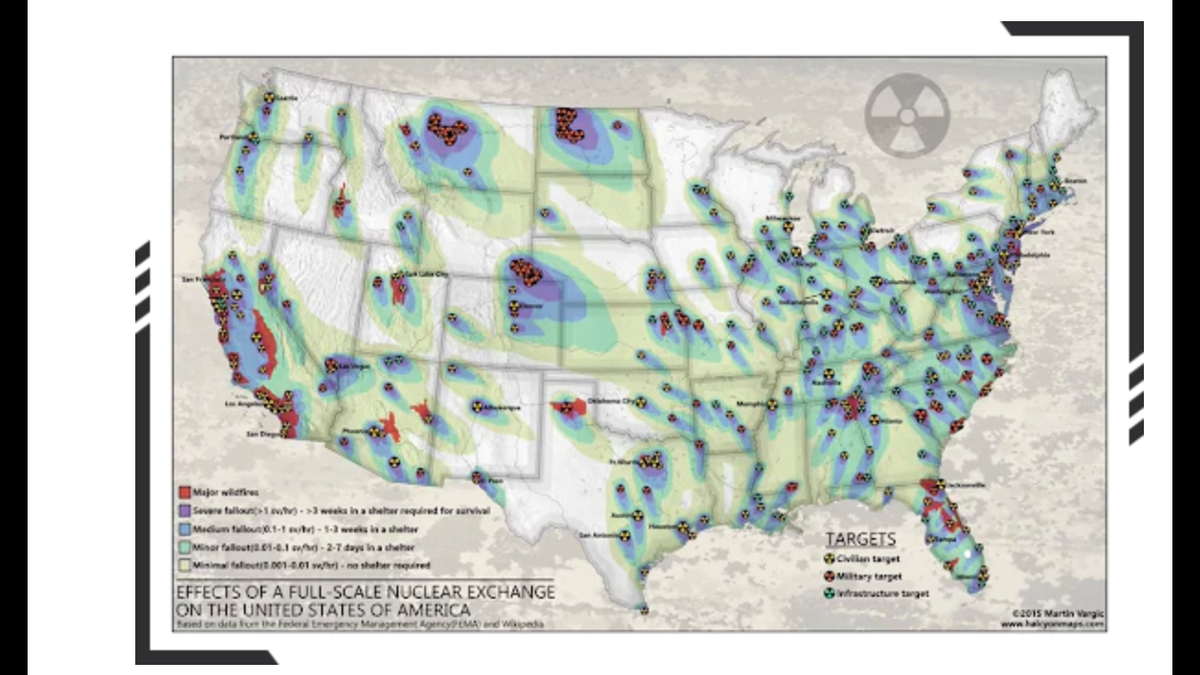
The World Population Review published an interactive map of nuclear targets by state in 2026, identifying where nuclear weapons could land in the United States.
“Many people believe that large population centers with a significant cultural impact are usually the first ones to be targeted,” the demographic data platform said. “However, typically, aggressors would target attacks on areas of strategic value.”
According to the World Population Review, areas considered to be of strategic value include:
- Bases with nuclear missiles
- Command and control centers responsible for communication
- Places with submarines or planes capable of transporting nuclear missiles
- Depots and storage centers for nuclear munitions
“If one country is able to take out all of the nuclear infrastructure required to launch nuclear weapons, they have effectively won the war,” the World Population Review said.
The ideal target for a nuclear attack is generally a densely populated region or some critical infrastructure, according to George Sichler, a preparedness expert with MIRA Safety. The Austin, Texas, company produces military-grade personal protective equipment.
Especially early on, more likely nuclear targets in the United States include highly-populated metropolitan areas such as New York City and Los Angeles, according to multiple sources.
Are there nuclear targets in Washington state?
The World Population Review map identified two locations in Washington state as potential nuclear targets in 2026, particularly in the event of a nuclear war involving Russia.
These sites are Jim Creek Naval Radio Station, a U.S. Navy radio transmitter facility near Oso, and Naval Base Kitsap, a Navy Installation that spans more than 12,000 acres across the Kitsap Peninsula.
The former could be targeted due its role as a command and control station, the World Population Review said, while the latter has a supply of vehicles capable of transporting nuclear weapons.
Joint Base Lewis McChord south of Tacoma could also be at risk of attack, along with the Seattle area and other parts of the Puget Sound.
“It is important to remain calm and remember that nuclear attacks are still highly unlikely, as all efforts will be made to de-escalate the conflict to prevent a nuclear war,” the World Population Review said. “Ultimately, if nuclear weapons are fired, then there is a good chance that people in all states will be negatively affected.”
Is Tri-Cities at risk of nuclear weapon attacks?
On May 22, MIRA Safety published a updated map highlighting key targets of nuclear attack in the United States and fallout risks.
The 2026 version of the map identifies the Tri-Cities area as a “population and leadership center” with moderate fallout risks.
“In a limited nuclear exchange, it is likely that the enemy would go after military targets in the hopes of reducing the United States’ ability to respond with their own nuclear weapons,” MIRA Safety writer Jeff Edwards wrote in a May 22 article.
“Nuclear reactors would make excellent targets in that it would take aim at the power grid while simultaneously creating an ongoing nuclear disaster that would have to be addressed,” Edwards added.
Could the Hanford Site be targeted in a nuclear war?
The Hanford Site north of Richland was once considered a major target of nuclear attack.
However, this was when the site was producing plutonium, actively contributing to the creation and expansion of the United States’ nuclear arsenal.
The Hanford Site hasn’t produced plutonium since the Cold War. The site now operates as a waste site and with an emphasis on cleaning up the environmental impact of plutonium production.
This change is likely to have considerably dropped its status as a target location.
Sichler said forces targeting a nuclear plant or similar location would aim to spread nuclear materials. Attacking the Hanford Site would no longer accomplish that.
“If they’re looking to do more harm to people, my assumption would be that it makes more sense to do some sort of a nuclear detonation in a more concentrated area,” Sichler said.
Staff with Hanford Mission Integration Solutions did not immediately respond to inquiries.
How can US citizens prepare for nuclear attacks?
In the event of a nuclear war ensuing, citizens may consider moving to safer regions.
According to MIRA Safety, regions considered “low risk” for nuclear attacks include the interior Pacific Northwest, “east of the Cascades, particularly central and eastern Oregon, well away from Naval Base Kitsap and the Bangor submarine base.”
Sichler said that preparing for a nuclear attack is similar to preparing for any emergency.
“What do you have in place in your house that you can be self-sufficient for 72 hours?” Sichler asked.
That means food, water, medicine and hygiene products as well as access to clear air.
Sichler noted humans can survive three weeks without food and three days without water, but only three minutes without air.
Once you have a supply for 72 hours, you can consider what you’d need for up to two weeks, Sichler said.
The preparedness expert said oyu can set yourself up for success by creating a safety plan with your household and keeping certain items on hand for emergencies.
“You can take little steps along the way and say ‘Hey, you know what, if this were to take place, what’s most important to me and my family right now?’ ” Sichler said.
What to do in a radiation emergency
The Federal Emergency Management Agency recommends steps to take in the case of a nuclear detonation, nuclear power plant accident or another incident.
“The best way to stay safe in any radiation emergency is to get inside, stay inside and stay tuned” for emergency broadcasts, FEMA said.
If you’re outside during a nuclear explosion, get the nearest building to avoid radiation.
FEMA recommends seeking out brick or concrete structures. Stay away from outer walls or the roof, and head toward basements or the center of the building.
Once inside, remove any contaminated clothing and wash any unprotected skin. You should remain inside for at least 24 hours unless instructed otherwise by local authorities, according to FEMA.
Keep pets inside and avoid plans to reunite with family or friends until after dangerous radiation exposure periods.
You can rely on local radio stations for updates in case Internet, cell service and TV broadcasts are disrupted.
This story was originally published May 26, 2026 at 5:00 AM with the headline "Where are targets in Washington if there’s nuclear war? See if you’re at risk."