
Ashford-based guide runs up Mount Rainier and back, shattering speed record
On May 9, Rainier Mountaineering Incorporated (RMI) guide Simon Kearns woke up in company housing in Ashford well before dawn. For breakfast, he had a bowl of oatmeal and a cup of coffee. He’d slept a total of 30 minutes, but that was normal for him before big mountain feats.
He drove up to the Paradise parking lot in Mount Rainier National Park, put on his mountain running gear – including Arcteryx shoes and Black Diamond microspikes – and cued up a French reggae playlist he’d recently been listening to.
At exactly 5 a.m., Kearns looked up at Mount Rainier and then took off for the 14,410-foot summit.
Three hours and fifty-three minutes later, he was back with a record.
Fastest Known Time
There’s a long history of what the outdoor world calls “car to car” records, or FKTs (Fastest Known Times). A “car to car” record is when you start a timer at your car and then run away to climb famous natural features, like El Capitan in Yosemite or entire mountain ranges like the Evolution Traverse on the east side of the Sierra Nevadas, and do not stop your timer until you get back to your car.
The FKT for Mount Rainier was previously held by Alex King, with a time of 4:14 set on June 21, 2021.
Kearns beat King’s record by more than 30 minutes.
Born for the mountains
Simon Kearns was born in Mancos, Colorado, near Durango, and grew up in the surrounding mountains. His parents are outdoorsy and introduced him to mountain sports like skiing, running and cycling early.
By the age of 12, Kearns was running ultra-marathons in the high-elevation atmospheres of the San Juan and La Plata mountains.
He ran track in high school, then went to college at Colorado University Boulder, where he transferred most of his attention from running to alpinism, skiing and climbing.
Almost immediately after graduating college in 2023, for fun, he grabbed the FKT on Mount Hood (also from King).
“This put me back into the mindset of mountain running again,” Kearns told the News Tribune from his home in Ashford.
Kearns followed the coast up to Washington state, living in his truck and training long link-ups and speed runs in various mountain ranges.
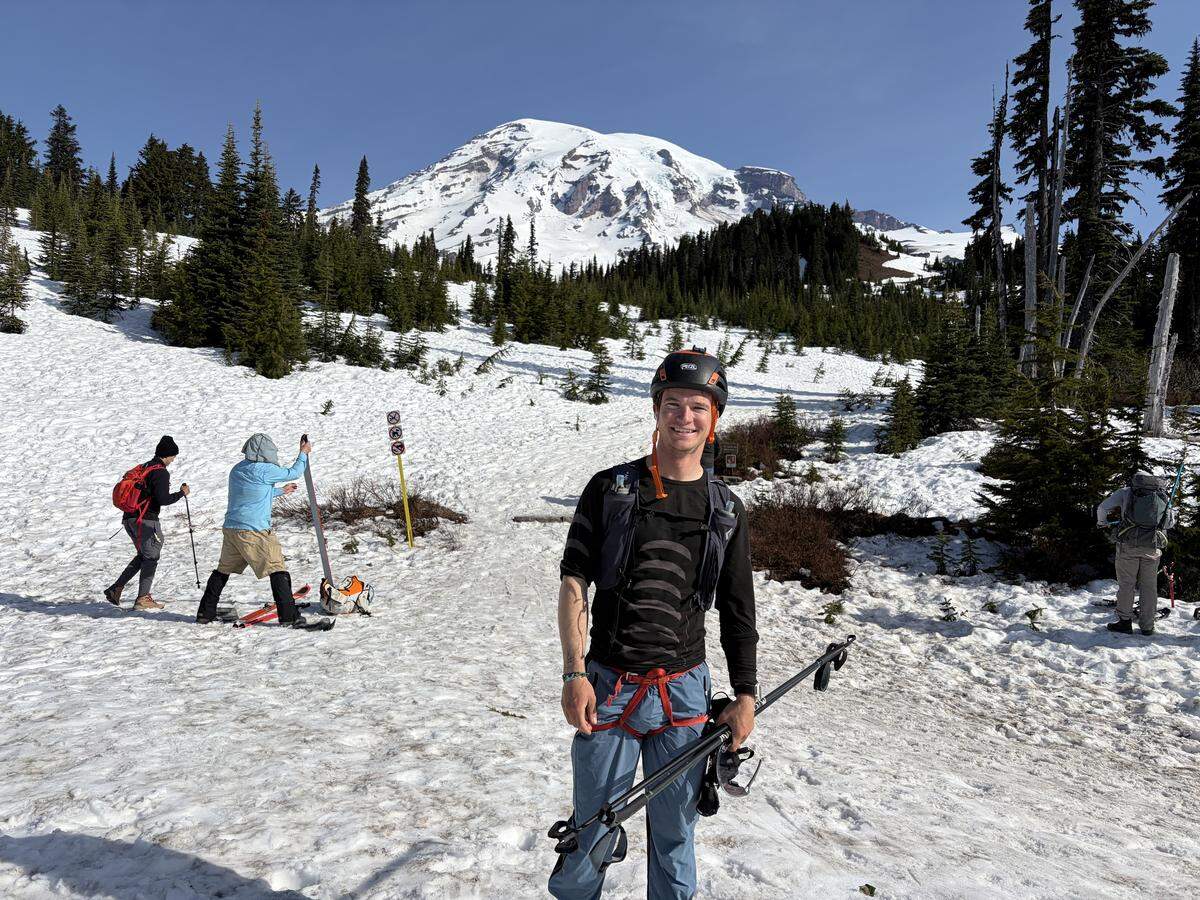
In 2024, he went for the FKT on Mount Rainier for the first time, but got stuck behind a large group guided by the legendary Mount Rainier guiding company, RMI.
“It was frustrating,” Kearns said. “But in chatting with the guide who stopped me, I realized that it actually sounded like a really cool job. So the next year I applied, got hired and moved out to Ashford.”
Kearns says he’s now been on the upper mountain close to 20 times, for guiding and personal recreation.
He attempted another FKT in 2025 but didn’t grab it. He was four minutes too slow.
“I wasn’t stuck behind a group that time, I just didn’t have it, I guess,” Kearns said.
A record-breaking run
Originally, Kearns was training to break the ski record this spring. But low snowpack and a broken ski inspired him to shift his sights to the foot record instead.
He knew he wanted to go for it in May.
“I was thinking I would go around May 20th, but I was doing a ski project on the mountain – skiing different lines the week before,” Kearns said. “The Thursday before, I went up and skied the mountain, and saw that it was in good shape for running. I took that next day off and decided to just go for it on Saturday.”
Kearns took the Ingraham Direct route, which is the route of choice for RMI in the early season due to being more direct and efficient than Disappointment Cleaver until crevasses and instability render the Ingraham Glacier impassable, usually sometime in June.
The first stretch, the lower part between Paradise and the Muir Snowfield, was soft and slushy. It didn’t freeze enough to be solid, and it hadn’t been warm enough to melt away. But he knew that was the case.
Once he got to the Muir Snowfield, it was nice and smooth, as it usually is this time of year. Later in the year, it gets “chopped up.”
“The lower mountain is faster if you wait until June or July when it’s all melted out, but then the upper mountain tends to be quite a bit slower,” Kearns explained. “So I felt like it was worth it to have a slower mountain down low and faster up high.”
As an employee of RMI, Kearns does a lot of the route work on the mountain – shoveling, ladder placements, etc. As a result, he has a good gauge of where things are and how to approach them the quickest.
Perhaps, most importantly, he has access to their group schedules, so he won’t get caught behind them again.
“I think on the way up, people didn’t know what I was up to,” Kearns told the News Tribune. “When I was coming down, most people were like, ‘Oh, he’s moving pretty quickly, I just saw him go up, and now he’s coming back down already.’ People started cheering and giving words of encouragement.”
Kearns allowed himself about 30 seconds on the summit before heading back down. Once he got back to the parking lot, he crumpled to the ground. A bit more out of disbelief than out of exhaustion. He had the record by over half an hour. And he had the whole rest of the day to enjoy it.
This story was originally published May 16, 2026 at 5:30 AM with the headline "Ashford-based guide runs up Mount Rainier and back, shattering speed record."
.jpg)