
Will turbines taller than Space Needle hurt air traffic at WA’s 3rd largest airport?
AI-generated summary reviewed by our newsroom.
- Rep. Dan Newhouse urges FAA to re-examine Horse Heaven wind project's aviation risks
- Scout proposes 671-ft turbines across 24 miles; community warns of airspace obstruction
- Local officials and residents cite impacts on medical flights, military and firefighting
Rep. Dan Newhouse, R-Wash., has joined the call for the Federal Aviation Administration to take a second look at how the proposed and state-approved Horse Heaven wind project near Kennewick would affect aviation.
“There remains a great deal of concern about its impact on safe and reliable air operations,” Newhouse said in a statement this week. “I believe a rigorous re-examination of the prior determination of ‘no hazard’ is essential to properly and accurately assess this project’s impact on the community.”
Scout Clean Energy has state siting approval under former Washington Gov. Jay Inslee to build a wind farm along 24 miles of the Horse Heaven Hills within four to six miles of Richland, Kennewick, Pasco, West Richland and Finley and less than two miles from Benton City.
Tri-Cities CARES, which opposes the project, says Scout submitted a proposal in August to the FAA Obstruction Evaluation Group for 141 turbines that stand 671 feet high for the project.
The community group believes the filing replaces an earlier proposal to the FAA for turbines that would be shorter at about 500 feet.
In comparison, the original turbines of the Nine Canyon wind farm by Kennewick are about 300 feet tall.
Since Scout applied for a state site certification for the project in early 2021 with proposals for various turbine numbers and heights, turbines taller than 500 feet have become the standard for wind farms.
The Horse Heaven ridgeline stands 1,500 to 2,000 feet above the valley below, and the proposed 671-foot turbines on the ridgeline would dominate the landscape and view from the valley below, according to Tri-Cities Cares.
The turbines also would have potentially devastating impact to the airspace, Newhouse said.
Tri-Cities airspace concerns
The airspace is used by commercial flights into the Tri-Cities airport, the third largest airport in the state, Newhouse said. The wind farm would be built about 10 miles from the airport.
The airspace is also used for air ambulance flights from northeast Oregon to the area’s only Level II trauma hospital, Kadlec Regional Medical Center in Richland, Newhouse said in a letter to Bryan Bedford, FAA administrator.
Building turbines that are taller than the Seattle Space Needle along the Horse Heaven ridgeline could also impact Department of Defense military training routes and the use of air tankers for aerial firefighting, Newhouse said.
Newhouse’s letter to the FAA administrator followed letters from nine Washington state legislators in September and letters from Tri-Cities Cares in September and November. Those letters also were sent to Defense Secretary Pete Hegseth and Transportation Secretary Sean Duffy, among others.
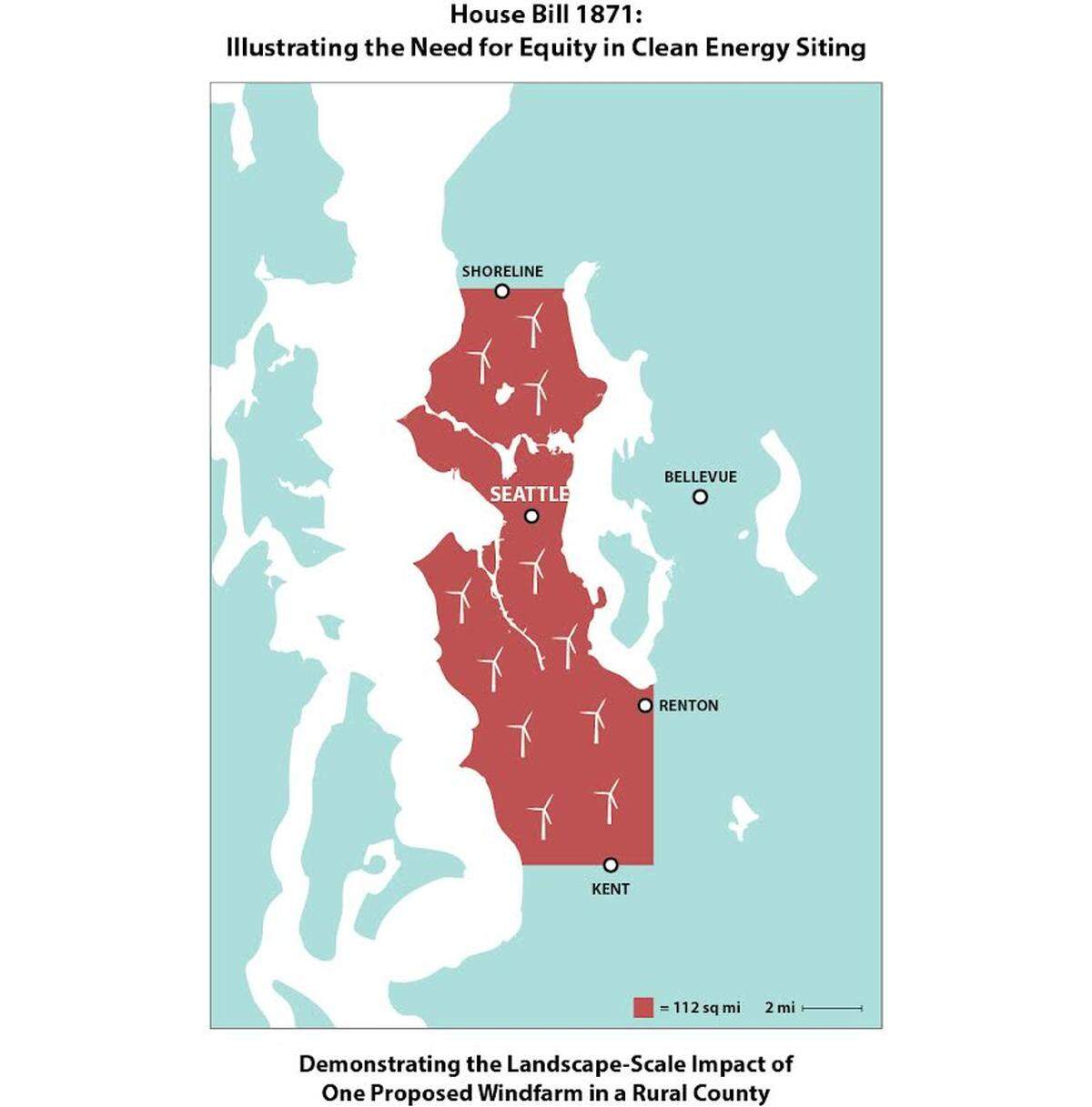
Tri-Cities Cares’ letters provided additional details about the disruption of airspace use, saying that military training routes and restrictions adjoin the Horse Heaven Clean Energy Project to the south and west. In addition, Navy training flights from the Whidbey Island Naval Air Station fly over the area.
Large air tankers based out of Grant County International Airport are used to control fast-moving wildfire on steep slopes near the Tri-Cities, including the Hose Heaven Hills Resource Area, which is under U.S. Bureau of Land Management fire control, said Tri-Cities Cares.
The group’s letter also pointed out that the Horse Heaven wind farm could have turbines as close as 4.1 miles from the helipad at the Kennewick hospital.
“There has never been a project of this size and expanse built so close to a major metropolitan area — over 320,000 inhabitants — anywhere in the U.S.,” Tri-Cities Cares said in its letter, using the combined populations of Benton and Franklin counties. “As the fastest growing metro area in Washington outside Puget Sound, air traffic and use of airspace will rise to meet demand.”
Former Gov. Inslee called out
All three letters call out former Gov. Jay Inslee, a Democrat, for approving the clean energy project, which also would include solar arrays and battery storage.
Inslee approved the project in September 2024, after the Washington state Energy Facility Site Evaluation Council sent him a revised proposal. The governor rejected initial restrictions proposed by the Washington state Energy Facility Site Evaluation Council and told it to come back with a proposal that considered the pressing need for clean energy.
“The project was permitted by Gov. Inslee over the objections of the host county, local business community, local tribe and a majority of local residents,” said the letter from state legislators.
”Those who know the area best have fiercely opposed the project for a multitude of reasons among which are concerns that should be shared by our federal partners, such as aviation safety, potential constraint on military operations and concerns that aerial fire suppression could be constrained for wildland fires that encroach on an urban area,” it said.
The letter was signed by Republican Sens. Matt Boehnke of Kennewick and Perry Dozier of Waitsburg and Republican Reps. Stephanie Barnard of Pasco, April Connors of Kennewick, Skyler Rude and Mark Klicker of Walla Walla, Chris Corry of Yakima and Deb Manjarrez of Wapato.
Newhouse said that Inslee had ignored community concerns and potential impacts to air operations when he agreed to a permit for the project.
Tri-Cities CARES said in its November letter that a push for renewable energy projects in Washington state has been driven by the former governor and has “seemingly taken precedent over all else.”
Scout Clean Energy did not immediately comment.
This story was originally published December 2, 2025 at 12:52 PM with the headline "Will turbines taller than Space Needle hurt air traffic at WA’s 3rd largest airport?."