
Amid rising risk, can a WA utility company shut off power during a heat wave?
As temperatures in parts of eastern Washington reached triple digits on Tuesday, it’s safe to say that summer is in full swing.
A heat wave can put the power grid at risk of being overwhelmed, as demand spikes. In these scenarios, utility companies can opt to employ smaller, temporary shutoffs to avoid large-scale blackouts. But this can leave people without power on the days when they need it the most.
In 2023, Washington’s state legislature passed a law to protect customers during a heat wave, but the law only applies to cases where someone’s power is disconnected due to a missed payment. So is the practice legal in other cases?
Here’s what state law says.
Are power shutoffs legal in WA?
In an email to McClatchy, Britt Gonzalez, a communications consultant with the Washington Utilities and Transportation Commission, said that the practice is legal in certain cases in Washington state.
“Utilities are required to maintain reliability, but under certain conditions, they are permitted to disconnect power. These include efforts to prevent wildfires, mitigate widespread outages, address safety concerns, or respond to tampering or nonpayment (subject to some exceptions),” Gonzalez said.
The state and partnering agencies regulate when and how a utility company can cut power.
“Oversight is provided through a combination of statute, UTC rules, case-specific orders, and regional coordination within the Western Interconnection,” Gonzalez stated.
WA state law on power shutoffs
Under state law, there are a few requirements utility companies have to meet regarding power shutoffs.
WAC 480-100-128 states that “a utility must establish conditions in its tariff(s) under which the utility will cease nonvoluntary service disconnections during inclement weather events.”
Additionally, state law requires utilities to try to minimize the number of outages to their service. WAC 480-100-148 states that utility companies have to “make those efforts that are reasonable under the circumstances” to avoid outages and, when an outage does occur, restore power as quickly as possible.
Companies have to report the number of power disruptions that occur on days when an excessive heat warning has been issued in a given year.
2023 WA shutoff moratorium
A 2023 law also protects customers from having their power shut off over a late payment on a day when an excessive heat warning has been issued.
While utility companies are allowed to shut off power for a customer who hasn’t paid their bill, if an excessive heat warning has been issued, they have to wait for a cooler day.
Additionally, customers who have had their service disconnected due to a late payment can request that it’s reconnected on a day with an excessive heat warning. This applies to city-run utility services as well.
Are there power shutoffs in WA?
According to Puget Sound Energy’s communications director, Christina Donegan, utility companies build around their highest-use days. As a result, they can usually handle demand during a heat wave, especially since electricity use typically peaks in the winter in Washington, not in the summer.
“We actually build our system to manage what we call peak demand,” Donegan said in a video interview. “So that would be a summer heat wave or a winter cold snap. In our service area, we’re primarily still a winter peaking utility.”
PSE operates in the western part of the state, though, and eastern Washington tends to see hotter summers. In 2021, a summer heat wave led to rolling blackouts in Spokane.
Additionally, several recent reports claim that the state’s risk for rolling blackouts is rising.
According to Donegan, while outages are possible in extreme circumstances, it’s more likely that your energy costs will go up on high-use days as your utility company has to purchase power that was generated elsewhere.
“In addition to having your own generation, you go out to the market to purchase power. And the real issue with that is that it’s supply and demand,” Donegan said. “So when there’s a lot of demand, the power costs get very high. And that’s what we saw back in January 2024, the power costs were really at an all-time high, and power cost for us is a pass through, we pass those costs to our customers.”
In order to avoid that scenario, some companies, including PSE, use a strategy called demand response. For PSE customers, that takes the form of “Flex Events,” where customers are incentivized to keep their energy consumption down during peak hours.
Power shutoffs for wildfire risk
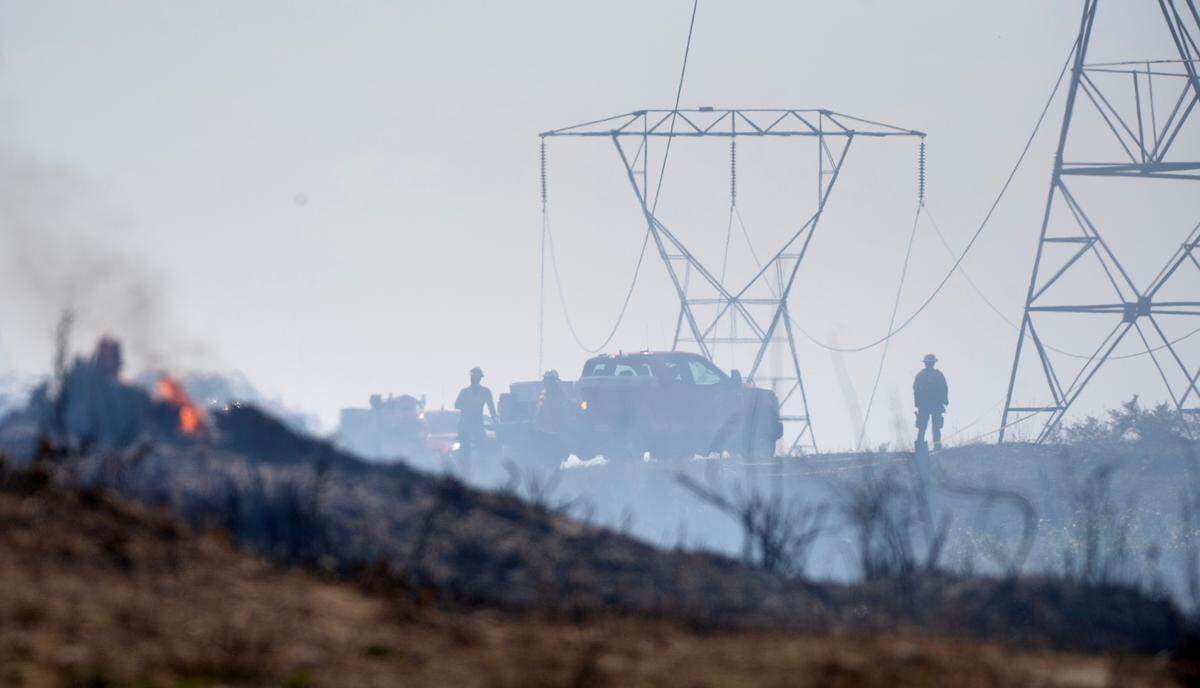
Another factor that could lead to heat-related power shutoffs in wildfire risk. PSE has protocols in place for shutting off power in certain areas on high-risk days. You can check the National Weather Service website for information on which areas are experiencing high-risk conditions.
“If there are high wildfire risk conditions, which are typically extremely dry weather and dry conditions, dry vegetation, high winds and low humidity, we look at those factors, plus the infrastructure we have in an area,” Donegan said. “For instance, if we have overhead infrastructure in that area, we’re going to look at that and we’re going to say, ‘Okay, is this a high risk situation where we need to shut off power to customers because of community safety?’”
According to Donegan, PSE has never had to go ahead with one of these shutoffs, although the company also operates in the part of the state that tends to have cooler summers.
“We have not done a public safety power shutoff but if conditions merit, we’re prepared to do so,” Donegan said.
If a safety-related shutoff does occur, your utility company would likely try to warn you in advance. Donegan said PSE aims to give 48 hours’ notice, although that isn’t always possible given how quickly conditions can change quickly.
“Our goal is to notify customers 48 hours in advance. So we have a meteorologist on staff,” Donegan said. “He is watching the weather every day. Plus we have our system operators who are watching the weather 24/7.”
Stay informed about power shutoffs
For more information about extreme heat, you can check the website for the National Weather Service office closest to you, to see if a heat advisory has been issued. NWS has two forecast offices in Washington, one in Seattle and the other in Spokane. Additionally, the Portland, OR office handles forecasts for parts of southwestern Washington, and the Pendleton, OR office covers southeastern Washington.
To stay informed during a power outage, the Department of Energy recommends following the news and social media closely for updates, subscribing to text alerts from local emergency preparedness officials, keep a list of emergency contacts and check online gas price resources.
Utility companies often update their websites with emergency alerts or outage information. PSE maintains an “alerts and advisories” page, while several companies, including Avista, Tacoma Public Utilities, Benton Public Utility District, Franklin Public Utility District, offer power outage maps.