
Gov. Ferguson rejects ‘untested’ wealth tax, sends state budget writers back to drawing board
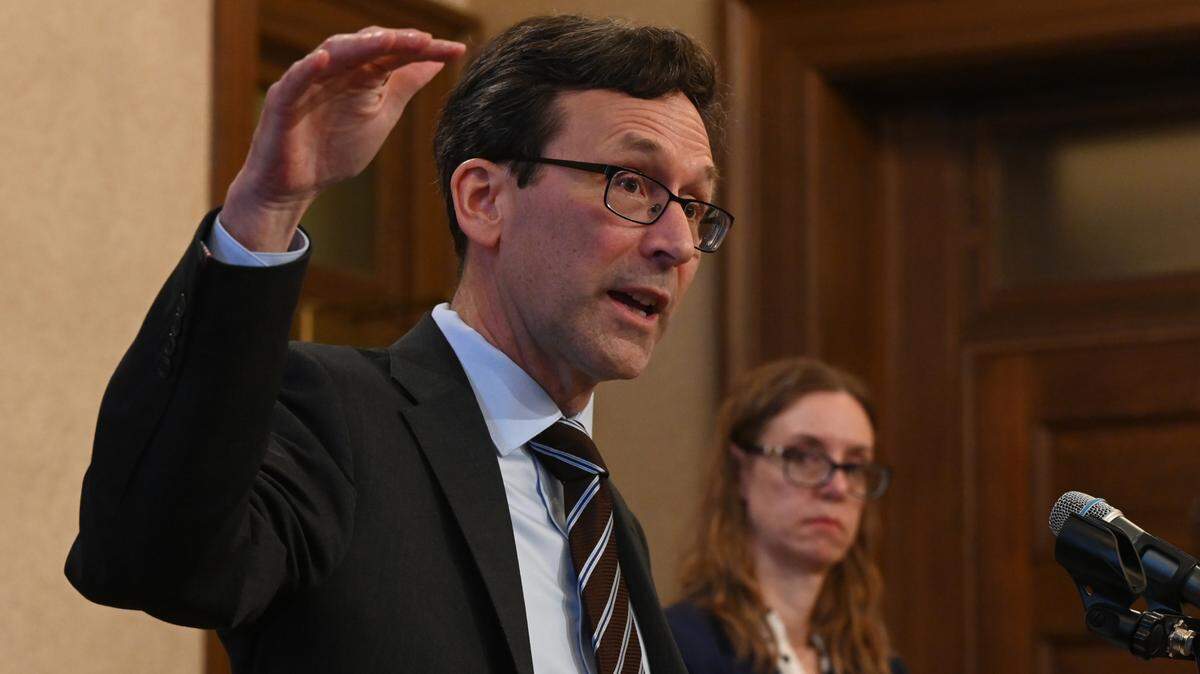
Lawmakers in the Washington House and Senate recently revealed their respective budget proposals for solving the state’s massive shortfall. Gov. Bob Ferguson said Tuesday that he wouldn’t sign off on either.
Ferguson, a Democrat, told reporters at a news event in the Governor’s Conference Room that in his view, both chambers’ plans depend too much on taxes. Each would rely on a so-called wealth tax, an idea that he noted would likely attract immediate legal challenge if implemented.
The governor before taking office cast doubt on the steadiness of such uncharted revenue terrain.
“It would be irresponsible to rely on an untested new tax to balance our budget, particularly given the situation we face with the federal government,” Ferguson told reporters April 1.
If lawmakers want to finish their work on time — the session is scheduled to end April 27 — they’ll need to work quickly to take their budget discussions in different directions.
Ferguson delivered a press conference in late February about proposals for $4 billion in savings — on top of the $3 billion in cuts suggested in December by his predecessor, outgoing Gov. Jay Inslee. Since then, the state received an updated revenue forecast, bringing its projected shortfall over four years to $16 billion.
And when it comes to the federal government, things have gone from rocky to seismic, Ferguson noted. President Donald Trump’s administration has axed federal dollars across various sectors in recent weeks.
Washington needs to brace for more potential federal cuts, Ferguson said.
“This is a five-alarm fire,” he said, “and I intend to treat it that way.”
That isn’t to say that Ferguson is embracing an all-cuts budget. He said he agrees with wealth-tax proponents that the state’s tax system is too regressive. That’s why Ferguson said he supports the state’s capital gains tax and defended it during his time as attorney general.
Still, Ferguson made clear that he couldn’t endorse the tax-dependent budgets laid out by state Democrats last week.
Ferguson previously proposed mandating one-day-per-month furloughs over two years for most state workers. The Senate’s plan would furlough state employees up to 13 days in one year; the House isn’t proposing furlough days.
Asked whether he had shifted his stance on furloughs, Ferguson replied that he hadn’t. There will be lots of negotiations in the coming weeks though when it comes to landing on the budget, he said. And he appreciates that most of his proposed savings and reductions were adopted by lawmakers, calling it a “big step in the right direction.”
Ferguson spelled out the five things that need to be present in any budget he signs:
The Budget Stabilization Account, also called the Rainy Day Fund, must be protected; the Senate’s proposal would tap such reserves while the House’s would leave them alone.
The budget has to be based on “realistic revenue projections, not the 4.5% allowed by law,” Ferguson said. The Senate budget does that, a facet that he supports.
Given today’s budget constraints, new investments must be kept to a minimum, Ferguson said: “This is not the time for major investments in any program, no matter how worthwhile.”
Billions of dollars of savings and efficiencies must be realized while still maintaining core services, such as K-12 education and public safety.
The budget can’t depend on revenue that could be overturned by the courts.
State Sen. June Robinson, the upper-chamber’s lead budget writer, said in a statement she appreciates that Ferguson offered more clarity on his operating-budget vision, as well as his “commitment to a balanced approach,” including both responsible reductions and new revenue.
“This aligns with the thoughtful, forward-looking mindset that’s guided our process from the start,” Robinson, an Everett Democrat, said. “I’m confident we will continue working together to deliver a final budget that meets the needs of Washingtonians and puts our state on strong financial footing for the future.”
State Rep. April Berg, chair of the House Finance Committee, said in an emailed statement that she appreciates getting further clarity from Ferguson.
“It’s clear we have work to do in negotiating a compromise that leads to a budget and revenue package that works for Washington families,” the Mill Creek Democrat continued. “I’ll be talking to the House Democratic Caucus members about the governor’s perspective and how to ensure our values are represented in the final budget.”
Budget situation ‘may soon become dire’
Federal funding makes up 28% of the state’s budget, Ferguson said: about $43 billion per biennium. There’s no guarantee that it will continue given the unpredictability of the actions happening at the federal level, he added.
Washington receives $34 billion per biennium for Medicaid, roughly 60% of the state’s Medicaid budget, he said, referring to the government health care coverage for those with low income.
“If, for example, the federal government cuts just 1% from that funding, the impacts could be profound for thousands of Washingtonians,” Ferguson said. “In other words, our budget situation is grim, but it may soon become dire.”
Another big worry is the harm that more tariffs could inflict on Washington as one of the country’s most trade-dependent states, he said. Roughly 40% of the state’s jobs are linked to trade.
Ferguson remained tight-lipped when asked about support for specific revenue proposals, including ones related to payroll and property taxes. He did make clear, however, that lawmakers need to work within the state’s means.
“Washington families must budget to the actual salaries of their family members,” he said. “The state of Washington, as long as I’m governor, will do exactly that.”
Response to the governor’s comments
After Ferguson’s press conference, four business-related organizations — the Association of Washington Business, Bellevue Chamber of Commerce, Seattle Metropolitan Chamber of Commerce, and Washington Roundtable — released a joint statement applauding his wealth-tax stance.
The group said it feels encouraged by the governor’s view that tax hikes should come as a last resort. Yet it remains worried about other legislative proposals such as a new statewide payroll tax and a business and occupation tax increase.
“Gov. Ferguson’s leadership is welcome, and his remarks are a good start,” the group said. “We hope it marks a shift toward smarter, more sustainable fiscal policy in Olympia.”
State Rep. Travis Couture, the House Republican budget lead, told McClatchy that he agrees with Ferguson’s five budget points. The Republican caucus has espoused many of the same aims, Couture said.
“It’s good to hear the governor come out and kind of lay down a line in the sand for some of those things,” the Allyn Republican said. “But it also feels like a reset button has been pushed on the session.”
Couture likened House lawmakers’ current budget to a house of cards: Without the wealth tax, it would topple.
And now that lawmakers are two-thirds of the way through the 2025 session, questions remain about whether a special session will need to be called. Couture pointed out that there’s a multi-billion-dollar chasm between what Ferguson wants and what lawmakers produced.
“I don’t see a path at the moment where this doesn’t land us in a special session,” Couture said. “I just don’t think you have a lot of runway left to close the gap.”
State Sen. Chris Gildon, the Senate minority budget lead, said Senate Republicans also proposed a budget last month that “supports the priorities of our state, without new taxes or service cuts.”
“We appreciate hearing the governor explain exactly what’s needed in a budget he will sign, and frankly, our plan seems much closer to his standards than what the Senate and House Democrats passed,” the Puyallup lawmaker said in a statement. “We remain ready to help deliver a budget that meets the needs of students, families and employers.”
State Sen. Nikki Torres, Senate Republicans’ assistant budget leader, said in a statement that she appreciates Ferguson’s Rainy Day Fund-defense, also noting his wealth-tax opposition.
“I wish he had also pushed back against the Democrats’ property-tax increase, as that will take billions upon billions from families of all income levels – but maybe it will be next,” the Pasco Republican said.
This story was originally published April 2, 2025 at 5:00 AM with the headline "Gov. Ferguson rejects ‘untested’ wealth tax, sends state budget writers back to drawing board."
.jpg)