‘Audacious’ goal. Central WA becomes hub for mobilizing thousands of Latino voters
Like the Yakima River itself, Mark Figueroa believes the stream of political change flows in waves down the valley.
“I think Yakima holds a really specific place in the historical context of elections,” the former Pasco High School teacher said.
“When you look at district-based voting, a lot of it kind of started here in Yakima through different organizations. We kind of see if we can create some change here in Yakima that can trickle down through the valley and hopefully create more change all the way there.”
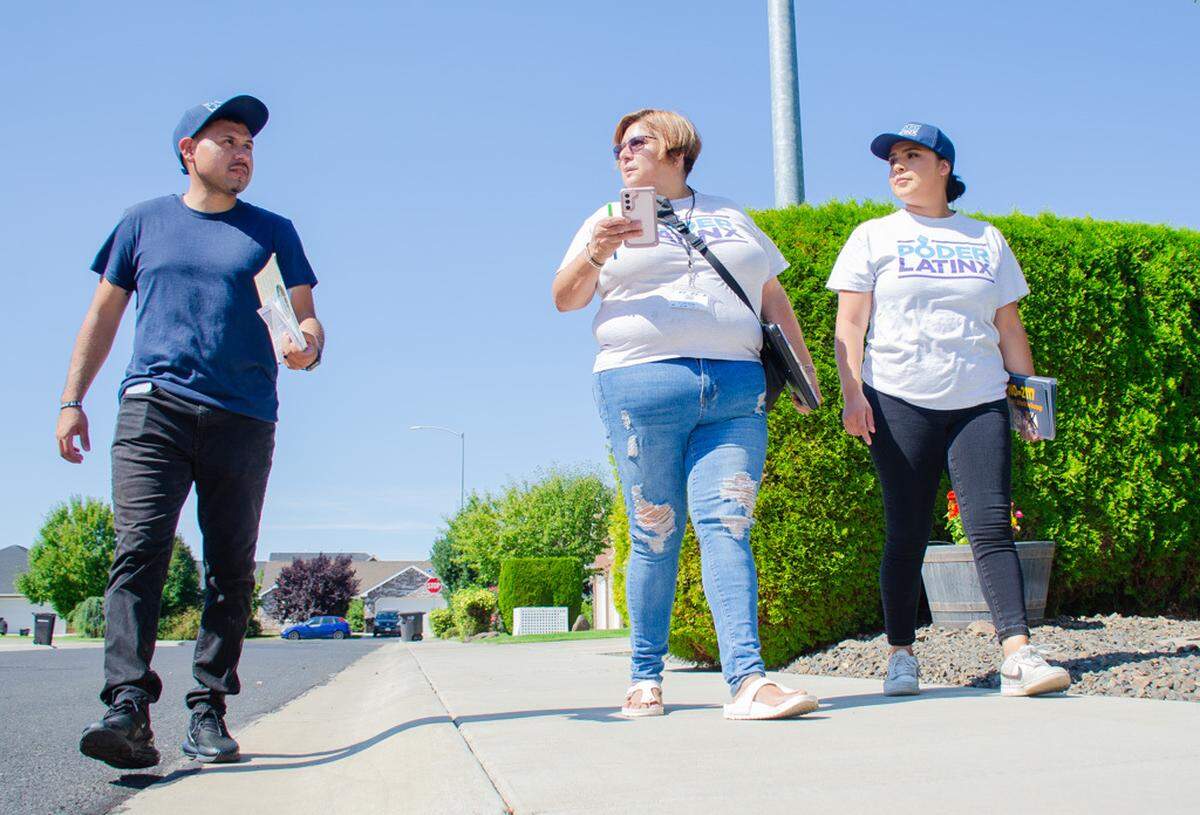
Beneath the simmer of an early summer heat on Tuesday, Figueroa and his team of four canvassers knocked on the front doors of more than a hundred recent voters in Yakima, with the goal of spurring Latino interest in the Nov. 5 general election and increasing voter registration.
Their effort was part of a one-day mobilization effort organized in six U.S. cities by Poder Latinx, an advocacy project based in Washington, D.C., that aims to empower Latino voters and candidates.
The organization narrowed in on communities with high percentages of Hispanic populations — from Orlando, Florida, to Yakima, Washington.
The canvasing took place just 62 days before the presidential general election. Ballots will begin going out to registered Washington voters here shortly, starting on Oct. 18.
Poder Latinx’s recent work in Central Washington also reflects broader efforts in recent years to get Latinos more politically involved and energized around candidates and statewide issues.
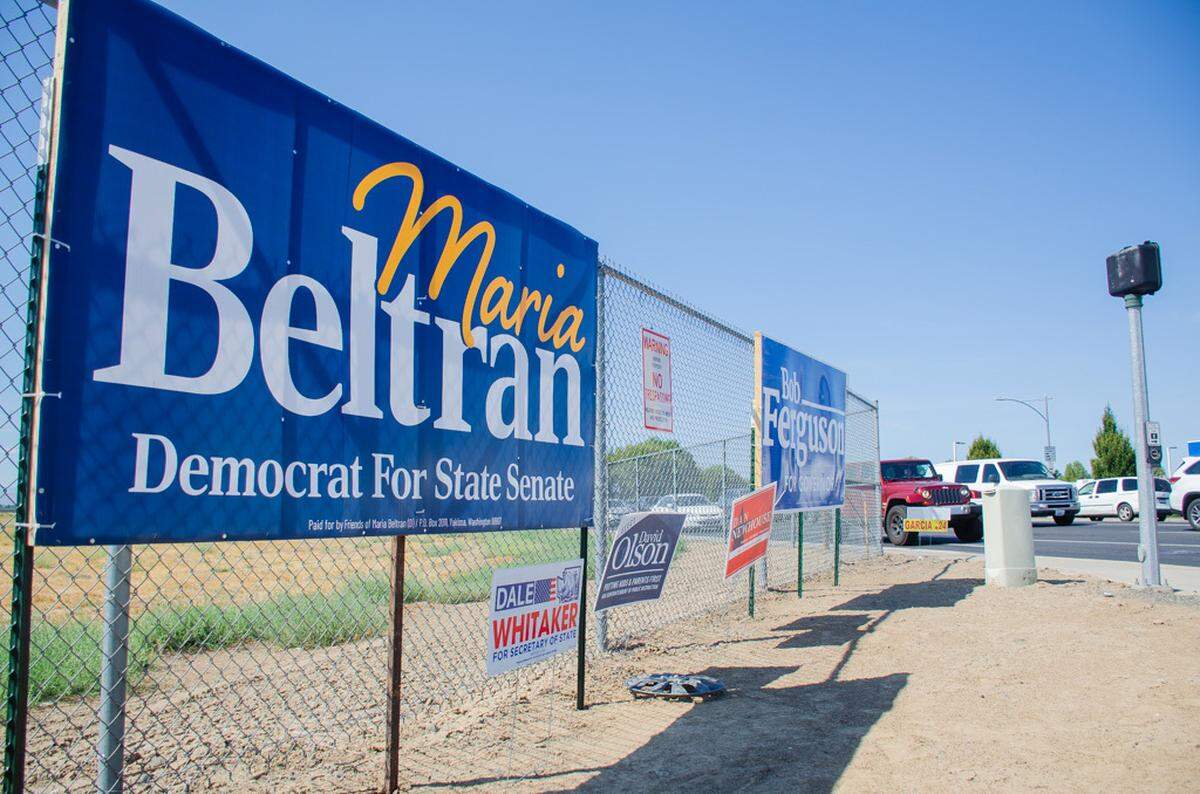
Three races in Washington’s 14th Legislative District, which includes large swaths of the Yakima Valley, will be among the most closely watched in the state this November, having attracted multiple Latina candidates.
Lower voter turnout
The district was recently redrawn by a U.S. District Court judge in a decision heralded by Democrats and denounced by Republicans.
While it’s the only district in the state with a majority voting age population that’s Hispanic, it has just 61,000 registered voters — the fewest of any of the 49 statehouse districts.
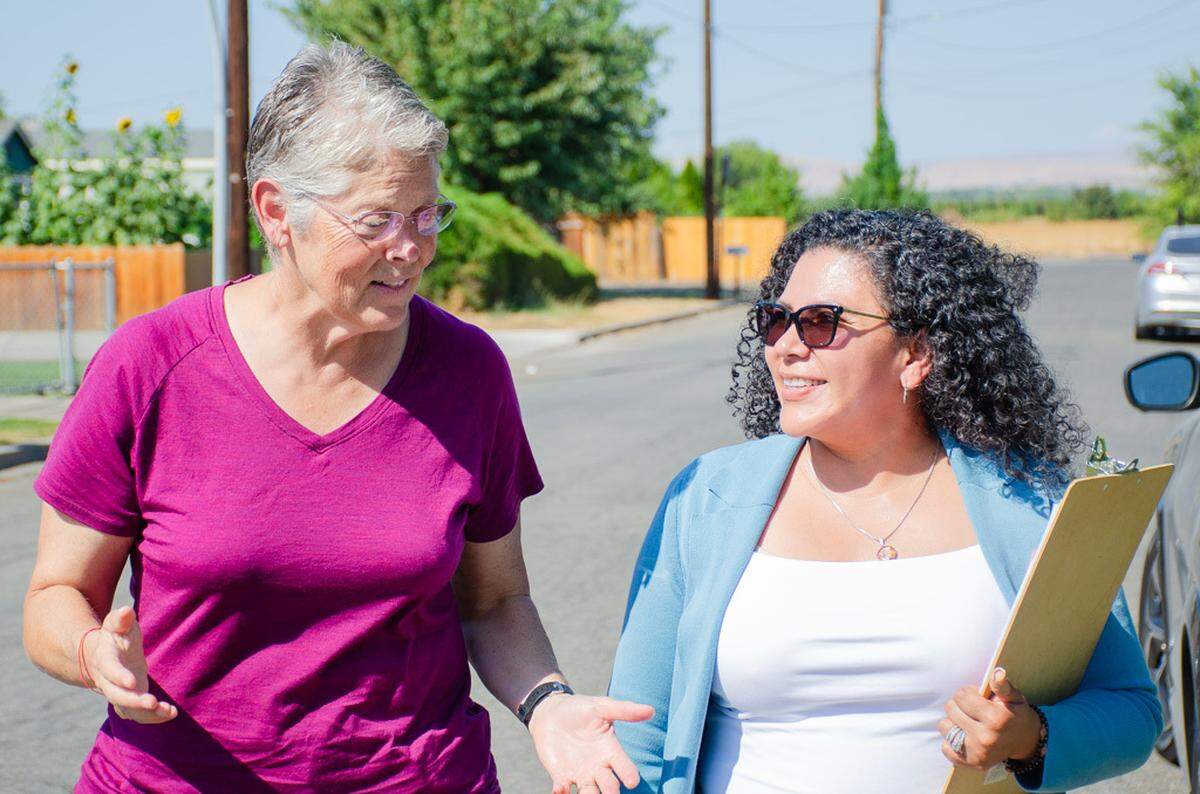
“I think of it as an opportunity,” said Washington House Speaker Laurie Jinkins, who was out door belling Tuesday in Toppenish for Ana Ruiz Kennedy, a Democrat from the Tri-Cities running in the district.
Competitive purple districts often attract lots of attention, but they also offer up new chances for engagement and political activism, Jinkins said.
The 14th also encompasses Yakima and Franklin counties, two that regularly see the lowest voter turnout in Washington state.
Figueroa says Poder Latinx’s goal is to increase voter turnout in Yakima County by 4 percentage points over the previous four-year cycle and register 5,000 new voters in time to vote in November — an “audacious,” yet “plausible” goal.
Since March, the organization has registered 800 new voters in Yakima County, many of them college-age Latinos.
While out walking Toppenish neighborhoods this week, Ruiz Kennedy of Pasco said she keeps voter registration forms on a clipboard, just in case she comes across someone of voting age who hasn’t registered yet.
That’s often the case in households with several family members.
Washington initiatives
Latinos are one of the fastest-growing voter demographics in the U.S., many disproportionately young and less partisan, the New York Times reports.
They make up roughly 15% of the nationwide electorate, and an estimated 36 million are eligible to vote this year, according to Pew Research Center.
Political polling in recent years has showed a steady decline in Democratic support among the demographic, with one earlier this year showing former President Donald Trump with a 16-point advantage over President Joe Biden.
Since Biden dropped out and Vice President Kamala Harris became the Democratic nominee, support has grown slightly. Both political parties are banking on strong Latino turnout to help them win the White House.
With kids back in school and parents at work, the late-morning streets of a West Valley neighborhood were quiet as Figueroa and his troop walk the sidewalk.
They were looking this week to speak with recent voters — mostly of retirement age — about the issues, while educating others about how to register to vote.
“We try and keep it brief and short,” he said.
Stacks of mailers opposing Initiative 2117 — the effort to repeal parts of Washington’s Climate Commitment Act, Gov. Jay Inslee’s landmark climate policy — are perched in their arms, but they’re soon tucked in the creases of voters’ front doors.
“We as an organization officially (opposed the initiative) because it really relates to one of our key, core issues, which is environmental justice,” Figueroa said.
“In relationship to that, we wanted to make sure people knew about this initiative, especially when we’re going about the Latino community and the environmental impacts that are going to be detrimental,” he said.
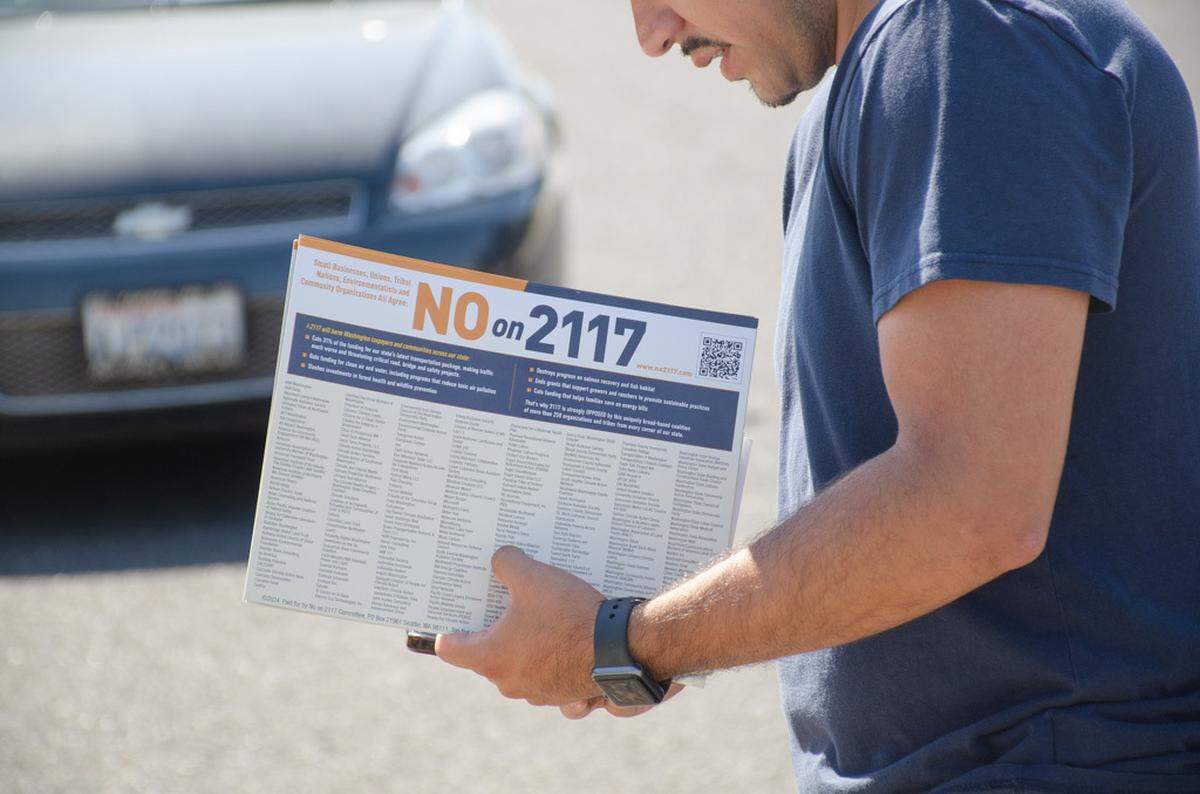
Republicans are mobilizing support behind four voter initiatives that will appear on the Nov. 5 ballot. Figueroa said Hispanic voters began voicing curiosity about the initiatives during the primary, too.
I-2117 is among them, but they also include other measures that, if passed, would prohibit government natural gas restrictions, repeal the state’s capital gains tax and allow employees to opt out of the tax funding the state’s long-term care benefits program.
Let’s Go Washington, the PAC behind the effort to pass the initiatives, submitted more than 1.7 million voter signatures last year to get the four initiatives on the ballot.
Three other initiatives restoring police pursuits, establishing a parent’s bill of rights in school and prohibiting personal income taxes were passed by the Washington Legislature in the final stretch of the 2024 session.
“There were a large percentage of Democrats that signed those and said, ‘We need change and this is how we’re going to do it,’” Curtis King, the four-term Republican state Senator running in the 14th, told the Tri-City Herald in August. “I found that interesting and compelling, and it reminded me of how we operate.”
Project 2025 and issues on Latino voters’ minds
In speaking with Latino voters, Figueroa said their top issues often include community safety, housing costs and resources and after-school outlets for youth.
In a statement, Yadira Sanchez, the executive director of Poder Latinx, said their campaign goes beyond just registering voters — they want to engage people who will ultimately “influence the future of American democracy.”
“Our mission is to ensure that the Latinx community not only has a voice but also the power to shape the present and future of our nation,” she said.
That includes engaging discussion around Project 2025, the widely discussed presidential transition plan the Heritage Foundation crafted in case Trump wins a second term. The federal policy agenda serves as a road map to recreate the federal government around conservative ideals.
Trump himself has disavowed the plan as “extreme,” despite some support for it from his base.
Figueroa said many Hispanic and Latino voters simply haven’t heard about the plan. Many immigrants have fled authoritarian governments, he said, so discussions around personal rights oftentimes have great meaning.
“We want to make sure that people understand this isn’t a partisan issue. It’s all about saving democracy and understanding what’s at stake,” Figueroa said.
“A lot of our folks come from different countries in Latin America. They understand the importance of their vote... A lot of our undocumented folks say, ‘Well, I can’t vote.’ But we’re a firm believer of not all can vote, but everybody can participate.”
While Poder Latinx endorsed the “No” campaign on I-2117, it has not weighed in on the presidential race.
This story was originally published September 9, 2024 at 5:00 AM with the headline "‘Audacious’ goal. Central WA becomes hub for mobilizing thousands of Latino voters."