This is what Tribal leaders told Inslee about education, social services, natural resources
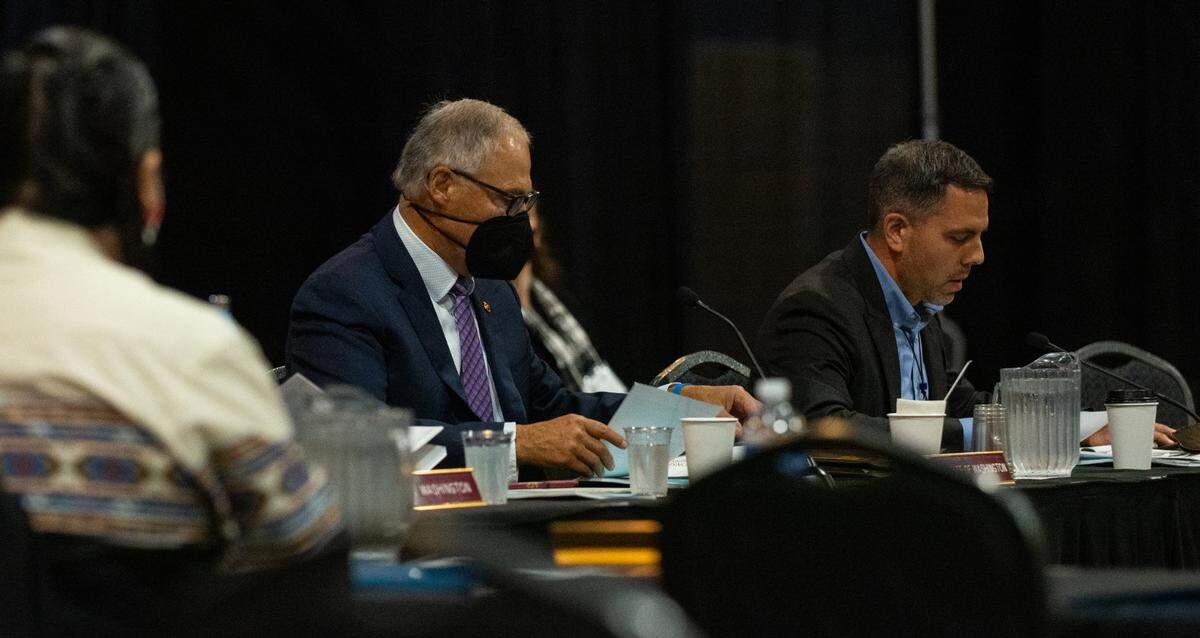
Washington state Tribal leaders focused on Tribal sovereignty and pushed Gov. Inslee for salmon recovery legislation language and enforcement of fishing treaty rights at the annual Centennial Accord Meeting Wednesday, Oct. 27, at the Skookum Creek Event Center in Shelton, Wash.
The annual meeting focuses on cementing the government-to-government relationship between the state and Tribes with representatives from the state’s 29 federally recognized Tribes and a few other Pacific Northwest Tribes.
Some Tribes criticized Gov. Inslee’s decision to veto sections of the Climate Commitment Act that Tribes worked on to guarantee historic levels of consultation and protections for their sacred sites and burial grounds.
Inslee acknowledged their concerns, but added he’s committed to developing a successful consultation process and is “very pleased about how our discussions are going in that direction.”
Tribal sovereignty was a through-line of the panels and presentations to the governor.
Representatives for Native education discussed the Since Time Immemorial: Tribal Sovereignty in Washington State Online Curriculum — a Tribal-developed project endorsed by all 29 of the state’s federally recognized Tribes that teaches Tribal sovereignty, culture, history and civics in K-12 schools.
Jon Claymore, executive director of the Office of Superintendent of Public Instruction Office of Native Education, reported that to date, 7,000 educators have trained in the curriculum and that the office supported the ongoing implementation of the curriculum, Tribal consultation, government-to-government training and data collection on Native students and educators.
Suquamish Chairman Leonard Forsman — who Inslee recently appointed as the first Native American on the UW Board of Regents — and Veronica Gallardo, assistant superintendent of the Office of System and School Improvement, also spoke about Native education and ways to serve Native learners.
The panel touched on HB 1356, a bill that went into effect July 25 requiring Washington schools that wished to keep their Native American names, symbols, images, mascots, logos and team names to consult with their nearest Tribe regarding their appropriateness.
An additional panel on social services also centered Tribal sovereignty with a new proposed structure for how social services for Native families would work with local, state and Tribal governments.
Climate change efforts
In a panel discussion on natural resources, Executive Director of the Northwest Indian Fisheries Commission Justin Parker focused on climate change and said better coordination for federal, state and Tribal efforts on salmon and climate change was a necessity.
Parker and JT Austin, senior policy advisor of natural resources for the governor’s office, discussed research on how climate change is affecting fish populations, riparian zones and Tribal lands. The pair also touched on the devastating wildfires that ripped through more than 150,000 acres of the Colville Tribes’ land this year.
Chairman Andrew “Badger” Joseph Jr. said 500,000 acres of the Tribe’s land has burnt since 2015 and half of its timber — a large economic resource for the Tribe — was lost. Earlier this year, the Tribe filed a lawsuit against the U.S. government alleging it failed to fulfill required duties before, during and after the 2015 wildfires.
Joseph thanked the governor and Washington Commissioner of Public Lands Hillary Franz, who was present at the meeting, for their leadership and swift action to help.
“When I flew to that site and saw over 100,000 acres of forest yet again burned... it hit me right here,” Inslee said, pointing to his heart. “To see my state ravaged by climate change is a deep wound to me… I’m going to do everything humanly possible to save my state from this beast.”
In discussing the statewide salmon strategy, Austin said Washington state is projected to be a climate refuge for people moving from the south to escape the effects of climate change.
“We must address the issues that are driving climate change in order to minimize the negative effects it is predicted to have on humans and biodiversity,” Austin said.
Salmon recovery
Austin’s presentation on the salmon recovery strategy was questioned by multiple Tribal leaders, particularly Jamestown S’Klallam Tribe Chairman Ron Allen, who challenged the governor’s office to share the legislative language with the Tribes ahead of their government-to-government meeting tentatively scheduled for Nov. 19.
Some Tribal leaders called for an expansion of fish hatcheries and enforcement of Tribes’ treaty rights with agents who are well-versed in the protection of natural resources and treaty rights.
“If we don’t have fish for our people, what’s the point of the treaties that we signed?” Wilson said.
Austin said staffing, legislation and funding for many areas, particularly enforcement, is in the works.
Inslee said he knows that hatchery issues are urgent, but are not self-supporting and can be expensive. He asked for the Tribal nations to help with funding.
Austin noted the governor has always put aside funding for hatcheries.
BEHIND THE STORY
MOREPlease help support this reporting
Natasha Brennan covers Washington state tribes’ impact on our local communities, environment and politics, as well as traditions, culture and equity issues, for McClatchy media companies in Bellingham, Olympia, Tacoma and Tri-Cities.
She joins us in partnership with Report for America, which pays a portion of reporters’ salaries. You can help support this reporting at bellinghamherald.com/donate. Donations are tax-deductible through Journalism Funding Partners.
You can sign up for her weekly newsletter here.
This story was originally published November 2, 2021 at 11:25 AM with the headline "This is what Tribal leaders told Inslee about education, social services, natural resources."