WA Indigenous communities remember boarding school era, call for federal investigation
Indigenous leaders and communities across the U.S. and Canada continue to come together in person or virtually to reflect on the Indian Residential School system during the week of The National Day for Truth and Reconciliation. Also known as Orange Shirt Day, Sept. 30 is a day of remembrance to honor those who were lost, killed and survived the schools.
Created in 2013 by First Nations peoples in Canada to bring awareness to the horrors, cultural genocide and historical trauma that residential schools inflicted on their communities, the sorrowful holiday is also observed by U.S. Indigenous communities through events and moments of silence.
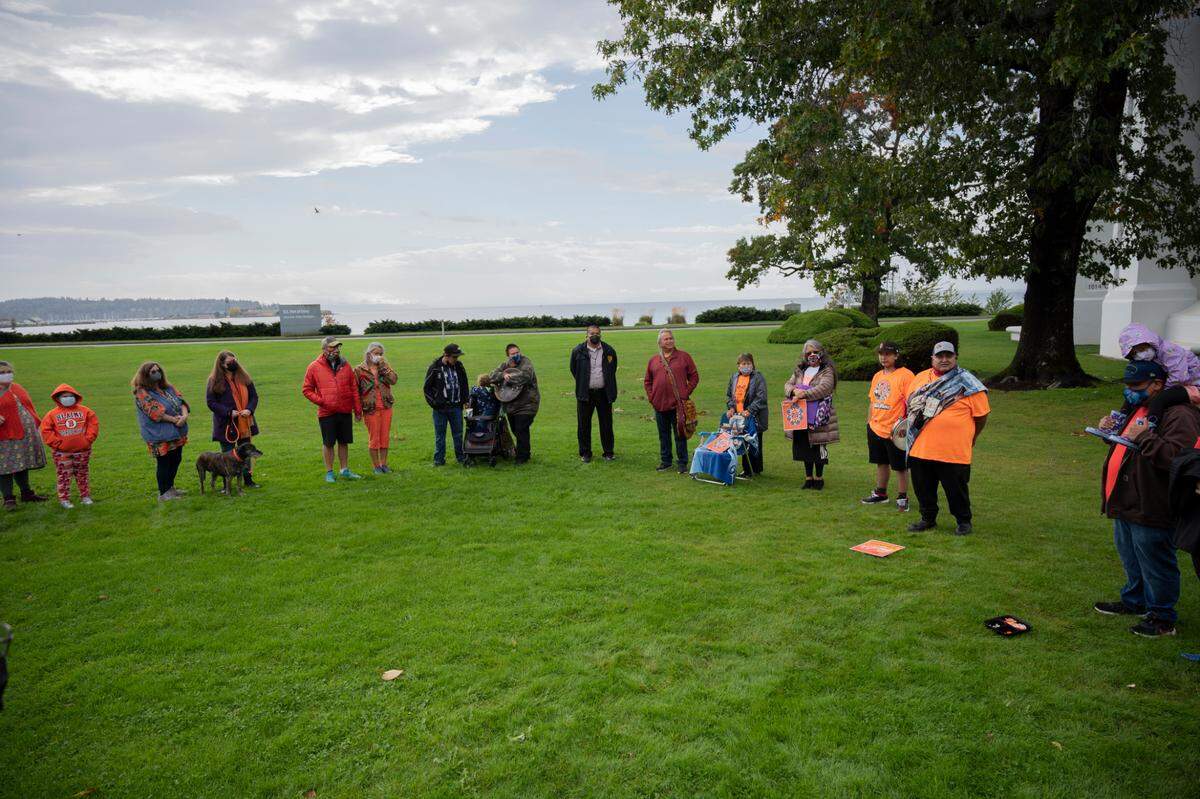
At Peace Arch Park in Blaine, Native activists, allies and Tribal members gathered to share prayers and songs of healing Thursday, Sept. 30. Organized by Althea Wilson of Lummi Nation and Thrisa Jimmy of the Nooksack Indian Tribe, the group of 40 participated in a two-minute, 15-second moment of silence beginning at 2:15 p.m. in honor of the 215 Indigenous children whose bodies were uncovered at Kamloops Indian Residential School in British Columbia earlier this year.
The Kamloops discovery affirmed what Indigenous communities in both Canada and the U.S. have said for many years and led to a nationwide investigation that has found more than a thousand remains at residential schools so far in Canada.
The landmark Truth and Reconciliation Commission report released by the Canadian government in 2015 found about 150,000 children were removed from their families and sent to the schools. The report identified 3,200 confirmed deaths, but an estimated 6,000 children may have died, according to the BBC.
Swinomish elder Beverly Peters — a dual citizen of the U.S. and Canada — felt compelled to the site to share her story and support those recognizing the day on both sides of the border by leading the group at Peace Arch Park in a prayer.
“Give us the strength to carry on with our families, for the children and their new songs that come about,” Peters prayed.
A survivor of the Kamloops school as well as St. Paul’s Indian Residential School in Canada, Peters attended Indian boarding schools from kindergarten to eighth grade in the 1950s.
With her father serving in World War II, she lived with her grandparents, Peters said. When it was time for her to begin attending school at the age of 6, she joined her cousins at St. Paul’s.
“I wasn’t really taken away, grandma just said, ‘You have to go. We weren’t allowed in the white man’s schools,’” she said.
Active in both countries throughout the late 1800s to the late 1900s, the schools forced assimilation and a Euro-centric, Christian education onto Indigenous communities through traumatic and often violent means.
The day of remembrance is commonly known as Orange Shirt Day “to honor the story of one girl whose treasured orange shirt given to her by her grandmother was taken away from her at residential school,” according to the National Native American Boarding School Healing Coalition. The orange shirt now symbolizes awareness for the children who died or went missing at these institutions.
This year, the day was elevated to a Canadian statutory holiday in light of the recent discoveries, but not all provinces have chosen to recognize the holiday.
Similarly, the United States has yet to fully recognized its Indian boarding school history. In the U.S., more than 200 boarding schools enrolled an estimated 34,000 children before closing in 1996.
“We haven’t unearthed any children yet — and I say ‘yet’ — but when we do, we are going to be right beside Canada. We already are standing in solidarity. What Canada feels right now and the mourning they are going through, we feel it too. We want (U.S. Interior Secretary Deb Haaland) to live up to her promise and investigate these schools,” said Wilson.
Wilson shared her father was at a residential school in Tulalip and her mother attended one in Canada.
“I feel like Native people in Indian Country are so busy trying to bring closure to the atrocities done to Indigenous people in Canada and the U.S.,” Wilson said. “We can’t get over one hurt without another coming up. Like the Missing and Murdered Indigenous Women crisis, which is a big issue — along with us fighting to bring our children and ancestors home.”
This June, Haaland announced the Federal Indian Boarding School Initiative. Haaland, the first Native American to lead the department that oversees the Bureau of Indian Affairs, ordered a comprehensive review of the troubled legacy of federal boarding school policies.
“I know that this process will be long and difficult. I know that this process will be painful. It won’t undo the heartbreak and loss we feel. But only by acknowledging the past can we work toward a future that we’re all proud to embrace,” Haaland said in a news release in June.
In Washington state, numerous schools and other assimilation institutions were operated: St. George’s Catholic Indian Boarding school in Fife; Cushman Indian Boarding School and Cushman Indian Hospital and Sanatorium in Tacoma; St. Mary’s Mission Pascal Sherman Indian School in Omak and Tulalip Indian School.
For nearly a decade, The Puyallup Tribe of Indians’ Historic Preservation Department in conjunction with The Puyallup Tribal Language Program has collected stories from Tribal elders who attended St. George’s Indian Boarding School, Cushman Indian Boarding School or Cushman Indian Hospital and Sanatorium on the Puyallup Reservation. To commemorate the day of remembrance, the Tribe’s Children of the River Child Advocacy Center hosted a virtual screening of “Dawnland” (2018).
BEHIND THE STORY
MOREPlease help support this reporting
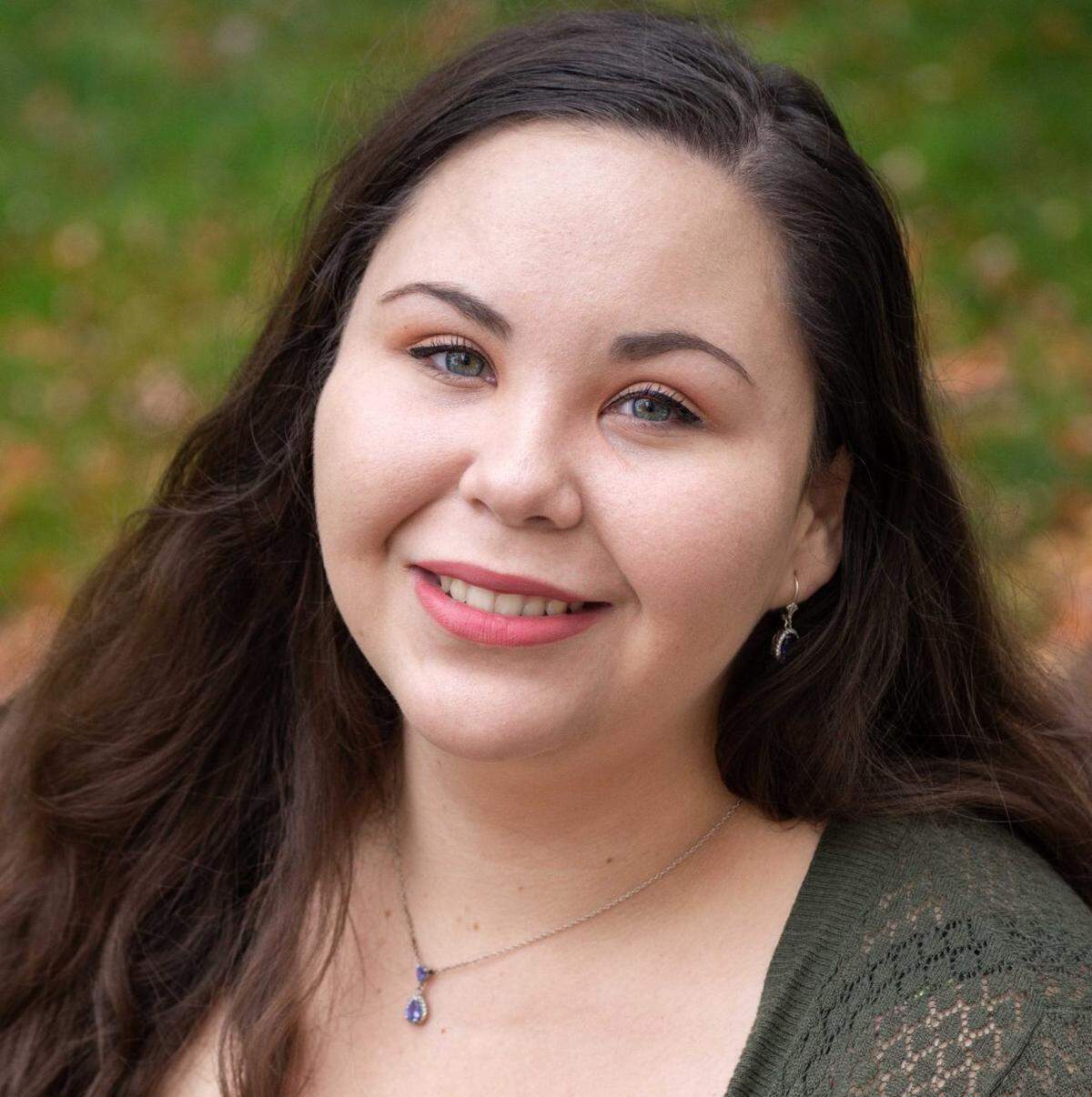
Natasha Brennan covers Washington state tribes’ impact on our local communities, environment and politics, as well as traditions, culture and equity issues, for McClatchy media companies in Bellingham, Olympia, Tacoma and Tri-Cities.
She joins us in partnership with Report for America, which pays a portion of reporters’ salaries. You can help support this reporting at bellinghamherald.com/donate. Donations are tax-deductible through Journalism Funding Partners.
You can sign up for her weekly newsletter here.
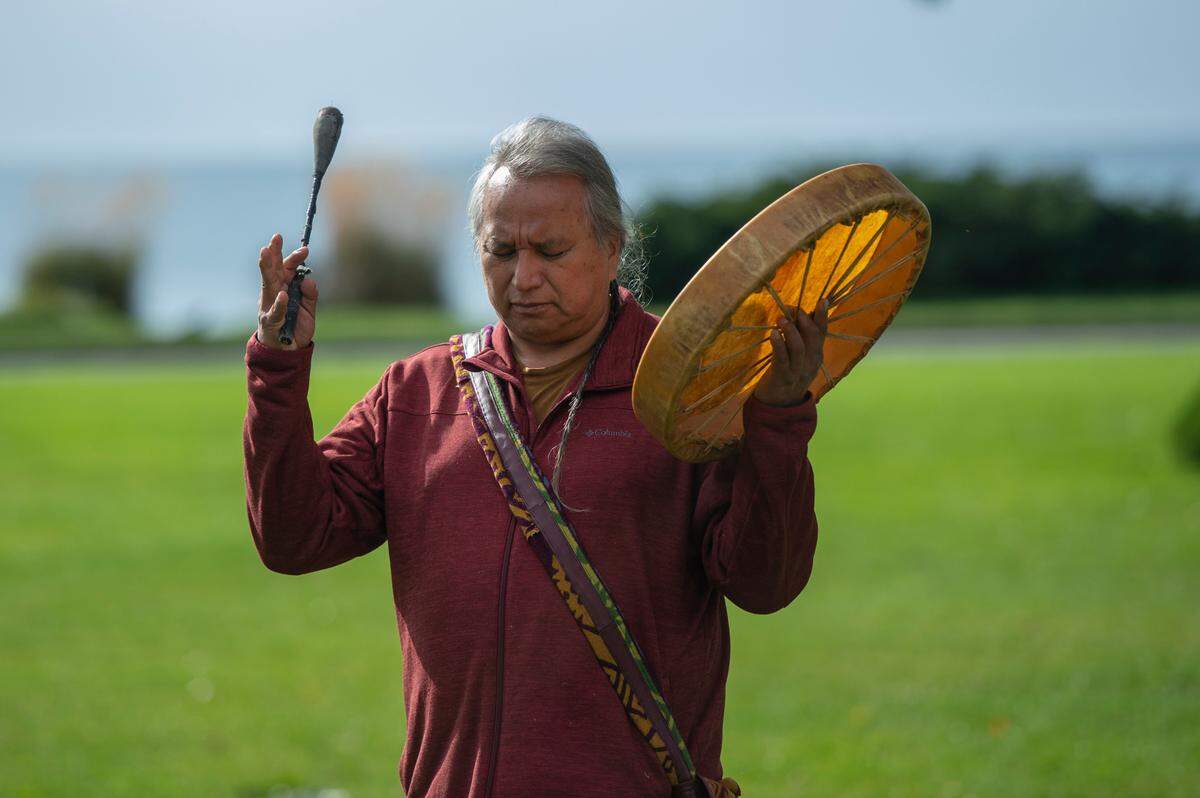
Antone George, who is Lummi, joined the group in Peace Arch Park to share a song he composed in honor of those lost at the residential schools.
“Both my parents were survivors. We talk a lot about how so much of it affected our parents and it explains why they are the way they are. Trying to numb the pain from that trauma. I composed this song for them and all the children,” he said.
Joined by his son, Patless, George shared the emotional story of his parents with the group before singing and drumming the song, which he planned to do later that evening again at a gathering in Tulalip.
To close the discussion, organizer Jimmy shared her own story of being raised by her white grandmother as her Nooksack mother fought for custody — how every day she wanted to go home. She said it was an example of how the trauma and experience of the boarding schools still plays out today and that Native people must fight to end it.
Jimmy and Wilson plan to schedule a larger event in support of the cause next year.
This story was originally published October 1, 2021 at 5:00 AM with the headline "WA Indigenous communities remember boarding school era, call for federal investigation."