
With Legislature’s control at stake, political parties, PACs funding 42nd District races
Hundreds of thousands of dollars in campaign contributions — portions of it from sources outside the area — are again flowing into the 42nd Legislative District, focusing on a key state Senate seat and two House races in traditionally conservative northern Whatcom County.
Democrats believe the 42nd District is in play for the first time in years — especially the seat of two-term state Sen. Doug Ericksen, a Republican who was elected to the Senate in 2010 after serving six terms in the state House.
He’s being challenged by Bellingham City Council member Pinky Vargas, a Democrat.
“(Democrats) do see it as winnable,” Vargas told The Bellingham Herald in an interview last week. “They do see it as one of three winnable districts in the state.”
Control of the Legislature is at stake in the Evergreen State, where Democrats hold a two-seat advantage in the House and a one-seat majority in the Senate.
Party control of legislatures and governor’s seats could be crucial in the years after the 2020 census, when states re-examine congressional and legislative district boundaries.
Half-million raised in Ericksen-Vargas race
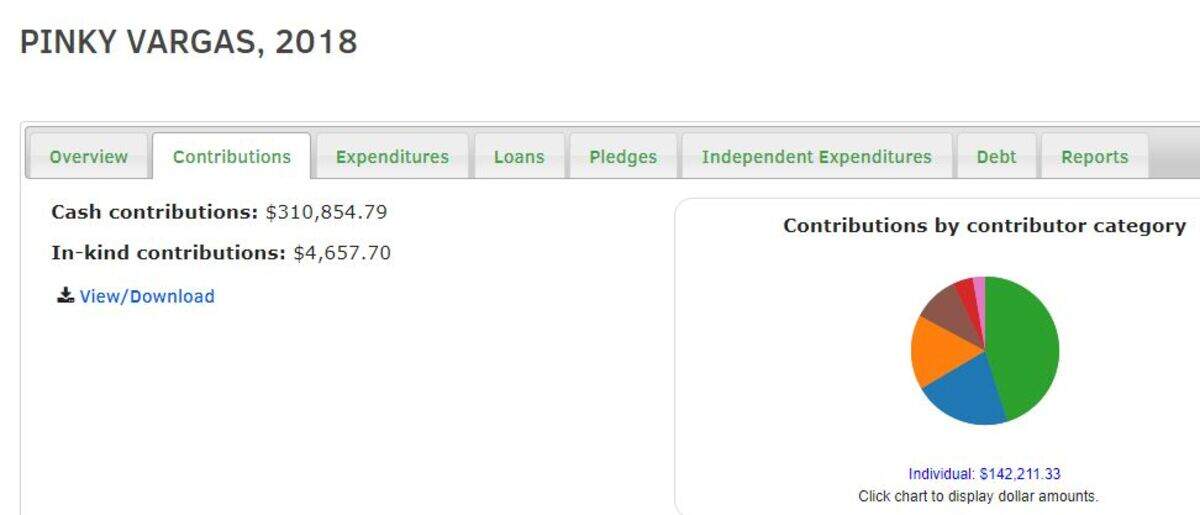
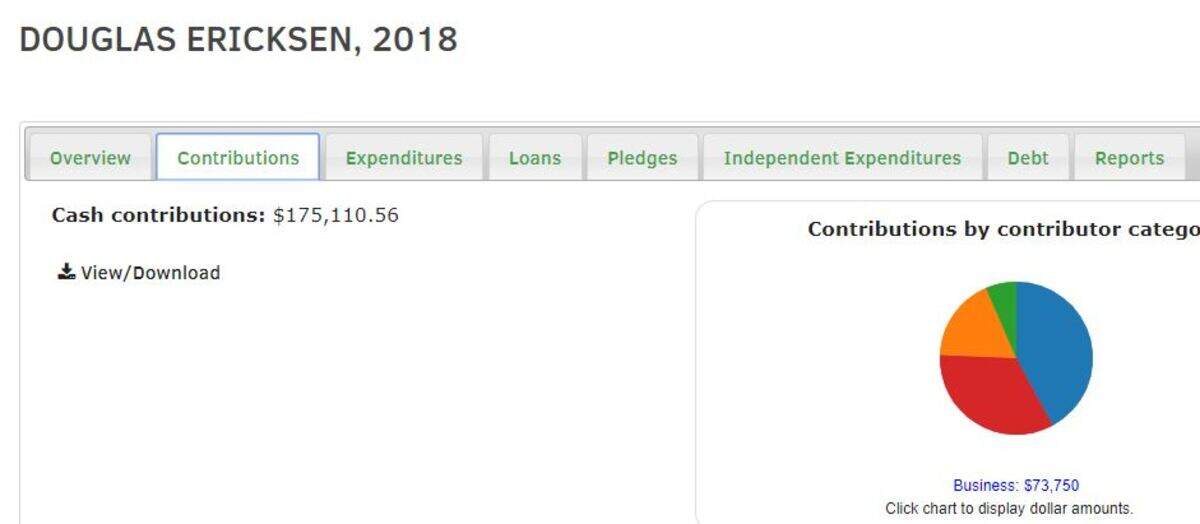
In reports filed through Oct. 11 with the state Public Disclosure Commission, Vargas had received almost double the contributions to Ericksen — $310,855 for Vargas to Ericksen’s $175,111.
About a third of Vargas’ contributions are a combined $115,000 in monies from the Washington State Democratic Campaign and from the state House Democratic Caucus Campaign Committee in Seattle.
In addition, a Democratic PAC called A New Direction has spent $130,000 independently against Ericksen.
But about half of Vargas’ direct campaign contributions come from individual donors ($142,211) and a smaller amount from businesses ($67,619).
“We anticipated that we’d get outspent,” Ericksen told The Bellingham Herald in an interview last week. “There’s only three or four competitive Senate races.”
Ericksen’s campaign donations largely come from businesses ($74,000) and political-action committees ($59,000) with about $31,000 from individual donors.
His large contributions include $2,000 each from Chevron and BNSF Railway, $1,950 each from Phillips 66 Co. and T Mobile, $1,600 each from Kroger and Puget Sound Energy and $1,500 from Amazon.
He’s also received money from employee PACs at BP North America refinery and Alcoa, major employers near his home in Ferndale.
“We have a lot of local donors, which is increasing every day,” Ericksen said. “I don’t consider it to be an out-of-area contribution if it comes from a company with a presence in the community.”
But it’s nowhere near what was spent in the 2014 state Senate race, when Ericksen defeated Seth Fleetwood 59 percent to 41 percent.
In that race, Ericksen raised $520,000 to Fleetwood’s $445,000 — with Ericksen getting Republican Party contributions valued at $200,000 and the Democratic Party giving Fleetwood cash or in-kind contributions of $165,000.
In 2010, when he first ran for Senate, Ericksen raised $175,000 to Democrat Pat Jerns’ $17,000 and won by a margin of 60 percent to 40 percent.
Is a blue wave cresting in red 42nd?
Ericksen was first in the three-way August primary, with 46 percent of the vote. Third-place Tim Ballew II threw his support behind Vargas. The two Democrats’ combined votes totaled 54 percent.
But that was the primary, when there was little on the ballot to energize Whatcom County’s conservative base, Ericksen told The Bellingham Herald in August.
Ericksen said then that he was confident that more Republican voters would cast their ballots in November, and a recent NPR-Marist-PBS poll showed a nationwide surge in Republicans who said they plan to vote in November.
In 2010 and 2014, Ericksen defeated his Democratic opponents by 20-point margins.
This year, however, Ericksen and the 42nd’s two Republican House members — Reps. Luanne Van Werven and Vincent Buys — are facing tougher races, with nationwide talk of a “blue wave” at the polls and recent voting trends that show part of the district turning blue.
“People haven’t thought that the 42nd is winnable in a long time,” Vargas said.
Democrats ‘waking up and voting’
Van Werven and GOP candidate Dean Berkeley drew a combined 49 percent of the vote to Democrat Justin Boneau’s 51 percent in the primary, and Buys trailed his Democratic foe Sharon Shewmake by a margin of 52-48.
“Clearly, we underperformed in the primary,” Van Werven told The Herald last week. “I was not surprised to see the state House Democrats spend money in the 42nd.”
Van Werven’s contributions totaled $137,332, with about a third from individual donors, a third from PACs such as BP North American Employee PAC, BNSF and Boeing ($2,000 each) and the Alcoa Inc. Employees Voluntary PAC ($900). Businesses and others made up the rest.
Some $25,000 in state Democratic Party funds also went to WWU economics professor Shewmake, who has reported contributions of $93,067, including $50,000 in individual donations and $5,000 from PACs.
“I think Democrats are waking up and voting,” Shewmake said in an interview with The Herald last week. “I’m hearing a lot of money is always important but what’s most important is grass-roots support.”
Buys has outpaced Shewmake in fundraising, with $118,922 through Oct. 11 — including about $30,000 each from individual donors and businesses and about $40,000 from PACs such as $2,000 each from Phillips 66, BNSF Railway and BP North American Employee PAC.
New PAC could aid 42nd GOP
Republicans in the 42nd could also benefit from a new PAC, the 42nd Legislative District Committee GOP Exempt, which has $79,000 that includes a $50,000 donation from Phillips Petroleum Co., $15,000 from a building industry PAC called Washington Affordable Housing Council and $10,000 from Chevron Policy Government and Public Affairs.
“We support pro-business candidates that promote sound, data-driven regulations that protect industry jobs and help the local economy,” said Josh Summers, spokesman at the Phillips 66 refinery near Ferndale. “The Republican candidates in the 42nd District meet that criteria and we strongly support their re-election.”
This new PAC hadn’t spent its funds as of Oct. 11.
‘Blue wave’ might have little impact
Washington state pollster Stuart Elway, in a spring survey of Washington voters, was hesitant to predict major legislative change at the polls in November.
“While Democrats in Washington continue to have a decided advantage, there are at least two reasons for caution: one is that Republicans appear to have gained some ground in recent months,” Elway wrote in April. “The other reason is structural — read district boundaries. A blue wave in blue districts will do little to change the political balance of power.”
Washington doesn’t register voters by party, so it’s difficult to judge how many Republicans and Democrats are registered in the 42nd District.
Impact of 2016 election
But The New York Times, in a nationwide project published in July, plotted the presidential vote in every precinct across the United States for “Political Bubbles and Hidden Diversity: Highlights From a Very Detailed Map of the 2016 Election.”
That map shows northern Whatcom County as a mix of pink, red and deep red, with pockets of blue and pale blue around Blaine, Ferndale, the Lummi Reservation and the South Fork Valley.
Coupled with heavily Democratic north Bellingham, it could provide hope for the Democrats.
Van Werven, who’s running for a third two-year term, said her campaign strategy always involves direct contact with voters.
“We’re getting a lot of boots on the ground, going door-to-door,” she said. “Meeting people on the doorstep is the best way to contact voters .”
No corporate PAC money for Boneau
Possibly no candidate in the 42nd is more focused on money and people than Boneau, a U.S. Navy veteran running against incumbent Van Werven. He’s raised barely $30,000, the smallest amount of money of any candidate running in the district.
“I’m not accepting any corporate PAC money,” Boneau said in an interview last week with The Herald.
He’s hoping the state Democratic Party will provide some funding, as it has for Shewmake and Vargas.
Boneau, who supervises a roadside cleanup crew for the state Department of Ecology, said his job leaves him little flexibility.
“I‘m out doorbelling every day that I can,” Boneau said. “I have a job and my wife works. We’re just a normal workaday family trying to make ends meet,” he said.
“Voters in the district want change,” he said. “I got 51 percent of the vote and that was after being outraised and outspent.”
This story was originally published October 15, 2018 at 5:00 AM.