
Here’s what you’ll vote for on your March 10 presidential primary ballot in Washington
Washington state Democrats will get a chance to influence their party’s choice of a presidential nominee when they participate in the state’s mail-in primary election this year.
In past election years, the state’s primary election has been a non-binding display of voter preference. The selection of delegates committed to candidates was determined at party caucuses around the state. But this year, Democratic primary voters will determine which candidates get delegates to the national convention, based on a complex proportional voting system.
Republicans can vote in the state presidential primary too, although only one name will appear on Republican primary ballots: President Donald Trump.
Ballots for the presidential primary will be mailed to all registered voters on Feb. 21, according to the Washington Secretary of State’s office. Returned ballots must be postmarked by March 10, and counties will begin the tally of those ballots at 8 p.m. on that date.
Washington is one of six states voting March 10. The big prize will be Michigan with 147 delegates. Washington is next with 108. Others: Missouri, 78; Mississippi, 41; Idaho, 25 and North Dakota, 18.
On Aug. 4, Washington state will have a Top 2 primary with nominees from all parties to determine the two candidates who will be on Washington’s Nov. 3 ballot for U.S. president.
Choose a party
State voters who want to participate in the March 10 primary balloting for Democratic or Republican presidential candidates will be required to make a public declaration of party affiliation. To do this, they will check off either the Democratic or Republican box on their ballot envelope, and then sign that envelope.
The parties themselves are requiring the declaration for voters who want to have a say in determining a party’s nominee, according to the Secretary of State’s office.
The ballots mailed to every registered voter will include both a Republican side with Trump’s name and a Democratic side with the names of Democratic hopefuls. Those who declare themselves Democrats cannot vote for Trump, and those who declare themselves Republicans cannot vote for a Democrat, according to the Washington Secretary of State’s office.
Ballots of any voters who refuse to check off either box will not be counted. Also on the discard pile will be ballots marked for more than one candidate.
Whatcom County Auditor Diana Bradrick said that under state law, each voter’s party declaration becomes a public record for the next 60 days, and interested organizations and individuals have a right to obtain lists of voters and their choice of party. A voter’s choice of candidate remains secret, Bradrick said.
The requirement to declare a party applies only to the presidential primary, according to the Secretary of State’s office. No such declaration will be required for voter participation in the Aug. 4 primary ballot or the Nov. 3 general election.
Democratic candidates
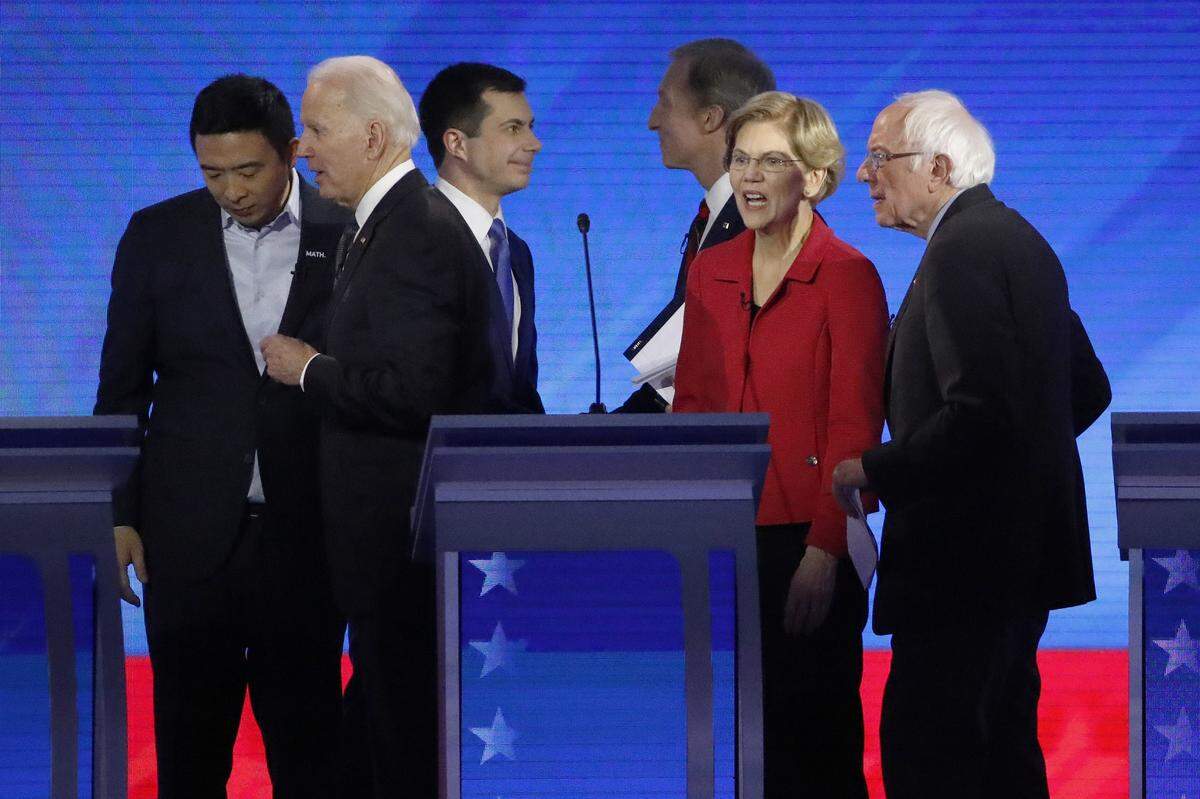
Voters willing to declare for the Democratic Party may choose from one of 13 candidates who met qualifications for the ballot earlier this year: Michael Bennet, Joseph Biden, Michael Bloomberg, Cory Booker, Pete Buttigieg, John Delaney, Tulsi Gabbard, Amy Klobuchar, Deval Patrick, Bernie Sanders, Tom Steyer and Elizabeth Warren.
“We set (qualification requirements) intentionally low,” state Democratic spokesman Will Casey said.
Since the party ballot was finalized, Patrick, Yang, Bennet, Booker and Delaney have bowed out of the race.
Democratic voters not ready to make a choice will have the option to send uncommitted delegates to the party’s national convention July 13-16 in Milwaukee.
Trump was the only candidate who met party qualifications for the GOP ballot, and GOP leaders chose not to give their party’s voters the option to choose an uncommitted delegate slate, according to information on the Secretary of State’s website.
Delegate votes
Washington state Democrats will send 107 voting delegates and seven alternates to the national convention that chooses the party’s Presidential nominee. Casey said primary voters will determine the candidate allegiance of 89 of those delegates. The remaining 18, referred to as “automatic” or “superdelegates,” include the Democratic members of the state’s congressional delegation, the governor, state party chairwoman Tina Podlodowski, and state members of the Democratic National Committee.
But the superdelegates won’t have superpowers when it’s time to vote for the party’s nominee. Casey said the 18 superdelegates won’t get to vote on the first convention ballot, although they will be able to serve on the party’s national platform committee. Those 18 would likely play a key role in the unlikely event that no candidate gets a majority on the first roll-call ballot of convention delegates. That hasn’t happened to the Democrats since 1952.
Several Democratic hopefuls may come out of the state primary with delegates committed to them on the first ballot in Milwaukee. Any candidate who gets 15 percent or more of the primary vote in one of the state’s 10 congressional districts is entitled to a proportionate share of delegates assigned to that district. Any candidate who gets 15 percent of the statewide primary vote is entitled to a proportionate share of 19 at-large delegates, Casey said.
The individuals who become pledged delegates to the Democratic National Convention will be chosen via a caucus process that begins with legislative district caucuses scheduled for April 26.
Republican caucus
Although the Republican presidential nomination is not in play, Republicans will also use a caucus system to pick delegates to the Republican National Convention Aug. 24-27 in Charlotte, North Carolina.
The GOP caucuses will be held at the precinct level on Feb. 29, and state GOP spokesman Kyle Fischer encouraged the party faithful to attend.
“Attendees will vote on delegates to the county convention and discuss the party platform,” Fischer said in an email. “Delegates to the county convention then elect delegates to the state convention, where we select the 40 delegates who will go to the national convention in Charlotte. Given what we see as the direction of Washington state, this is a great grassroots opportunity for people to get involved and have their voices heard and we are expecting a lot of excitement and participation from Republicans across the state who want to show their support for President Trump and participate in the process.”
John Stark covered politics during a 30-year career with Gannett and McClatchy newspapers.
This story was originally published February 12, 2020 at 9:09 AM.