Bellingham OKs ordinances prohibiting landlords from charging ‘junk fees’
AI-generated summary reviewed by our newsroom.
- Bellingham Council passed ordinances banning unfair rental 'junk fees' citywide.
- New rules require clear disclosure of all rental fees on lease front pages.
- Landlords must exclude fees for things like in-unit appliance use and mail collection.
In a third and final vote Monday, the Bellingham City Council enacted two ordinances designed to squash attempts by property owners to impose so-called ‘junk fees’ on tenants.
The council voted unanimously Monday, June 23 to approve both ordinances after nearly a year of discussion, fact-finding and community engagement determined that excessive and unfair fees make accessing and affording housing more challenging.
The first ordinance prohibits landlords from charging tenants “unfair or excessive” fees in residential agreements and leases. The second ordinance prohibits landlords from doing the same in manufactured and mobile home lot lease agreements.
Councilmember Jace Cotton originally brought the issue forward after renters told the Council they have often been surprised by undisclosed fees, forced to pay for services they didn’t want and have been charged for services not provided.
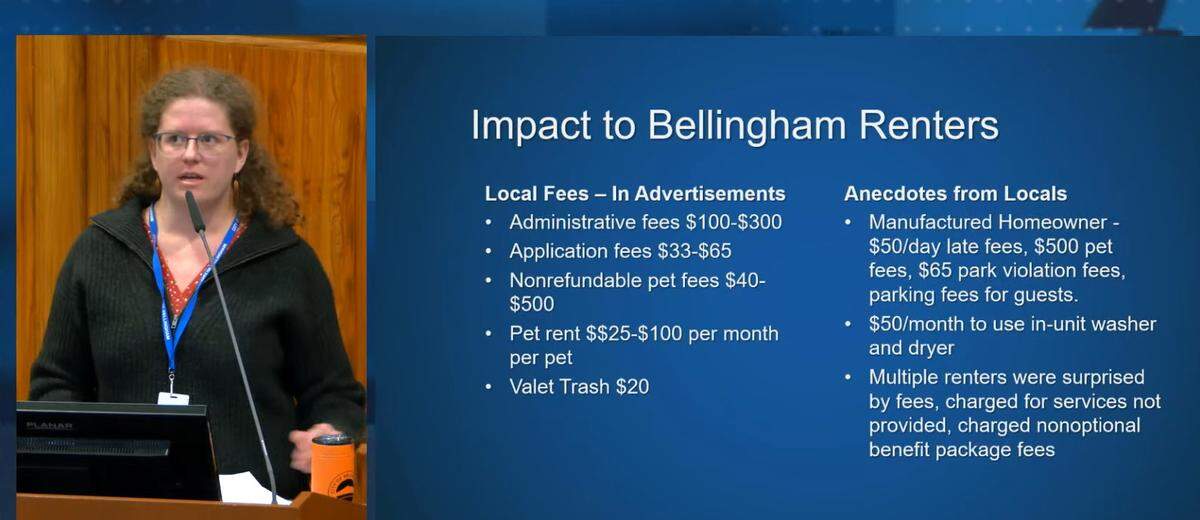
The ordinances define which rental fees are permitted, limit amounts for some of those rental fees and promote fee transparency.
“Unfair or excessive” fees imposed upon tenants with residential agreements and leases are defined as:
▪ Any fee for the use of an in-unit appliance by a tenant.
▪ Any fee for a tenant’s access to common areas.
▪ Any fee to accept rent payments or other payments by personal check, money order, cashier’s check, or ACH.
▪ Any fee for mail or package collection and distribution.
▪ Any single time or periodic fee required for pets to occupy the unit that exceeds 2% of the monthly rent.
▪ Any fee for the performance of a legally required landlord duty.
▪ A fee for a partial change of tenancy at the end of the current lease, such as adding or removing a tenant to the rental agreement.

A landlord is now also legally required to “conspicuously disclose on the first page of the rental agreement” all mandatory and optional fees and utilities associated with the unit, according to the first ordinance.
Some “reasonable fees” with limitations are still permitted.
In addition to rent, landlords may still charge tenants applicant screening fees, refundable security deposits, pet damage deposits, utility fees not included in rent, “reasonable” fees for agreed-upon goods and services, late fees, fees for insufficient funds and lease violation fees, according to the first ordinance.
“Unfair or excessive” fees for manufactured home residents are defined as:
▪ Any unlawful fee for temporary guests
▪ Any fee for a tenant to park their vehicles or guest’s vehicles within their manufactured home lot
▪ Any fee for a tenant’s access to common areas
▪ Any fee for not signing a new lease agreement, lease extension or renewal
▪ Any fee for a pet or assistance animal
▪ Any fee to accept rent payments or other payments by personal check, money order, cashier’s check, or ACH.
Manufactured home park residents can still be charged “reasonable fees” with limitations. Those include applicant screening fees or application fees, move-in fees, utility fees not included in rent, “reasonable” fees for agreed-upon goods and services, a monthly late fee and fees for insufficient funds, according to the second ordinance.
The ordinance will take effect Aug. 1.
Bellingham’s housing is 54% renter-occupied and 46% owner-occupied, according to the city of Bellingham. More than 20,000 Bellingham renters are considered cost-burdened, including at least 6,450 who are severely cost-burdened, according to the 2023 HUD Comprehensive Housing Affordability Strategy Dataset.
Editor’s note (June 24): This article was updated to revise the date the ordinances go into effect — Aug. 1, 2025.
This story was originally published June 24, 2025 at 1:20 PM.