Bellingham’s Holly Street bike lanes report shows popularity among cyclists but not drivers
A trial project to add bike lanes on Holly Street from Ellis to Bay streets through downtown Bellingham appears popular with cyclists and disliked by drivers because of increased congestion and other factors, according to a new report from the Public Works Department.
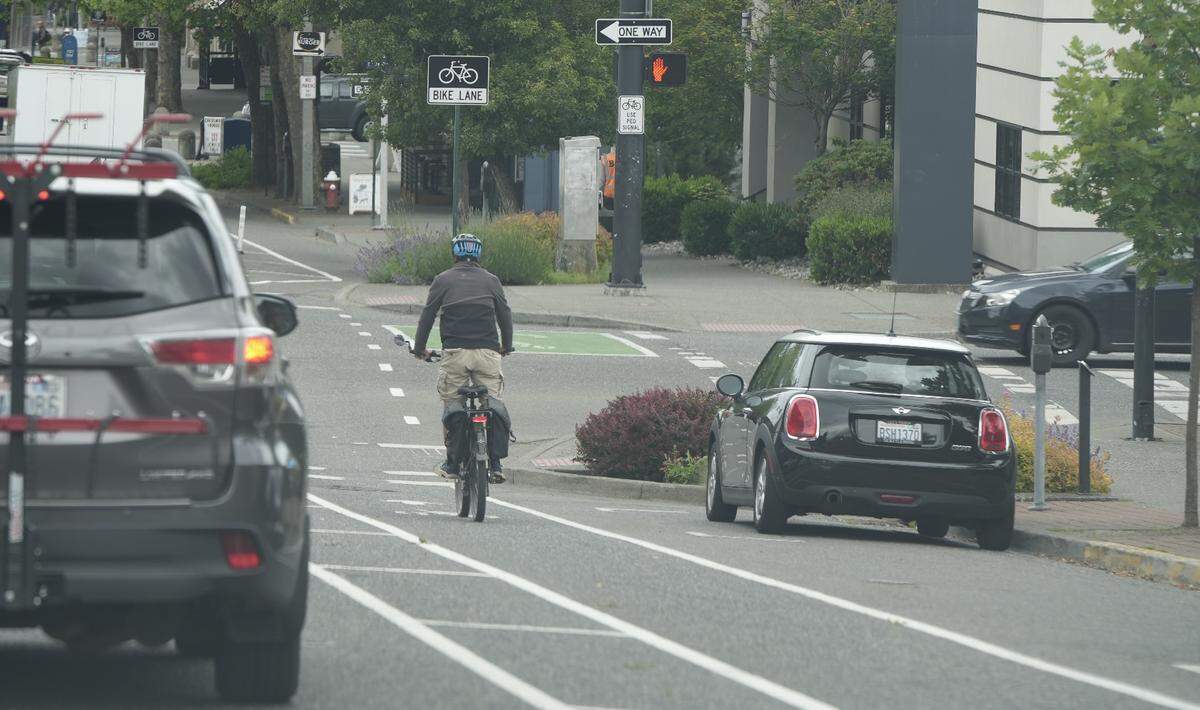
Bike lanes from Ellis to State streets are “buffered” lanes marked with small pylons. But the lane configuration for bicycles from State to Bay streets, which features “parking protected lanes,” is being criticized as unsafe and will be redesigned, the report said.
Bicyclists said it is difficult to make turns, especially left turns, from the parking-protected lanes on the right side of Holly Street, which is one-way downhill. Drivers said they had trouble seeing bicyclists in the bike lanes because parked cars block their vision.
More than 1,100 people responded to an online survey about the project.
An 18-page document prepared by the Public Works Department over the period from May, when the lanes were installed, through October found that there was:
▪ A 33% average increase in bike ridership. “Bike volumes have remained elevated through the early fall with worsening weather conditions,” the report said.
▪ An average lane utilization rate of 87%. ”Bicyclists are overwhelmingly choosing to ride in the bike lane versus mixing with vehicles in the traffic lanes,” the report said.
But as bicycling has increased, fewer drivers are using Holly Street and fewer people are walking in that stretch of downtown.
“The data show that overall vehicle and pedestrian volumes were lower in August compared to March, which is an unexpected result. This change could be attributed to several factors, including Western Washington University not in normal session or people choosing to use alternative routes to Holly Street due to increased congestion. Subsequent monitoring during September and October indicate that volumes have increased since August but have not returned to the volumes observed back in March.
Overall car traffic was down 12% through the May-October period and pedestrian use was down 4%.
About 12,000 cars and trucks were using Holly Street daily at Billy Frank Jr. Street in March, and that figure dropped to 11,000 by October.
According to the report, city engineers adjusted the timing of traffic signals to ease congestion.
In addition, pedestrian crossing signals were adjusted to lest people on foot enter a crosswalk before cars going the same direction got a green light.
City officials stressed that the report is a draft.
“Engagement is ongoing with Transportation Commission and stakeholder groups. Based on feedback, we will present a final report to City Council this winter,” the report said. “We will work on a new design for Holly Street this spring that reflects the concerns of residents — increasing visibility for bikers, decreasing right-turn conflicts and slowing bikers down through intersections.”
This story was originally published November 10, 2024 at 5:00 AM.