Bellingham City Council suspends remote public comment periods after hate speech incidents
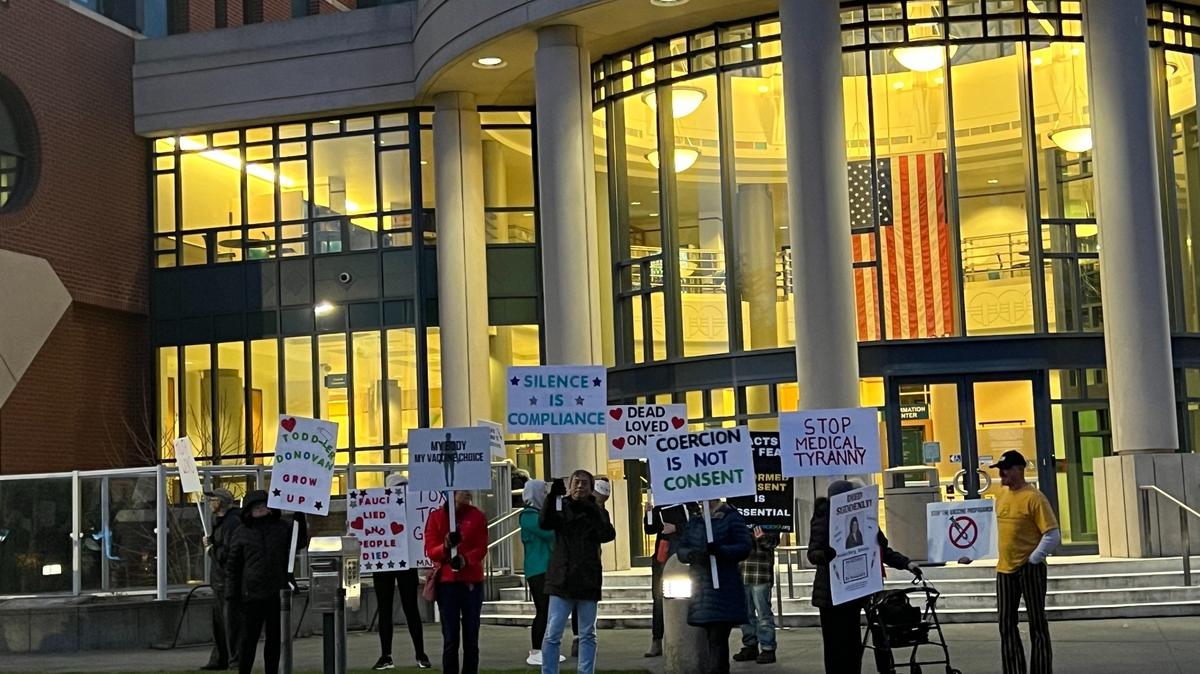
Members of the Whatcom County Council are considering changes to the public comment part of their meetings after a second incident in which online participants used hateful language in an apparently coordinated attack.
Further, the Bellingham City Council has suspended online comment, City Council office manager Jackie Lassiter said via email Thursday.
“In light of recent hate speech incidents across the state, the Bellingham City Council will not be offering public comment via Zoom until further notice. Public comment is always welcome via e-mail, phone, or mail. Our agenda and packet cover pages have been updated with this new information and we are in the process of updating our website,” Lassiter said Thursday.
Several callers during the Whatcom County Council’s online public comment session on Tuesday used racist and antisemitic slurs, including centuries-old Jewish stereotypes and tropes, and leveled false allegations against the Anti-Defamation League — a group whose mission is fighting bias, bigotry and extremism of all kinds.
County officials and others denounced the incident.
“I condemn this in the strongest terms. County Council needs to find a solution that prevents these hateful disruptions, and I am hopeful that it will,” County Executive Satpal Sidhu told The Bellingham Herald in an email. Sidhu, an Indian immigrant and among only a handful of elected Sikh officials across the U.S., was the target of racist attacks in his 2019 election campaign.
One speaker saved his most offensive remarks for the final seconds of his allotted 3 minutes Tuesday night, and a second caller didn’t speak but used an insulting screen name. Councilman Todd Donovan interrupted the third speaker’s slurs and the online connection was cut off. It was followed by another speaker who ridiculed Jewish culture and customs, and that feed was silenced.
“We’ve got to do something about how this isn’t working, in compliance with state law,” which requires government officials to allow oral or written testimony, Donovan said. Councilman Ben Elenbaas agreed.
Council Chairman Barry Buchanan immediately adjourned the meeting into executive session so that council members could discuss the issue of hate speech privately with their lawyer.
“We’ll be working on a process to try to fix this,” Buchanan said after the executive session ended.
“It’s so frustrating and disappointing that bad actors can make a couple of comments and spoil it,” Buchanan told The Herald in an interview.
Council Clerk Dana Brown-Davis told The Herald that the objectionable comments will be removed before a recording of the meeting is posted online. She provided the Herald with a copy of the full recording to review.
A similar process followed the Whatcom County Council’s Nov. 7, 2023, session, where speakers also made racist and antisemitic statements and used offensive screen names.
Increasing hate speech
Such “zoom-bombing” incidents are increasing nationwide, including several in Washington state and one in Blaine, according to The Northern Light newspaper.
Miri Cypers, regional director of the Anti-Defamation League’s Pacific Northwest Division in Seattle, told The Herald that the ADL hoped to discuss the incidents with Whatcom County Council members.
“We at the Anti-Defamation League are concerned about recent antisemitic remarks made by a constituent at the Whatcom County Council meeting. We are aware of a growing trend of community members spewing antisemitic and hateful rhetoric at city council meetings in the Pacific Northwest and around the U.S. and are reaching out to the council to explain these hurtful tropes and share our resources about how to combat hate in government spaces,” Cypers said in an email.
Past issues
Bellingham City Council has had its share of speakers leveling racist and antisemitic remarks and COVID disinformation over the past several years, when government agencies began conducting meetings online.
During the summer of 2021, YouTube briefly suspended the city’s account, which contains recordings of official meetings and other material, because speakers violated YouTube’s community standards on COVID misinformation, a YouTube official told The Herald at the time.
“I think that public comment is important, but I think that it has been hijacked right now, and I don’t feel it’s serving the purpose,” former Councilwoman Pinky Vargas said in September 2021.
To avoid YouTube’s limits on speech, Bellingham has been recording its public comment sessions through the Zoom online meeting platform and including links to the archive at the city’s website. Official meetings are published to YouTube, but not the public comment part.
Before this week’s policy change, speakers could make public comment in person or call using a computer or telephone.
Exercising restraint
At the Bellingham City Council’s last meeting Jan. 29, one speaker repeatedly used racist language, specifically targeting Asians and Indigenous Americans. Recent speakers before the Bellingham council have used antisemitic phrases to criticize Israel for its military response to the Hamas massacre of civilians on Oct. 7. Others falsely refer to the COVID vaccines as “experimental” and share other medical misinformation.
None have been challenged, because the council’s policy is to let the speakers talk without interruption or response.
Councilman Skip Williams, the Bellingham council’s only person of color, told The Herald in a phone call that he ignores speakers who hurl insults or weave conspiracies. It takes discipline, he said.
“It’s hard. My restraint in reacting really comes from the way I was raised. But it doesn’t mean I don’t deal with it. It means that I don’t (react) in the moment,” Williams said. “Some people have a problem with that, but the way I was raised, it pays off.”
Limits on speakers
Council President Dan Hammill told The Herald on Wednesday that the city has several security measures to address “disruptive and harmful incidents,” both in person and online.
“We have reviewed and strengthened these measures, especially in light of incidents experienced recently by the County Council. We are taking other measures necessary to prevent malicious and offensive interruptions. We have taken steps to focus our council public comment periods on offering opportunities to communicate directly with council and avoiding violations of YouTube’s content guidelines,” Hammill said in an email.
Both councils have guidelines for those who address them during public comment period, when anyone can have 3 minutes to speak about any topic.
Bellingham prevents “disorderly speech or action; name-calling or personal attacks; obscene or indecent remarks; derogatory comments on personalities; racist, homophobic, or other forms of hate speech; advertising or promoting the sale of products, services, or for-profit enterprise; promoting candidates for public office or upcoming ballot measures,” Lassiter told The Herald in an email.
At the County Council, “any person making personal, impertinent, or slanderous remarks, or who becomes boisterous, while attending a council or council committee meeting may be requested to leave the meeting and may be forthwith, by the presiding officer, barred from further audience before the council during that meeting,” Brown-Davis told The Herald, quoting from the County Code.
Public comment important
Hammill said that it’s vital to let Bellingham residents give direct feedback to their elected representatives.
In addition to public comment, residents can also write a letter, send email or attend a public hearing, he said.
“It is equally important that we take a stand against tactics that are disruptive to our meetings and harmful to community members. We have no obligation to provide a forum for racist, homophobic and other offensive speech and we do not tolerate it.” Hammill said.
Whatcom County Councilman Jon Scanlon told The Herald that providing online comment makes it easier for residents who live an hour’s drive away from the County Courthouse in Bellingham to participate in the democratic process.
“You’re striking a balance. We want to hear from the public. Even for someone from the South Fork, it can be hard for them to get here,” Scanlon said in a phone interview.
This story was originally published February 9, 2024 at 11:50 AM.