
Check your weedkiller: It may make honeybees unable to fight off disease, study finds
It turns out that a popular weedkiller might also be linked to deaths of something else: honeybees.
That’s according to a study published in the journal Proceedings of the National Academy of Sciences, which found that honeybees exposed to glyphosate, the main ingredient in weedkillers like Roundup, are more likely to die from a bacterial infection than those that weren’t.
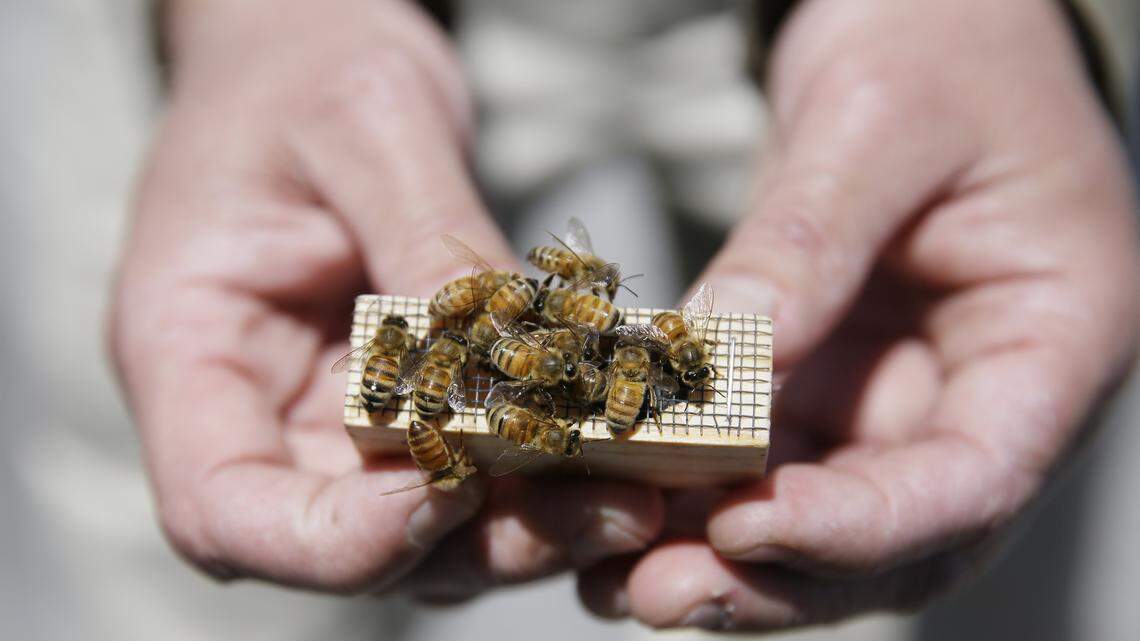
Researchers exposed the honeybees to glyphosate, then marked them with black dots before letting them free. The bees were examined three days later, the study says, and it was found that four types of gut bacteria in the insects were reduced.
The affected gut bacteria helped ward off diseases and digest food, according to the study’s authors.
Researchers then introduced the bees to a bacterium called Serratia marcescens — and the rates of survival depended upon exposure to glyphosate. Bees with healthy gut bacteria survived the infection about half of the time, and the others lived just 10 percent of the time.
Erick Motta, who helped lead the research as a graduate student, said in a press release from the University of Texas at Austin that the big discrepancy in survival rates proves glyphosate poses a threat to honeybees.
“We need better guidelines for glyphosate use, especially regarding bee exposure,” Motta said in the press release, “because right now the guidelines assume bees are not harmed by the herbicide. Our study shows that’s not true.”
However, not everyone is sure about the findings.
Oliver Jones, a chemist at RMIT University in Melbourne, Australia, said that the study used far too much glyphosate, The Guardian reported.
“To my mind the doses of glyphosate used were rather high,” he said, according to The Guardian. “The paper shows only that glyphosate can potentially interfere with the bacteria in the bee gut, not that it actually does so in the environment.”
But in an interview with Newsweek, University of Sussex professor Dave Goulson said “glyphosate is sometimes found in bee food stores, at concentrations similar to those used in this study.”
And a spokesman for Monsanto, the company that manufactures glyphosate, called the study “simply not true,” per The Guardian.
“No large-scale study has found any link between glyphosate and the decline of the honeybee population,” he said, according to The Guardian. “More than 40 years of robust, independent scientific evidence shows that it poses no unreasonable risk for humans, animal, and the environment generally.”
As noted in the press release, a phenomenon known as “Colony Collapse Disorder” has left beekeepers with dwindling numbers of honeybees as the insects continue to die for mysterious reasons. Motta said the study suggests weedkillers could play a role in that.
“It’s not the only thing causing all these bee deaths,” he said in the press release, “but it is definitely something people should worry about because glyphosate is used everywhere.”
It’s not the first time Monsanto’s Roundup has caused controversy.
A July 2018 study from China found that honeybee larvae exposed to “high concentrations” of glyphosate had a higher chance of death than those that weren’t.
And in August, a jury awarded a man $289 million after he argued the weedkiller gave him terminal cancer. That man, Dewayne Johnson, said he used the product while working as a school groundskeeper, according to CNN. Hundreds have sued Monsanto with similar claims.
This story was originally published September 25, 2018 at 12:35 PM with the headline "Check your weedkiller: It may make honeybees unable to fight off disease, study finds."