
Jury deliberations begin in Whatcom County camping trip murder trial
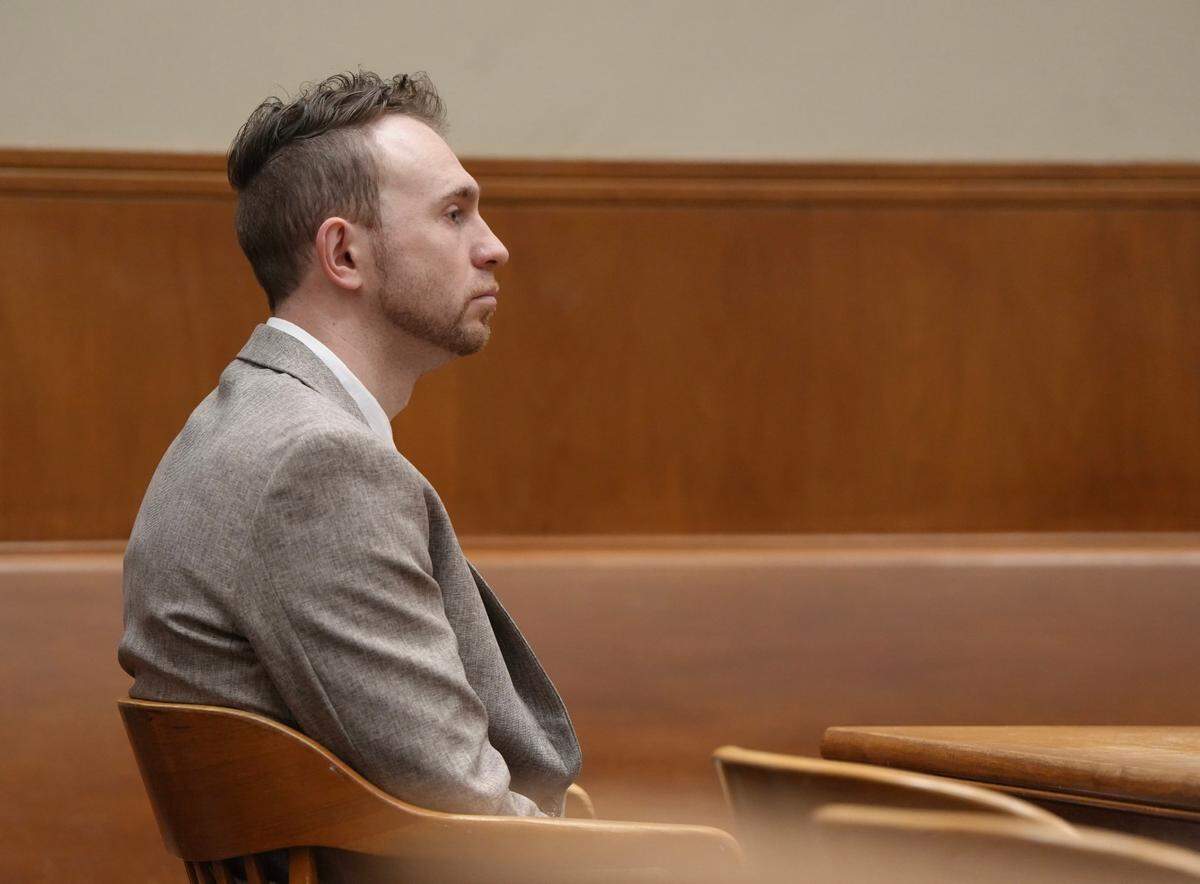
Jury deliberation began Thursday afternoon in the trial of Alexander Vanags, who was accused of murdering his friend while they were camping at Baker Lake in 2019. The four-week trial involved numerous testimonies and more than 500 exhibits surrounding the death of 28-year-old Mark Stebakov.
According to prosecutors, Vanags intentionally caused Stebakov’s death when he slashed him at least 14 times with a machete while the two were on LSD. Vanags’ attorneys argued that he acted in self-defense and was therefore not guilty of second-degree murder.
This is Vanags’ second trial in Whatcom County Superior Court, with the first one ending in a hung jury in 2022. Members of the current jury were not told that the proceedings were a retrial.
Differing analyses of autopsy, wounds
While the first week of the trial focused primarily on the crime scene, the following weeks included significant testimony on the injuries sustained by both Vanags and Stebakov. Medical examiners called as witnesses from both the prosecution and defense offered differing opinions on the altercation between Vanags and Stebakov and the order and manner in which wounds were sustained.
Former Snohomish County Chief Medical Examiner Dr. Daniel Selove described the incident as a “fast-evolving fight” when he was called to testify by the defense. He said that Stebakov’s autopsy and Vanags’ injuries were consistent with Vanags’ prior testimony of what took place on the night of April 13, 2019 — namely, Stebakov attacking Vanags, and Vanags hitting him with the machete to protect himself while the two were facing each other.
Selove also testified that even after he was wounded, Stebakov could have continued to attack Vanags, prompting Vanags to continue slashing at him with the machete.
His conclusions contradicted that of Dr. Gary Goldfogel, the former Whatcom County medical examiner who performed Stebakov’s autopsy. According to Goldfogel, the wounds to Stebakov’s back and the back of his neck were likely inflicted while Stebakov was facing away from Vanags, rather than attacking him.
Police investigation
Witnesses expanded on the investigation into the events leading up to Stebakov’s death beyond the findings in his autopsy.
Significant testimony was provided by Whatcom County Sheriff’s Office Deputy Derek Bogle, who was a detective at the time and led the investigation into Stebakov’s death. He was present in the courtroom with prosecutors at the trial every day.
Bogle met with Vanags after he was booked into Whatcom County Jail. He took photos of Vanags and his injuries, which were the subject of testimony and scrutiny from multiple witnesses.
Those called on behalf of the defense pointed out bruises on Vanags’ eye, blood around his mouth and possible signs of choking on his neck. Prosecutors and their witnesses questioned the severity and causes of Vanags’ injuries, with Senior Deputy Prosecutor Benjamin Pratt focusing on the “widely disparate” injuries between Vanags and Stebakov in his closing argument.
The defense made a case that Vanags suffered a concussion during the altercation, which was not visually apparent. They brought in multiple experts who testified about the impacts of traumatic brain injuries and tests showing Vanags still struggles with his memory and cognition.
Beyond interacting with Vanags, Bogle looked at the physical evidence in the case. He showed jurors everything from the torn rain pants and corduroys Stebakov was wearing when he died to the machete used to kill him.
Relationship between Vanags and Stebakov
Over the course of his investigation, Bogle obtained hundreds of text messages between Vanags and Stebakov. He acquired even more in the time following the first trial, with messages now dating back to late January 2019.
In the messages, the two men discussed their experiences with hallucinogenic drugs. Stebakov told Vanags about taking LSD, describing a time that he hallucinated aliens chasing him while he was riding his bike. Jurors were also shown a video from the phone extractions recorded by Stebakov while he was under the influence of LSD.
Prosecutors argued that the messages and video showed that Stebakov could distinguish between what was and was not real on hallucinogens, which would disprove the defense’s argument that Stebakov attacked Vanags because he was having a “bad trip.”
The state claimed the opposite — that it was Vanags having the negative experience, because of outside stressors in his life. In response, defense attorneys pointed to texts in which Stebakov told Vanags that hallucinogens “barely faze you.”
However, other texts from Vanags sent while he was high on the hallucinogenic drug DMT described him seeing things like walls melting. He also said he saw little spots of light after taking “fairy dust,” or PCP.
Vanags admitted during his testimony that he had previously lied under oath in 2022 by stating that the only hallucinogenic drugs he used were LSD and psilocybin, or mushrooms. James Dixon, one of Vanags’ attorneys, said in his closing argument that the omission was not intentional, and if anything it indicated his lingering cognitive issues.
Rekindling a friendship
The two first used hallucinogenic drugs together after high school, according to Vanags. He said Stebakov was already using drugs at that time and “shaped” Vanags’ view of them.
While the two were close as teens, Vanags stopped speaking to Stebakov in 2017 after Stebakov betrayed his trust while house-sitting for him. Vanags said he reached out to Stebakov in 2019 to rekindle their friendship and to know that Stebakov was OK.
Vanags said that at that time, Stebakov’s drug use consisted primarily of psychedelics. He previously used heroin, according to Vanags, and was now using hallucinogens as a sort of therapy.
As the two continued to talk in 2019, they decided to take a trip together where they would both use LSD. Stebakov texted Vanags that he had “really good vibes about this entire thing,” and Vanags said he was also excited.
Stebakov bought the LSD for the trip to Baker Lake about three weeks in advance and gave the drugs to Vanags, according to testimony. Vanags did not tell his wife about the drugs or the camping trip.
Vanags’ testimony of April 13, 2019
Vanags told jurors that he and Stebakov arrived at the campsite near Baker Lake while it was still light out. They set up the camp, draping a tarp in the trees in case it rained, setting up lights and building a fire.
Vanags said Stebakov walked away at one point, and when he returned, he told Vanags that he’d taken the LSD. Vanags took his own dose, and then gave the rest to Stebakov.
Stebakov started to act “fidgety,” Vanags said, pacing around and mumbling. Vanags said he became concerned when Stebakov began swearing at him, and he suggested that they sit in his truck for a change of scenery.
Vanags said Stebakov went back to cursing at him even after getting in the truck, asking Vanags, “Why’d you leave me all alone?”
They left the truck at Vanags’ suggestion, and Vanags recalled Stebakov running past him toward the campsite. He said he thought about leaving but didn’t want to abandon Stebakov in the middle of nowhere. Instead, he went to his camp chair and asked Stebakov to give him some space.
When he realized Stebakov didn’t listen to him, he said he stood to try to walk away himself. However, as he was getting out of the chair, he said Stebakov grabbed his jacket and started punching him in the face.
Vanags said he fell forward onto the ground and felt impacts to the back of his head. He tried to get up and run away, he said, but Stebakov grabbed him from behind with an arm around his throat.
“It flooded into me that there’s nobody to help me,” Vanags said. “I got really scared.”
He said he managed to slip out of his jacket and grabbed the machete. He said it was never his intention to actually use it, but when Stebakov lunged at him with his hand out, Vanags slashed at his arm.
Stebakov stopped for a moment, Vanags said, and then moved toward him again.
“Every time I paused, he would just come at me,” Vanags said. “It all seemed so fast.”
He said he couldn’t recall the exact order of events or the series of blows.
When Stebakov eventually fell to the ground, Vanags tried to use his phone flashlight to see what had happened to Stebakov. He said he couldn’t remember his password, and ended up using the flash on his camera. He later deleted the photos and videos he took but they were recovered when his phone was searched.
“I just stood there,” Vanags said. “I was shocked.”
He said he didn’t know how long he stood there. At some point, he put a blanket over Stebakov’s face, though he said he didn’t know why.
Calls from the car
Vanags said he left the scene to drive for cell phone service. He first tried to call his mother, who didn’t pick up. Then he called his friend, who told him to call 911. While he later called dispatchers from a gas station, his next call was to his wife, Yana Vanags.
Yana Vanags recalled the phone call on the witness stand. She said her husband told her he’d killed Stebakov because he was being attacked. When she asked why, she said she was told that they were both on LSD.
When she was later asked by a detective if her husband used drugs that night, she said no. Alexander Vanags also denied drug use until after he was booked in jail.
Yana Vanags said she was “really, really scared” when detectives spoke with her.
“It felt like a nightmare.”
Closing arguments
At the close of the trial Thursday jurors were asked to decide three things: whether Alexander Vanags’ actions led to Stebakov’s death; whether the incident occurred in the state of Washington; and if Alexander Vanags acted with the intent to kill Stebakov.
If the answer to any of those questions is no, the jury must find Alexander Vanags not guilty of second-degree murder.
Pratt, who provided the closing argument on behalf of the state and fellow Deputy Prosecutor Maggie Peach, called the incident a “massacre,” not a fight.
He pointed to Vanags’ placing of the blanket over Stebakov’s head and the deletion of photos as showing a “consciousness of his guilt,” indicating his actions were intentional.
Dixon argued that Vanags’ actions were reasonable for someone in his situation. He walked the jury through his and fellow defense attorney Jennifer Cannon-Unione’s case on behalf of Alexander Vanags, and asked jurors to “look beyond the absolute tragedy of one friend dying at the hands of another.”
There is no set date for the jury to return a verdict.