Report details struggles of Whatcom County families to afford household necessities
New data highlights just how hard it continues to be for families in Whatcom County and across the state to afford the basic costs of living.
The cost of household necessities in Washington has risen faster than inflation for more than 15 years in a row, highlighting the challenges of the growing affordability crisis, according to data from the latest ALICE report.
United Way of Whatcom County measures the cost of living with its ALICE report, which surveys the growing number of households that are “asset-limited, income-constrained, employed,” or those who live above the federal poverty line but don’t earn enough to afford necessities such as housing, childcare, food, transportation and healthcare.
“What we learn from tools like the ALICE report and ALICE Essentials Index is how local households are experiencing financial hardship in our communities,” United Way of Whatcom County President and CEO Kristi Birkeland said in an announcement about the report.
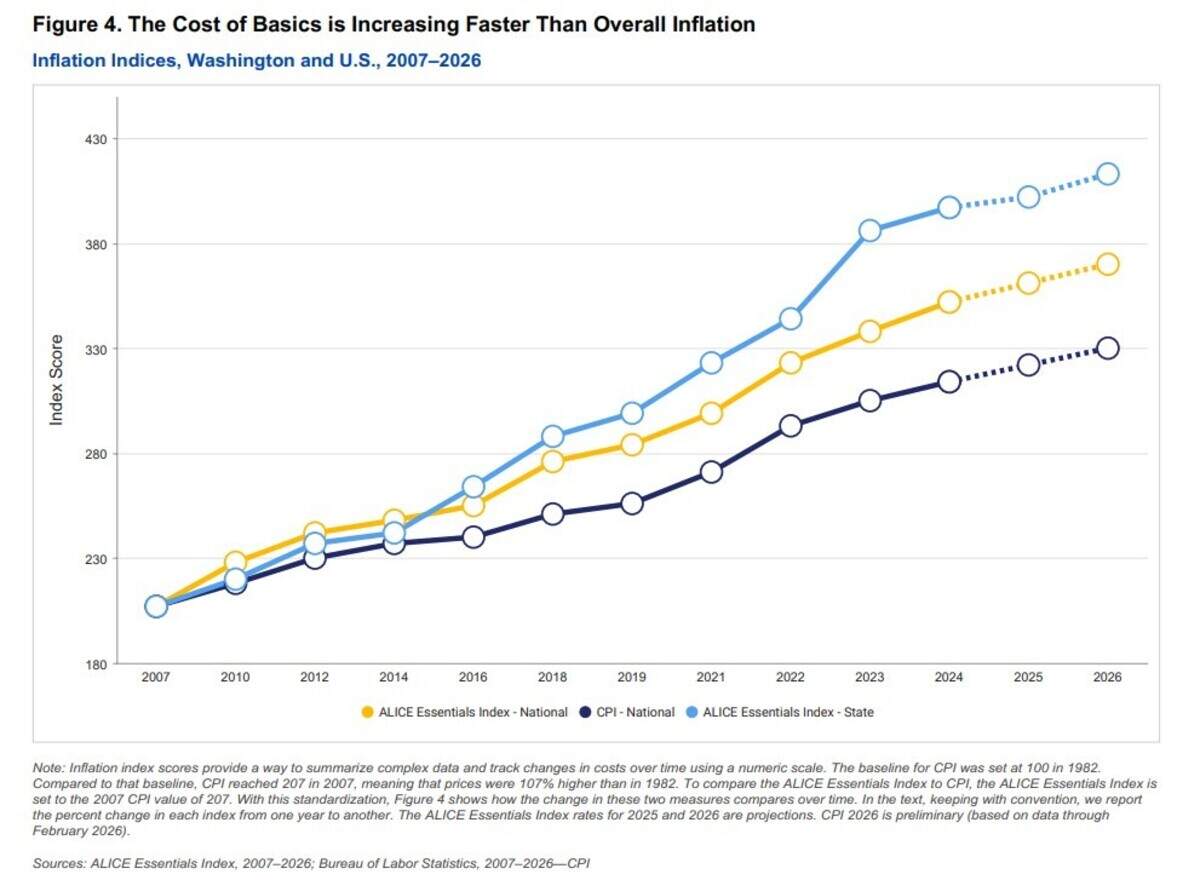
Between 2007 and 2024, the ALICE Essentials Index for Washington increased 92%, compared with 52% for the broader Consumer Price Index (CPI), which reports inflation across more than 200 categories of goods and services, and is often used to factor cost of living.
“In this case, we can see that the costs for the most basic necessities are increasing at a greater rate than overall CPI — and have been for some time. This means that families who are struggling just to afford the basics are really getting hit the hardest,” Birkeland said.
According to the 2026 ALICE report, more than 1.1 million households in Washington fell below the ALICE Threshold for survival in 2024.
The report highlights one of the main issues for families as a gap between wages and expenses.
In 2024, a family of four in Washington with two kids in childcare needed to make more than $109,000 to cover the essentials — nearly four times the federal poverty level of $31,200. If both parents in that family were working full-time in two of the state’s most common jobs — a cook and a teller — the family’s combined income still fell short of the cost of basics by more than $30,000.
About 38% of Whatcom County households fell below the ALICE threshold in 2024, according to the report. That’s a decrease from last year’s report and the previous year of data, when 45% of Whatcom County’s households fell below the ALICE Threshold of Financial Survival in 2023.
Still, Birkeland noted this data is two years old and today’s cost-of-living increases continue to indicate widespread affordability challenges.
“Interestingly, the latest numbers mark a return to ALICE levels from two years ago,” Birkeland said. “But we need to remember this reflects data from 2024. Based on the current rising costs of gas, groceries and other essentials, it likely doesn’t feel like there’s been much improvement. We also need to remember that behind all of these numbers are real people and real struggles.”
Key Washington findings included in the report:
- Washington ranked 14th in financial hardship among all 50 states plus the District of Columbia.
- ALICE households were found in every major industry statewide, affecting some of the most common jobs. Occupations with the highest levels of hardship include agricultural workers (73%), cashiers (49%) and personal care aides (45%).
- Minimum-wage workers in Washington saw hourly pay rise to $16.28 in 2024, up from $15.74 in 2023 (as of Jan. 1, the current minimum wage in Bellingham is $19.13, $2 above the state minimum wage for 2026). Yet for one full-time adult worker with one school-age child, that wage still was not enough to support the ALICE Household Survival Budget, the minimum cost of basics, in any county across Washington.
- Racial disparities persist in the rates of financial hardship. Statewide, 53% of Black and 49% of Hispanic households struggle to make ends meet, compared with 36% of white households.
- Statewide, the rate of financial hardship was higher in rural areas of Washington in 2024, where 42% of households were below the ALICE threshold compared to 37% in urban areas.
Key Whatcom County findings included in the report:
- In Whatcom County in 2024, the youngest and oldest households had the highest rates of financial hardship: Seventy-eight percent of households headed by someone under age 25 and 48% of households headed by someone aged 65 or older were below the ALICE threshold.
- Also, 77% of single female headed households, 48% of 65-and-older households, and 50% of Hispanic households fall below the ALICE Threshold for survival.