Whatcom County cougar activity ramping up; here’s what to do during an encounter
State wildlife officials are investigating at least one recent encounter with a cougar on Galbraith Mountain, during which the big cat didn’t appear afraid of nearby humans.
It’s the latest in a series of reports from people who recorded cougar activity on their home camera systems or saw them in the wild — including one sighting that spooked residents near a Bellingham elementary school.
Becky Elder, a spokesperson for the Washington state Department of Fish and Wildlife Police, confirmed a report this week from a mountain biker on the south side of Galbraith Mountain.
“The incident occurred (Tuesday) when a cyclist spotted a cougar following them for a period of time and then made its way back into the woods. WDFW staff will be posting signage at the nearby trailhead markers,” Elder told The Herald in an email.
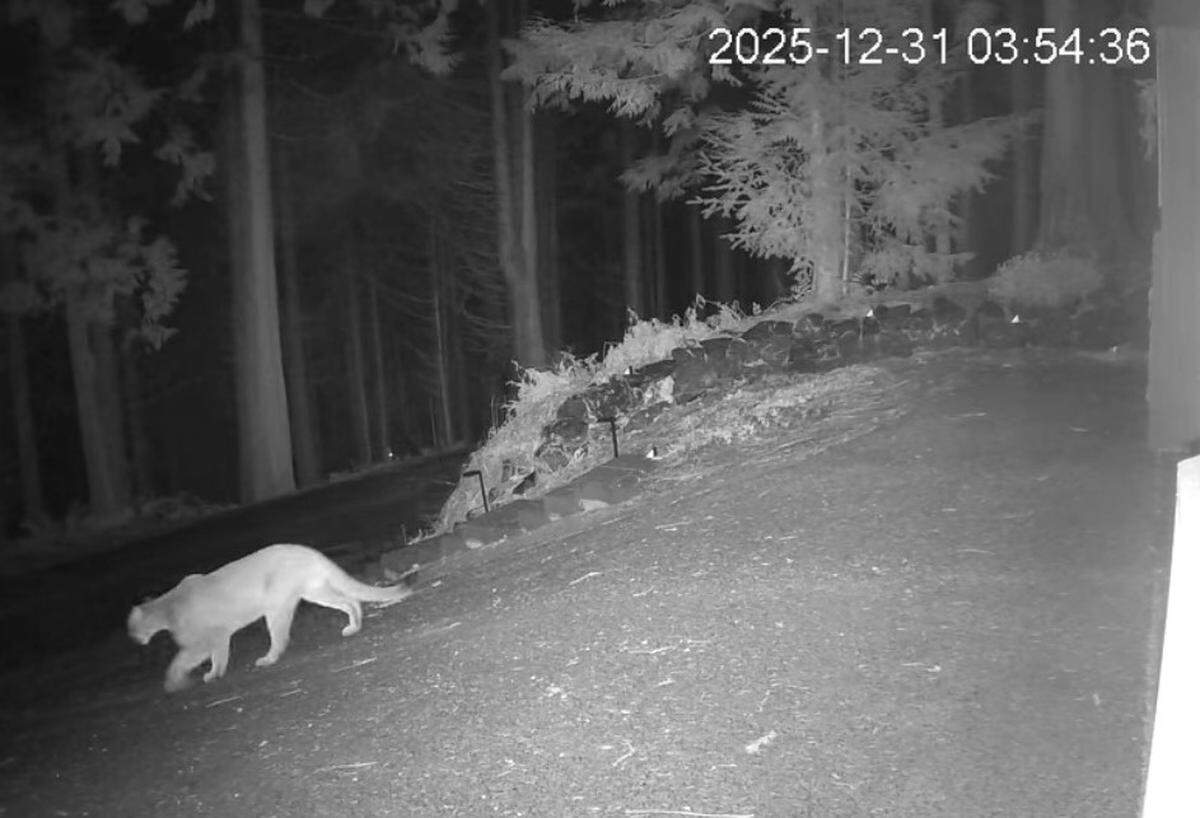
This week’s incident comes amid a surge of mountain lion sightings posted on social media, including one where a large cat walked past a home in the Geneva neighborhood last month in broad daylight, causing jitters among local residents.
Bellingham Public Schools spokeswoman Dana Smith told The Herald that Geneva Elementary warned its staff, students and families about the sighting last month and was sending additional safety reminders in a newsletter.
“Yes, we are aware that a cougar has been sighted in the neighborhood, but there have been no reports that we are aware of a cougar being seen near the school or by students. Our understanding is it has only been spotted on the south side of Cable Street and not in proximity to the school,” Smith said in an email.
In a social media post, the Whatcom Mountain Bike Coalition warned riders and trail runners about the Galbraith Mountain encounter.
Eric Brown, the group’s executive director, told The Herald that a solo mountain biker saw a cougar Tuesday on the Overtime trail at the bottom of Unemployment Line, not far from Checkpoint Bravo. The big cat stood its ground when the cyclist made noise, raised his bike in the air and backed away slowly, Brown said in a phone call.
“It wasn’t aggressive, more like curious. It wasn’t hissing or making noise in an assertive manner. But it also wasn’t walking away. This guy did everything right and (the cougar) just sat there,” Brown said.
Brown said he’s concerned about cyclists and runners with dogs. He encouraged them to stay vigilant.
“We’re just trying to make sure that (safety) is top of mind and create awareness,” Brown said..
Sightings common
Cougar sightings are common in rural Whatcom County and across Washington, which is home to an estimated 2,400 “independent” cougars. That figure includes adult and “sub-adult” cats living on their own, Fish and Wildlife said at its website.
An adult male cougar weighs 140 to 180 pounds and measures 7 to 8 feet long from nose to tip of its tail, standing about 30 inches at the shoulder. They have a range of 50 to 150 square miles, overlapping with the ranges of three or four females, Fish and Wildlife said.
More frequent sightings?
Sudden Valley residents have been posting recently on social media about cougar sightings in the community of about 7,000 people that borders both the Stimpson Family Nature Reserve and the Lookout Mountain Forest Preserve, a collection of trails through steep, wooded and remote terrain.
It’s not that cougars are becoming more numerous or bold, but that more people have ways to record them and share the images, Fish and Wildlife spokesman Chase Gunnell told The Herald.
“A likely reason for a perceived increase in cougar sightings in wooded areas around Bellingham and other Western Washington suburbs is technological advances that homeowners and outdoor recreationists now have access to. Security cameras such as Ring cameras that work even when its dark outside, motion-activated trail cameras, as well as smartphones and other recording devices that are readily available in the pockets of hikers, trail runners, and mountain bikers, have all become more affordable and effective. Today there is more opportunity than ever before to capture images of wildlife and post them to social media or neighborhood forums,” Gunnell said in an email.
Attacks are rare
Cougar sightings happen because their habitat can overlap populated areas, Elder said.
“Cougar attacks on humans are rare. In Washington, there have been two fatal cougar attacks and approximately 20 other recorded encounters that resulted in human injury in the last 100 years,” she said. “Cougars can be found anywhere where a main prey item (typically deer) exists. If you live in areas in or near cougar habitat and keep livestock and pets, predation on livestock and pets could occur. Keeping your animals in secure enclosures, including those with high fences and a roof, can help prevent conflict.
Fish and Wildlife gets involved when a predator has begun to view livestock or pets as food.
“In these instances, the cougar has to be lethally removed to help protect public safety. Conflicts between cougars and humans are often emotionally difficult scenarios. Managing these situations is something that our staff take very seriously,” Elder said.
If you see a cougar
- Stop and pick up small children.
- Do not run. Running and rapid movements may trigger an animal to chase and perhaps attack.
- Face the cougar. Talk firmly to it while slowly backing away, and make sure you leave the animal an escape route. Do not take your eyes off the cougar or turn your back. Do not crouch down or hide.
- Do not approach the cougar.
- If the cougar does not flee, be more assertive. Shout, wave your arms, and throw objects at the cougar to scare it away.
- If the cougar attacks, fight back and protect your head and neck. Be aggressive and try to stay on your feet. Use bear spray or pepper spray if you have it.
“We recommend when recreating outdoors to carry bear spray, and/or an air horn. Even a walking stick can be used to deter an animal. No matter the method you use for deterring an animal, make sure it is within easy reach and that you know how to use it. Bear spray can turn into more of a hazard than helpful resource if not used correctly,” Elder said.
Recreating in cougar country
- Hike in groups whenever possible and make noise.
- Don’t hike after dark.
- Keep small children close to the group, preferably ahead of you.
- Do not approach dead animals.
- Be aware of your surroundings, especially if running or jogging. Headphones can be distracting.
- Carry bear spray, an air horn, and/or walking stick within easy reach to help deter an animal. Be sure that you’ve learned how to use these.
- Take a safety class (such as the hunter education classes offered by WDFW) and follow all regulations before carrying a firearm or weapon. Weapons may only be used for self-defense.
- When hunting, remember that rabbit and fawn calls may attract a cougar, bear, or wolf.
This story was originally published January 16, 2026 at 1:51 PM.