
WWU pantry goods flying off the shelves as students cope with food insecurity
Nearly half of Washington’s college students — including those at Western Washington University in Bellingham — are considered food-insecure, and about 44% of university students have experienced food insecurity in the last 30 days, according to a study conducted by the Washington Student Achievement Council,
The Western Hub of Living Essentials (WHOLE) pantry at Western offers some food assistance to students by providing them with the essentials. The pantry was created in 2018 and received an increase in the purchasing budget made possible through a student fee that allowed the program to hire a full-time food pantry coordinator, Tulsa Brodsky Enochs.
More than 2,000 students use the WHOLE pantry during a given week, according to Enoch, and they go through more than 500 pounds of food in a day — or 3,000 to 3,500 pounds a week. There has been an increase in use at the WHOLE pantry in the last year, following the recent temporary suspension of federal SNAP benefits.
“Our usage has, a couple of weeks ago I would have said it stabilized around 2,000 students a week, which is up 330% from the 600 students per week last academic year,” Enochs said. “However, ever since we saw the SNAP pause, we shot up to about 2,400 … about 14% of the student population.”
The pantry hosted a food drive Oct. 18 for hunger and homeless awareness week, and raised 511.4 pounds of food, according to Enoch. However, all of that food had been completely stocked and taken by students before the WHOLE pantry closed the next day.
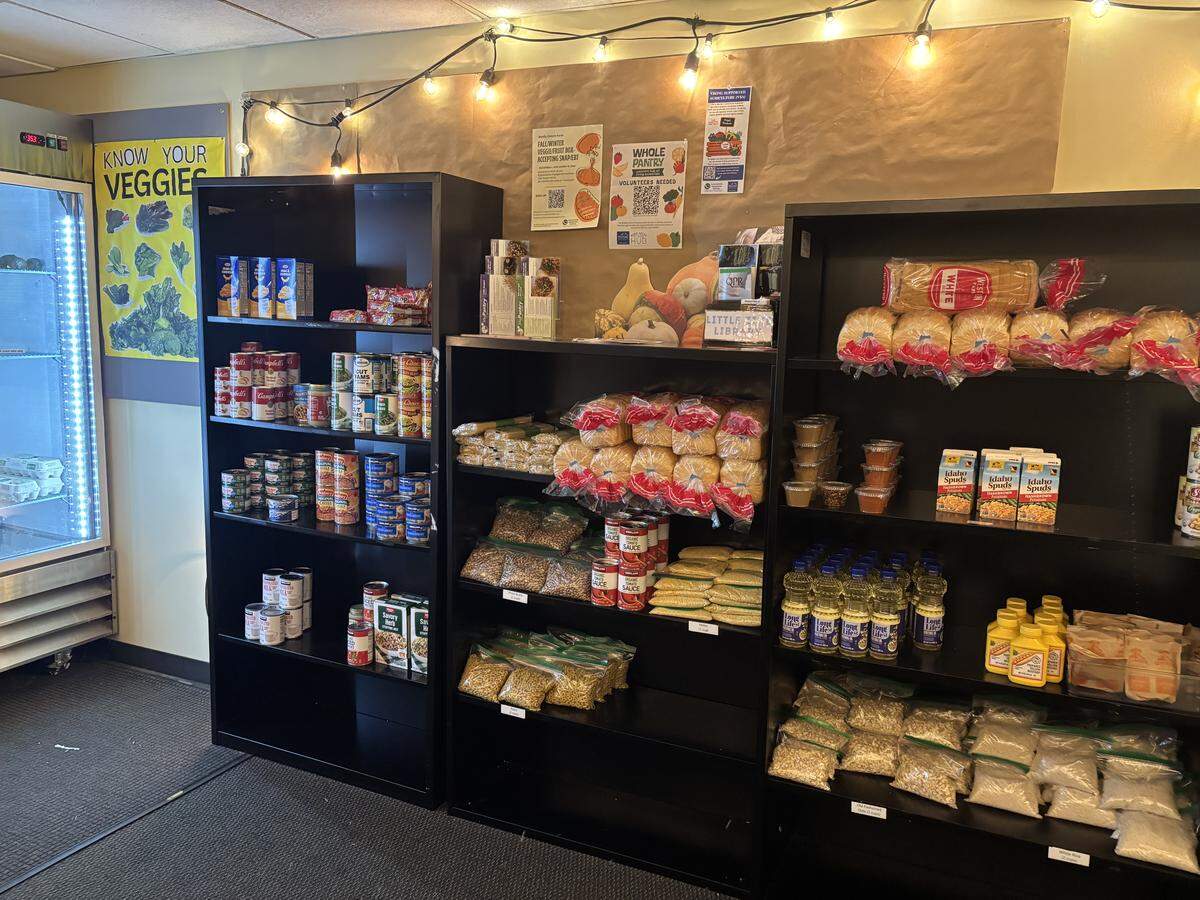
The pantry offers the necessities to students such as bread, milk and eggs. Staff also purchase bulk items such as potatoes, onions, garlic, rice, spices and a variety of other goods depending on what’s available, Enochs said. Canned goods are also usually in stock.
Hygiene and toiletry items such as soap, toothpaste, shaving razors, feminine hygiene products, condoms, Narcan and fentanyl test strips are also available.
The WHOLE food pantry is open to all students, and they are allowed to take as much as they need at any time.
“There’s no barriers to the pantry, it’s just sort of an honor system,” Enochs said. “You come in, you take what you need, hopefully being mindful of others, because the need is incredibly great that we are seeing.”
A 2024 vote through the associated student government and the WWU board of trustees, allowed the WHOLE pantry to be funded through a student fee. The mandatory Food Security Fee is an extra $4.50 per quarter for all undergraduate students taking 12 credits or more, and all graduate students enrolled in eight or more credits. The fee funds the WHOLE pantry through the 2025-2026 school year.
Prior to the implementation of the fee, the pantry was funded almost entirely through donations. Now they have about $131,000 in funding for the academic year, although donations are still very useful, Enochs said.
The Food Security Fee is up for a renewal vote in the spring, and while there is belief it will be renewed, it’s far from certain.
“Given how things are going, given the increased use, it is very likely to continue,” Enochs said.
Funding for the pantry comes entirely from the student fee, without any financial support from the university.
“A lot of time students, as evident in this situation, end up bearing a lot of the brunt and the work and the cost of providing their own support services,” Enochs said.
The WHOLE pantry is located in the Viking Union building, Room 435. It is open weekdays from 9 a.m. to 5 p.m. and weekends 10 a.m. to 5 p.m. It is closed on holidays and whenever the Viking Union building is closed.
Donations can be made at the pantry itself, in specified locations of the Viking Union building or online through the WHOLE website.
.jpg)