
Unrepresented WWU students preparing bargaining rights bill for 2026 session
Students at Western Washington University are working to pass a new bill that would extend collective bargaining rights to student workers not covered by previous laws.
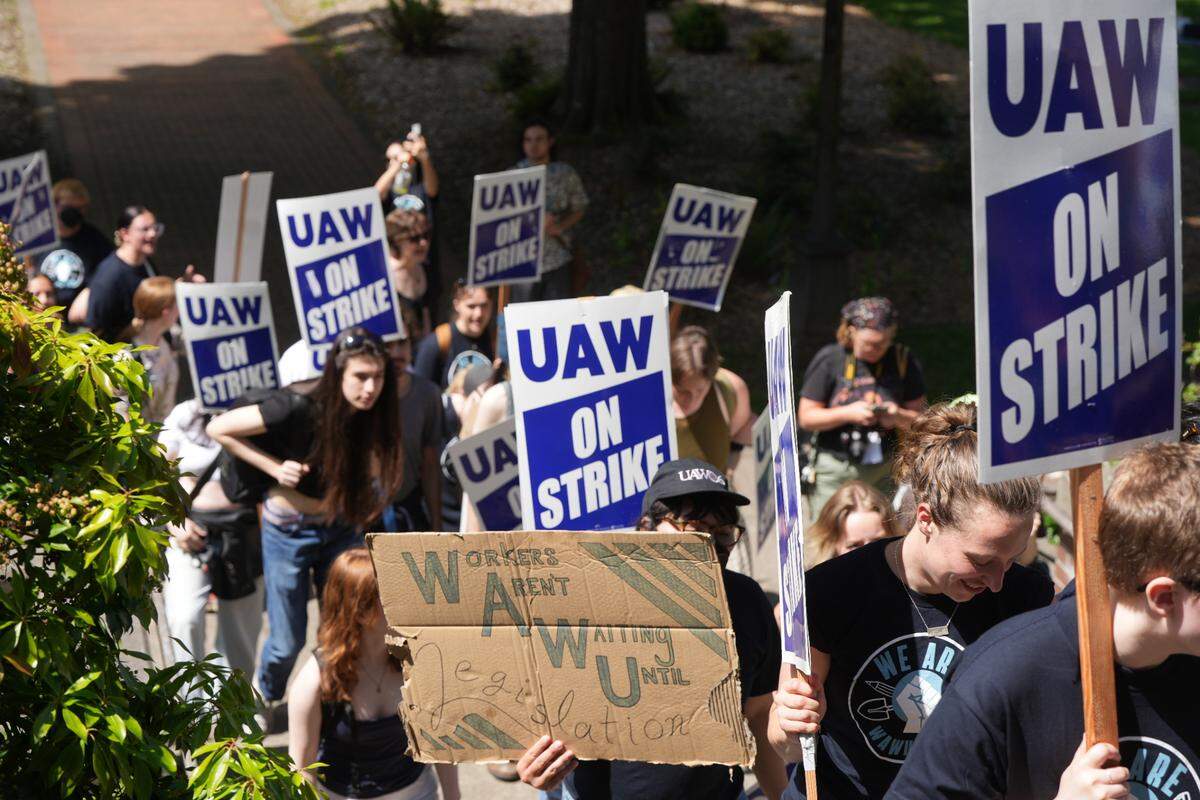
Currently, only educational student employees (ESEs) at WWU are covered by state legislation and are officially recognized as a part of Western Academic Workers United. ESEs include tutors, teaching assistants, lab assistants, faculty assistants, research assistants, library assistants and peer advisers.
Operational student employees (OSEs), which include resident advisers, program support staff, assistants, editors and laborers, are not recognized. Out of 2,300 student employees at Western, 1,200 are OSEs, according to the WAWU website.
Recognition as a union would allow OSEs to bargain for terms specific to their jobs.

Similar bills have been introduced in the Washington State Legislature but all have died in committee. They were too expensive to pass with Washington’s current budget deficit.
In addition to Western, these bills would have affected Central Washington University, Eastern Washington University and Evergreen State College. The latest bill removes other universities, which significantly reduces the cost.
Currently, the latest bill’s fiscal note is $1.5 million less than previous efforts, according to Aspen Cates-Doglio, president of Associated Students of Western Washington University and one of the students working on the bill.
“I’m optimistic that we can get this across the finish line,” Washington state Rep. Joe Timmons said in an interview. Timmons is the bill’s prime sponsor. “If, for whatever reason, this doesn’t cross the finish line next year, I’m fully willing to bring it back in 2027.”
Nearly 70% of Americans age 18-34 approve of unions, according to a recent Gallup poll. In the past decade, there’s been an increase in student unions at higher institutions, per a 2024 report from Hunter College.
In 2024, student assistants at California State University voted to join California State University Employees United, forming the largest union of undergraduate students in the U.S., according to their website.
After the WAWU strike in the spring, members worked with WWU students to write a resolution providing OSEs with similar terms that ESEs have in their existing contract. The ESE contract does not include safety measures, and OSE positions are more likely to include manual labor.
“We’ve got these terms and conditions that are really, very great, but they’re not all encompassing,” WAWU vice president Olive Dillemuth said.
The student-run Recycle Center halted operations in the spring after an assessment determined that five of the six vehicles were inoperable. They reportedly had inoperable brakes and lift gates, and would die while being driven.
“Over the last year the Recycle Center has faced issues that would have been avoided if we had a contract,” WWU student Emma Jean said on the WAWU Instagram page.
“WWU cannot voluntarily recognize the bargaining unit until enabling legislation is enacted by the state legislature,” said Joyce Lopes, Western’s vice president of business and financial affairs. WAWU says that Western can choose to recognize a student union without legislation.
“The Public Employment Relations Commission and the courts have long held that there is nothing legally preventing Western from voluntarily recognizing the OSEs’ majority intent to form a union,” the WAWU website says.
The new bill is expected to be ready by the next legislative session, which begins Jan. 12.
“I think it is the responsibility of our lawmakers to pass this bill,” WAWU president Willow Heidt said.
Noelle Reger is a journalism student at Western Washington University and a freelance contributor for The Herald.